Equations of Emunah, Formulas of Faith
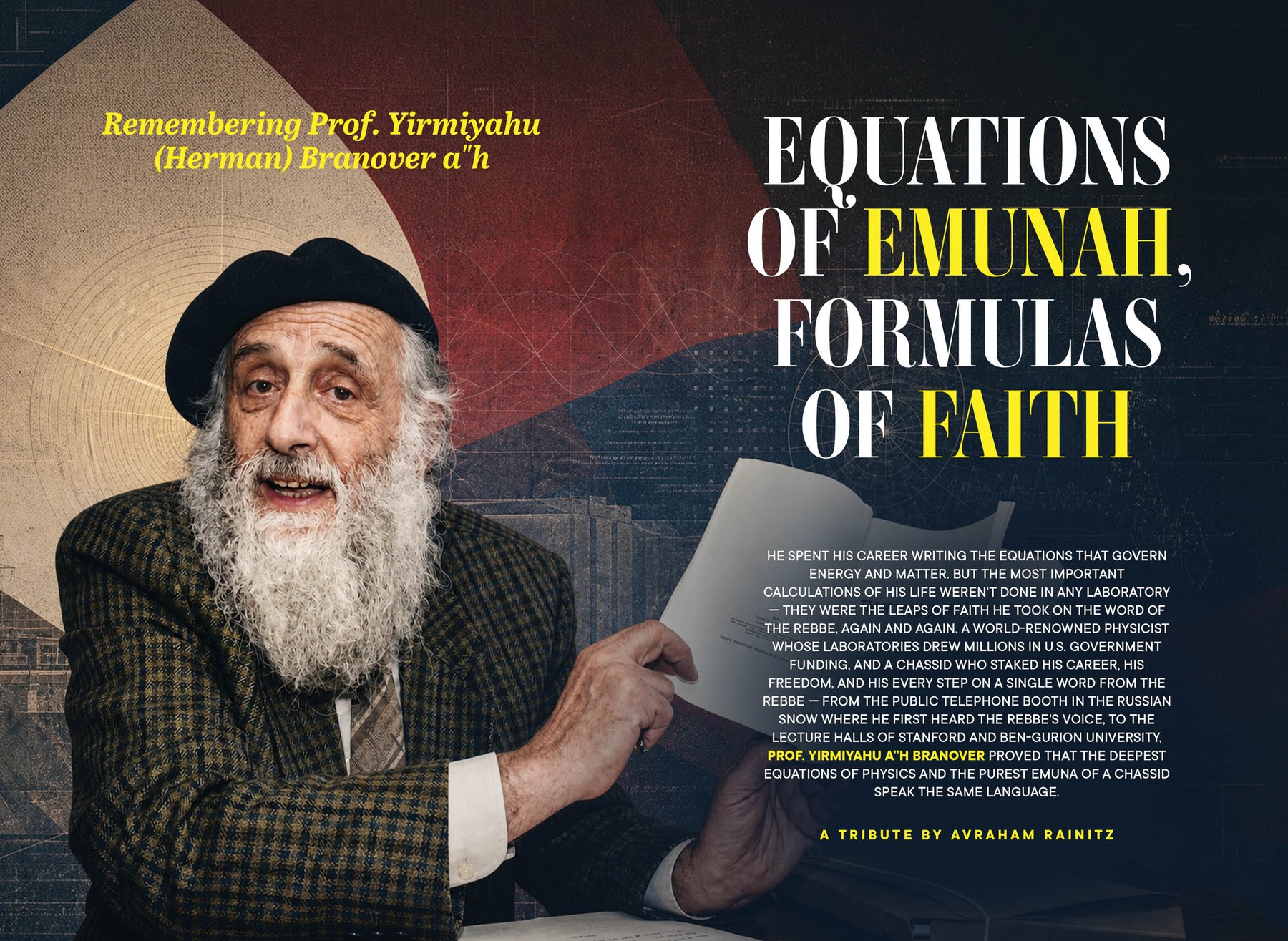
Remembering Prof. Yirmiyahu (Herman) Branover a”h
He spent his career writing the equations that govern energy and matter. But the most important calculations of his life weren’t done in any laboratory – they were the leaps of faith he took on the word of the Rebbe, again and again. A world-renowned physicist whose laboratories drew millions in U.S. government funding, and a chassid who staked his career, his freedom, and his every step on a single word from the Rebbe – from the public telephone booth in the Russian snow where he first heard the Rebbe’s voice, to the lecture halls of Stanford and Ben-Gurion University, Prof. Yirmiyahu a”h Branover proved that the deepest equations of physics and the purest emuna of a chassid speak the same language.
The Russian cold of the winter of 5731 cut to the bone, but for Professor Yirmiyahu (Herman) Branover a’h, the real freeze didn’t come from the weather; it came from the menacing corridors of the KGB. On the very morning he submitted his exit visa application from the Soviet Union, he was unceremoniously thrown out of his position in academia. Every door slammed shut at once. The message from the authorities was clear and unambiguous: you have no professional future, there is no place for you here where you can make a living.
To complete the pressure, secret service agents cut the telephone line in his home. From that point on, surveillance, threats, and “administrative arrests” without lawyers or trial became the routine of his life. Yet from the depths of the isolation of the Iron Curtain, the brilliant professor found a spark of hope. Tucked between the pages of an old Chabad siddur, he discovered a telephone number in Brooklyn, New York. It was the number for Merkos L’Inyonei Chinuch, the Rebbe’s secretariat.
The senior scientist found himself trudging through the snow toward a public post office to place an international call across the ocean to a man he had never met. “What do I have to lose?” Branover thought to himself in those moments. “I’m being arrested anyway, so I’ll be arrested again. At least I’ll know what for.”
He approached the counter and booked the call. In the Soviet reality of those years, waiting for an international connection could take nerve-wracking days and nights. But here the first miracle occurred: within just ten minutes, the connection was made. On the other end of the line was the Rebbe’s secretary, Rabbi Binyamin Klein. Branover asked to speak with the Rebbe. “The Rebbe doesn’t speak on the telephone,” Rabbi Klein replied simply.
But the stubborn professor would not let go. “Maybe the Rebbe doesn’t usually speak,” he insisted, “but in my case, I’m certain the Rebbe will take the call.”
After minutes of pleading, when Klein was worn down by the argument, he transferred him to the chief secretary, Rabbi Chaim Mordechai Aizik Chodakov. Rabbi Chodakov repeated the well-known rule but added gently: “What’s the problem? Tell me and I’ll pass it to the Rebbe immediately.” Branover dug in: “No, I have a special case…”
And then, suddenly, it happened.
A powerful electric current coursed through the body of the scientist thousands of kilometers away. A second voice came on the telephone line. No one had prepared him for this, he had never heard that voice before, yet in that split second he knew with absolute certainty: it was the Rebbe.
The Rebbe did not address him directly, but spoke to Rabbi Chodakov in Yiddish, in words that would be engraved in Branover’s soul forever: “Zogt im az er hut shoyn alleh brachos, un bald vet er aroysforen” – “Tell him he already has all the blessings, and soon he will leave.”
Just three weeks after that unimaginable conversation, in complete contradiction to all expectations, and to immigration officials who had spoken of fifteen or twenty years of waiting until his research “became obsolete,” Branover received his longed-for exit permit.
That rare moment, somewhere in a public telephone booth in Russia, encapsulates more than anything else the life story and character of Professor Rabbi Yirmiyahu Branover. A man of numbers, formulas, and probabilities, who chose to set aside all the laws of physics and human logic and rely with complete, unconditional trust on a single word from the Rebbe.
The following is the story of a world famous scientist whose greatest and most important discoveries were made not in laboratories for magnetohydrodynamics research, but in the laboratory of faith. This rare combination of an exceptional analytical mind and pure, uncompromising Chassidic faith, is what eventually made him an “ambassador of Moshiach” in the world of science.
The Crucible of Faith
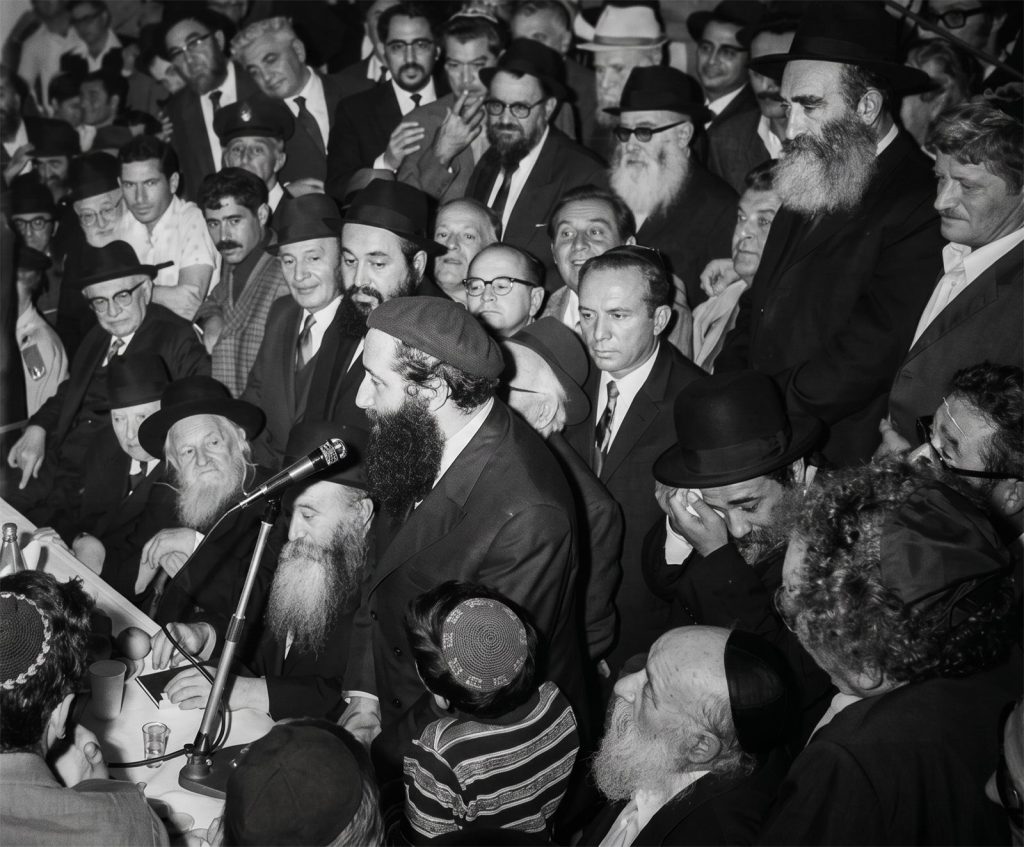
Professor Branover’s story begins in the turbulent melting pot of Jewish life in Soviet Russia in the previous century. He was born on 3 Teves, 5692 (1931), in the city of Riga, capital of Latvia, into a non-observant Jewish family. “My worldview was completely materialistic,” he later testified about himself.
His childhood was cruelly cut short when World War II broke out. His father, an agronomist, was murdered by Latvian nationalists who collaborated with the Nazis, may their names be erased. Only through the resourcefulness and self-sacrifice of his mother, who managed to spirit him and his brother deep into the Soviet Union, did they survive the years of hell.
At the age of sixteen and a half, Yirmiyahu traveled to Leningrad to live with his widowed uncle, where he found himself in a cramped room in a typical Soviet communal apartment. Five different families shared corridors, one kitchen, and five kerosene stoves. From this material deprivation, his brilliant analytical mind stood out. His great dream was to study nuclear physics, the most prestigious scientific frontier of the day. But the doors of the faculties slammed shut before him one after another. The reason was not lack of talent, but the “Jewish” nationality entry that appeared on his identity document.
The antisemitic Soviet establishment thought it was blocking the young Jewish man’s path, but in truth, wondrous divine providence was guiding him toward a different course. With no alternative, Branover turned to engineering, and specialized in the field that would become his life’s work: magnetohydrodynamics – a complex and exclusive scientific discipline dealing with the generation of energy from the interaction between magnetic fields and electrically conducting fluids. Already in the 1960s he published groundbreaking research that earned him a worldwide reputation.
But the deeper he delved into the secrets of matter and energy, the more a different thirst grew within him. The young scientist, raised on the knee of atheism and dismissing every trace of faith, began to feel an emptiness before the cold and alienated world offered by Marxist philosophy.
“Only around age 18 did I begin to take an interest in Jewish matters,” Branover recounted in an interview he once gave. “It involved very serious difficulties. I obtained some Jewish books that had been translated into Russian, and that gave me the first push toward further thought. It took many years until I was truly able to read and study.”
The real turning point came when contact was established between him and the Chassidic underground. The contrast between the coldness of the Soviet academy and the warmth and truth he encountered among Chabad Chassidim in the Soviet Union shook up his world. When I once interviewed him at Beis Moshiach, he mentioned in particular the man who was mekarev him: “My teacher and mentor, who drew me near to Judaism and Chassidus was Rabbi Nosson Nota Berkahn a’h.”
The long hours of conversation with the underground Chassidim, at immense personal risk under the watchful eyes of the secret police, had their effect. Branover discovered that the lawfulness, order, and unity he had sought all his life in science were explained in the deepest and most complete way in the teachings of Chassidus. The equations of physics became for him not merely a collection of rational mathematical laws, but the language in which the Creator of the world governs creation.
Thus, in the heart of the world’s greatest atheist stronghold, the promising professor became an observant Chassidic Jew, meticulous about Jewish law down to the smallest detail. That faith was put to a cruel test when he decided the time had come to leave for freedom.
The Price of Truth and the Road to Freedom
In the year 5731, already a secretly observant Chassid, Professor Branover took the step that in the Soviet Union amounted to academic and personal suicide: he filed an official application for an exit visa to Eretz Yisrael for himself and his family. The authorities’ response was immediate and brutal. “On that same day I was thrown out of my position and was told that no other institution would ever accept me,” Branover recounted. Overnight the respected and sought-after scientist became “an enemy of the people.”
But it was precisely then – ostracized, without income, under constant KGB surveillance – that Branover chose to accelerate. Rather than quietly hiding at home, he became one of the leaders of the teshuva movement in Russia and began giving Torah classes in secret. This path was by no means easy for him personally. In a candid interview he described his feelings from those early days: “I began giving classes on Judaism which caused me a great deal of doubt and pain, because I didn’t feel I was ready to teach a subject that I myself didn’t yet fully know.”
But reality, and the Chassidic responsibility burning within him left him no choice. He embraced the well-known Chabad principle of underground activists from those difficult years: “There was a saying that whoever has learned the letter alef must teach alef tomorrow to ten people…”
His underground and public activities put him in the crosshairs of the authorities, who tried to break his spirit. “I was arrested many times,” he recalled. “They tried to frighten me, arrested me again and again without procedure and without lawyers – they simply put you in prison and that’s that.”
It was during that dark period that the wondrous miracle in the post office occurred (described at the opening of this article), when the Rebbe promised by telephone from New York that “soon he would leave.” And indeed, just a few weeks after that rare phone call, the long-awaited news arrived: the authorities had approved his exit.
But here another hurdle awaited him and his family, one that seemed insurmountable. The Soviet authorities demanded a “brain tax” in exchange for freedom – a levy imposed on academics seeking to emigrate. “I received my exit visa at the time when the large education ransom was required,” he explained. “Since I held several academic degrees, I had to pay for each of my diplomas.” The total sum came to $40,000, a vast, utterly unimaginable fortune for a Soviet citizen, all the more so for an unemployed refusenik living hand to mouth.
But a Chassid, as it is known, is never alone. On the other side of the Iron Curtain, the organization Ezras Achim swung into action. Through the organization’s intervention, the ransom sum was raised and paid in full to redeem the Chassidic physicist. As Rabbi Yaakov Yehuda Hecht a’h, put it in a radio interview he conducted with the professor in 1974: “They are very proud of that fact, as they made a very good investment…”
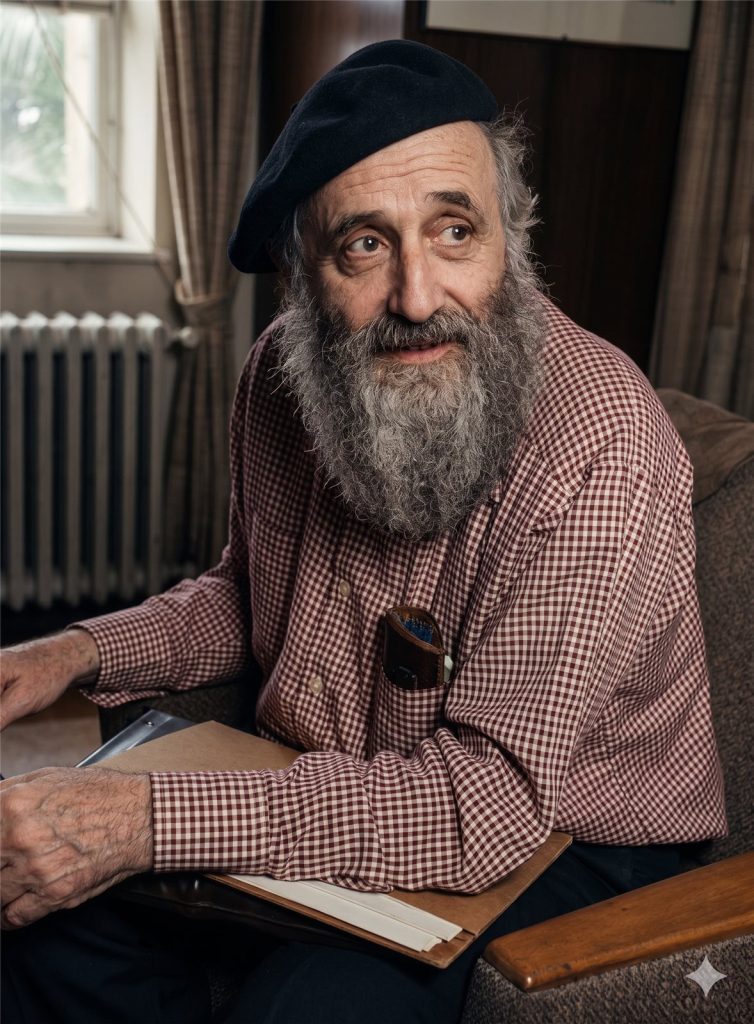
The Iron Curtain opened. Yirmiyahu, accompanied by his wife Fanya and their son Danny, left the Soviet Union and made aliyah, fully shomer Torah and mitzvos, meticulous in Jewish law, and adorned with a Chassidic beard. The arrival in Israel and the longed-for freedom was the fulfillment of a dream. But for Branover it was not an ending; it was the beginning of a new shlichus.
One critical question now remained: should he leave the world of science entirely to devote his life to Torah study? The surprising answer he received from the Rebbe in yechidus would change the course of his life and the map of energy science across the entire world.
“The World Needs a Believing Scientist”
Shortly after arriving in Israel, Professor Branover flew to New York. Standing at the entrance to the holy yechidus room at 770 Eastern Parkway, he assumed his scientific career was over. Now that he was in a free land, he wanted to devote his life solely to sacred matters – to become a rav or a teacher.
But the Rebbe had entirely different plans for him. The moment he entered the room, the very first thing the Rebbe said to him was connected to those Torah classes he had taught in the underground. The Rebbe smiled at him and said that precisely the fact that he had taught others while he himself was still learning and catching up was what had given him his strength.
Immediately afterward, the Rebbe turned to the subject of the professor’s scientific research in magnetohydrodynamics. The Rebbe rejected entirely any thought of leaving academia, and made his true calling clear: “The world needs scientists who believe in the Creator of the universe. You must show that there is no contradiction between Torah and science.” From that point on, his scientific career became his life’s mission, under the direct guidance of the Rebbe.
How directly involved the Rebbe was in steering that scientific career can be learned from an astonishing story that took place in the winter of 5733. That winter, Branover embarked on a two-month lecture tour in the United States. Near the end of the tour, Rabbi Avraham Shemtov approached him and asked him to add the University of Pennsylvania in Philadelphia to his schedule. Although he and his wife were exhausted from all the travel, their dedication to spreading the wellsprings of Chassidus moved them to agree.
A few days before the scheduled trip to Philadelphia, Branover was granted a private audience. During the meeting, the Rebbe mentioned the planned visit and then suddenly instructed him: “While you are in Philadelphia, don’t forget to introduce yourself to a local professor who has an interest in your field.”
This sentence left Branover stunned and baffled. His knowledge of applied physics was extremely specialized, and he was well acquainted with the names of American scientists working in the field of magnetohydrodynamics. He was absolutely certain there was no professor in Philadelphia working in or interested in that subject. When he arrived at the Philadelphia train station, he told Rabbi Shemtov that the Rebbe’s instruction seemed to him to be a mistake. Shemtov’s response was firm: “The Rebbe does not make mistakes. Let me help you track down this scientist.”
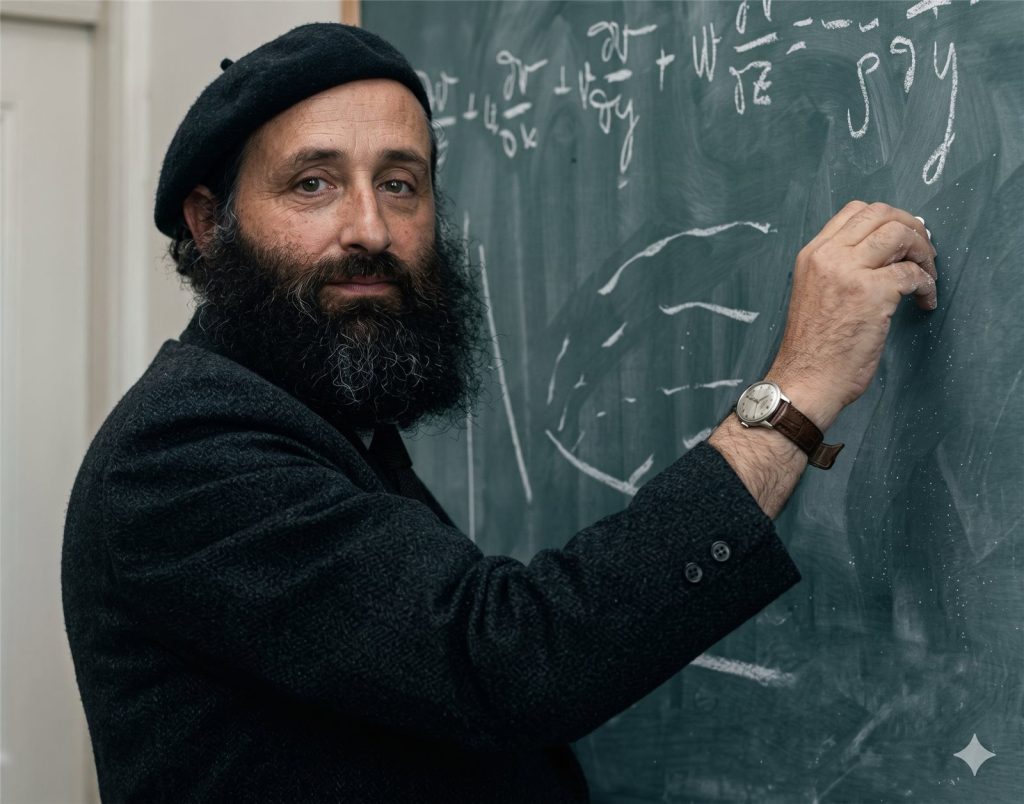
After hours of inquiries with the faculties of Temple University and the University of Pennsylvania, they did indeed find a local professor named Hsuan Yeh. To Branover’s enormous surprise, the professor displayed extensive knowledge of magnetohydrodynamics. Near the end of their conversation, the host professor mentioned that in six weeks an important international conference in the field would be held at Stanford University in California. “Although the conference program is already closed, I will insist on adding your name to the list of speakers,” the professor said with a smile, explaining that he was a member of the organizing committee.
Branover, whose return flight tickets to Israel were already in his pocket, was initially inclined to decline. He wanted to go home. But when he reported this to the Rebbe before his return, the Rebbe instructed him to change his plans, cancel the flight to Israel, and attend the Stanford conference, as it was “an important opportunity.” A Chassid does not question his Rebbe, and Branover flew to Stanford. That lecture changed the course of his professional life and Israel’s standing in energy research.
Immediately after his address, two senior representatives of the U.S. Navy’s Office of Research from Virginia approached him. Deeply impressed by his work, they asked where he planned to establish his laboratory. When he replied “in Israel,” they offered him generous funding to build his own research laboratory. That laboratory, established at Ben-Gurion University in Be’er Sheva, went on to earn a worldwide reputation. The contract with the U.S. Navy’s Office was renewed six times over the years, and the project ultimately received a $15 million grant from the U.S. government. This entire research empire was born solely from a seemingly cryptic sentence the Rebbe had uttered in a private audience about an obscure professor in Philadelphia who needed to be met.
But as Branover was yet to discover, the Rebbe’s heavenly vision did not only locate people on the far side of the country it also penetrated the most complex lines of code and calculations produced by supercomputers.
When the Rebbe Corrects a Supercomputer’s Error
The special relationship that formed between the Rebbe and the scientist was not only Chassidic in nature; it also carried a genuine professional-academic dimension. Branover would regularly update the Rebbe in detail on the progress of his research in applied physics.
In one of his private audiences, Professor Branover presented the Rebbe with a detailed report summarizing an advanced and complex study on which he and his team had labored. The report included long data tables and complex equations, all computed by a state-of-the-art supercomputer and resting on the most cutting-edge theories his research team had developed. The data was of a kind that only a handful of people in the world could read and decipher.
The Rebbe began leafing through the scientific report. Suddenly, in the course of a swift review of the sea of numbers, the Rebbe paused, pointed to two specific figures, and said simply: “These two numbers here are not consistent with each other.”
Branover was thunderstruck. He knew full well that the model on which the report was based was theoretically flawless, and that all those enormous calculations had been verified by the computer program. “But all the calculations were done by a computer, and the software we used is based on our most advanced theory!” he replied, politely standing his ground.
The Rebbe looked at him, smiled a fatherly smile, and replied calmly: “With all due respect to the experts, you will find there is an error here.”
Branover returned to Israel, assembled his senior research team at the laboratory, and tasked them with re-examining the lines of code and formulas from scratch. The team dug through the data, tried to locate the inconsistency the Rebbe had identified, and searched for an error in a system that was supposed to be perfect. Only after a full six months of frustrating system checks and deep dives into the algorithm did the researchers discover something beyond belief: there was indeed a deep error in the way the calculations had been prepared – in precisely the spot the Rebbe had identified at a glance.
The Rebbe’s Door is Open to the Professor
Ever since leaving Russia, Prof. Branover enjoyed a rare and extraordinary relationship with the Rebbe, whose door was always open to him. Over the years, up until Chof-Zayin Adar I, 5752, he received hundreds of responses to his letters (some of which were published in the Igros Kodesh series).
He also became the central liaison and trusted confidant of the Rebbe in all matters concerning Soviet Jewry. As the Chassid Rabbi Moshe Chaim Levin attests, whenever various proposals related to Russian Jewish affairs came before the Rebbe, Prof. Branover’s opinion carried great weight and the Rebbe gave it serious consideration.
The Rebbe, for his part, saw enormous importance in leveraging Branover’s academic standing as a means of spreading Judaism. A clear example of this occurred when the Rebbe’s shluchim in Brazil invited him to lecture to students on faith and science.
Branover told them that he had an explicit instruction from the Rebbe: every formal invitation to lecture abroad must come from the local university. The Rebbe explained that when an academic institution recognizes his standing – thereby lending legitimacy to his identity as a Jewish man of science – his influence on students would be many times greater. Only alongside or following those official university lectures, the Rebbe instructed him, could he also appear and speak at local Chabad houses.
The Rebbe’s guidance to the scientist was not limited to correcting mathematical errors; it also included bestowing deep spiritual meaning upon his physical work. On one occasion, ahead of Branover’s participation in an international conference of Jewish scientists, the Rebbe called him in and offered him a beautiful metaphor to deliver to the participants.
“You research solar energy,” the Rebbe said to him, “and you must encourage every Jew to be like the sun. Why is this star so important? After all, there are celestial bodies far larger than the sun that dwarf it and its power completely. So what makes it special? It provides light and generates heat!” the Rebbe explained.
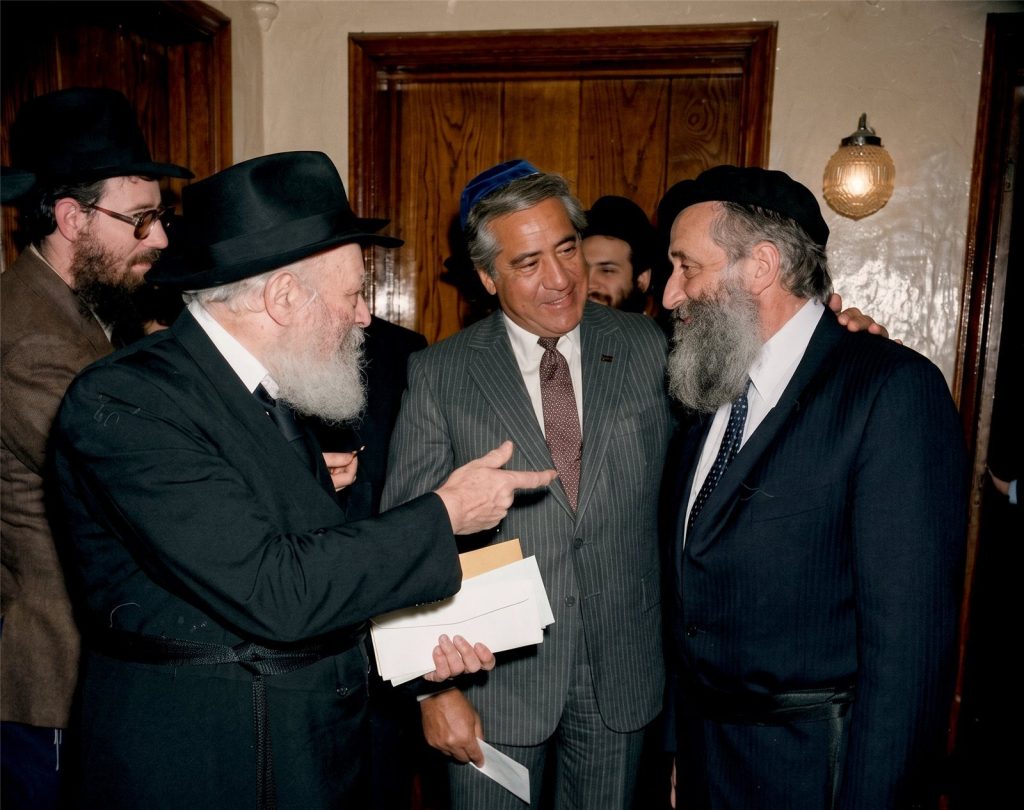
“By contrast, there are other phenomena in the heavens called ‘black holes.’ These too are enormously powerful energy sources, but there the energy is directed inward. Black holes pull everything toward themselves – even the energy they themselves emit.
“The sun, by contrast, gives of itself generously to the entire planetary system. So too, a Jew must radiate Ahavas Yisrael. If the sun could only warm its own mass, who would even notice it?!”
Professor Branover took this message deeply to heart. He began using his academic standing not only to study nature, but to illuminate with Ahavas Yisrael and bring about a genuine revolution among those who remained imprisoned in the darkness of Communism’s “black hole,” i.e. the academic immigrants from the Soviet Union.
Thus was born the SHAMIR Association, and the intellectual revolution that set out on its way with the Rebbe’s blessing.
To be continued
Beis Moshiach #1509 • pp. 14-21, 22
© 2026 Beis Moshiach Magazine. All rights reserved.
This article originally appeared in Beis Moshiach #1509. You are welcome to share it with friends and family by email or in print, provided that you do not change, add to or omit any part of it, you credit the author and Beis Moshiach, and you include a link to archive.bmoshiach.org (written out in full in printed copies).
To republish this article in a newspaper, magazine, book or website, please request permission in advance at [email protected].