Why Does Lubavitch Call Shavuos “Chag HaMatzos”?
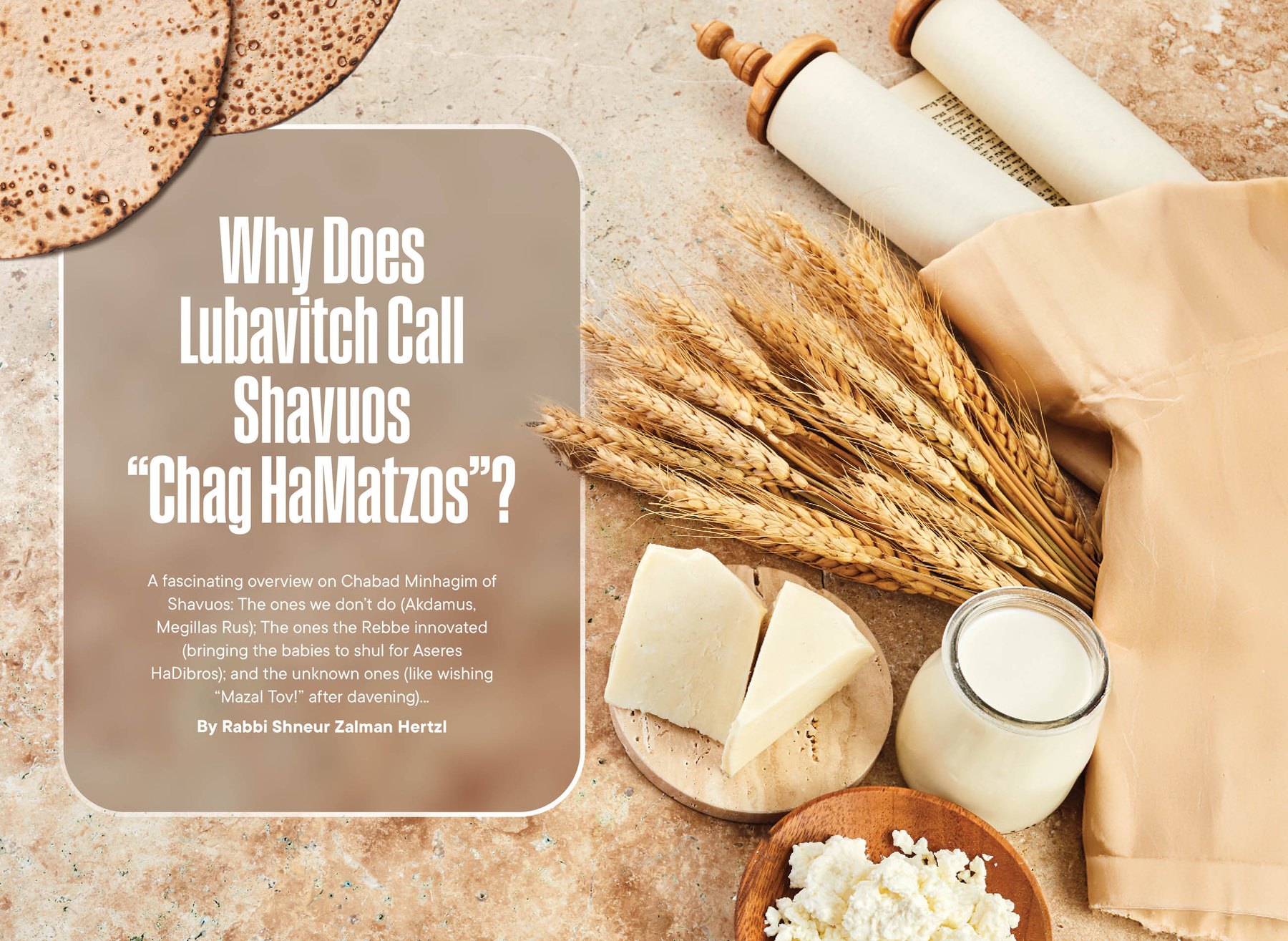
A fascinating overview on Chabad Minhagim of Shavuos: The ones we don’t do (Akdamus, Megillas Rus); The ones the Rebbe innovated (bringing the babies to shul for Aseres HaDibros); and the unknown ones (like wishing “Mazal Tov!” after davening)…
Chag Ha’motzos
The Yom Tov of Shavuos has several names (Mattan Torah, Chag HaBikkurim, Atzeres) and Chabad Chassidim have an additional name for it, Chag HaMotzos! This is why:
1) The Rebbe Rayatz said, “Shavuos was called ‘Chag HaMotzos’ in Lubavitch because Chassidishe rabbanim would come then… and it was called ‘Chag HaMotzos’ because Chassidim call a rav a motz (= moreh tzedek).”
It’s possible that this title (in its original version) was first given by Rebbetzin Shterna Sarah, mother of the Rebbe Rayatz, and as Rabbi Eliyahu Yochil Simpson related: “Rebbetzin Shterna Sarah, known for her clever sayings, said that Chag HaShavuos is the Chag HaMotzin.”
According to the data available to us, the custom of rabbanim going to Lubavitch began in the time of the Tzemach Tzedek and continues till this day. Our Rebbeim valued the arrival of the rabbanim and gave them special and respectful treatment.
The Rebbe Rayatz writes: On Shavuos, at the “Torah tisch” to which the guest rabbanim were invited, my master, my great-grandfather, Mori v’Rabi the Tzemach Tzedek would delight with the rabbanim in divrei Torah in Nigleh and would amaze them with his ingenious chiddushim.
The Rebbe writes about this in his reshimos: The Tzemach Tzedek would make a tisch on the morning of the second day of Yom Tov, and it was called “der rabbanisher tisch.” All the rabbanim were invited to this meal including, of course, the Tzemach Tzedek’s sons. The Tzemach Tzedek himself would eat with them. They would speak in Nigleh in a manner of give-and-take. He did not go on long, only about three quarters of an hour to fifty minutes.
The Rebbe Rayatz also notes: The young men were not allowed to be present at this event and “the rabbanim were afraid of this tisch because our master, the Tzemach Tzedek would ask questions in learning.”
The Rebbe Maharash did not hold an actual meal, it was rather in the form of a “kiddush.” The Rebbe Maharash would ask the rabbanim “about the unusual questions that came up during the time – in Nigleh as well.”
The Rebbe notes that the arrival of rabbanim for Shavuos took place also in the time of the Rebbe Rashab and with his successor, the Rebbe Rayatz.
2) Why did the rabbanim go for Shavuos? The Rebbe spoke about this at length at a farbrengen on Shavuos 5750.
“Rabbanim cannot leave their communities for Pesach because they need to be present to answer the many questions that come up about Pesach. So too, with Sukkos, there are many dinim having to do with sukka and the dalet minim. In addition, in a number of places, the custom was that one of the rav’s sources of income was that people would buy the dalet minim from him (and paid extra for it in honor of the rav).
“On Shavuos there are no particular dinim or questions, certainly not many.”
Up to this point he spoke about the technical reasons (which enabled rabbanim to come only at this time), but the Rebbe – as is his way to see the divine providence in everything and the inner significance – explains the substantive connection between matza, rav, and Shavuos:
“Chag HaMotzos also alludes to the idea of bittul (since matza is the idea of bittul), which is the main inyan of a rav, because in order to merit to arrive at the absolute true halacha a rav needs to be in a state of bittul, ‘may my soul be as dust to all,’ for this brings about ‘open my heart in Your Torah.’ In this matter, rabbanim receive additional strength by coming on ‘Zeman Mattan Toraseinu,’ ‘Chag HaMotzos,’ to Lubavitch, to their Rebbe, and in this case, to the place (the shul and Beis Medrash and house of good deeds) of my father-in-law, the Rebbe, Nesi Doreinu.”
In that sicha, the Rebbe also connects the idea of a moreh tzedek to Moshiach:
“Moshiach Tzidkeinu is a ‘moreh tzedek,’ like his title of Moshiach Tzidkeinu, as it says, ‘and he will judge with righteousness etc. and righteousness shall be the girdle of his loins,’ ‘and I will set up for Dovid a righteous shoot etc. and he will perform justice and righteousness etc. and this is his name that he shall be called, the L-rd is our righteousness.’”
The Rebbe also explains:
A moreh tzedek embodies two aspects: 1) Din – halachos [and there is no compromising in halacha], and 2) tzedaka and chessed, “and they will judge the congregation and save the congregation,” in a way of “beyond the letter of the law.” At Mattan Torah they receive this power to be morei tzedek.
While the rabbanim were in Beis Chayeinu, the Rebbe spoke about their role in general and in our generation in particular. The Rebbe told them to meet together to discuss halachic matters, especially new things in the world [such as in medicine, including mental health (because of the descent of the generations), and also preventive medicine].
Kabbolas Ha’torah B’simcha U’b’pnimiyus
In the Rebbe’s letters and sichos in the days preceding Shavuos, he would wish, a “kabbolas ha’Torah b’simcha u’b’pnimiyus.” The Rebbe often added to this wording a line that emphasized that the wording of this blessing is “in the words of the rav, he is my father-in-law, Admor [Rayatz].”
The Rebbe writes: Just as with other matters of my father-in-law, the Rebbe, who was precise in his wording [to say things] like he heard from his father [the Rebbe Rashab], surely this is also so with the wording of the blessing for Shavuos.
The Rebbe explains the words “b’simcha u’b’pnimiyus,” in Likutei Sichos:
The receiving of the Torah needs to be both with joy and pnimiyus. Joy over G-d choosing us to be a holy nation and enabling us to get close and unite with him through Torah and mitzvos, and this ought to inspire us to receive the Torah in an internal fashion, so that the Torah permeates our day to day life.
Tikkun Leil Shavuos
Tikkun Leil Shavuos is an order of study instituted by the kabbalists for the night of Shavuos when it is customary to remain awake all night and study Torah as a preparation for the receiving of the Torah the next morning. It says in the Zohar, parshas Emor, “The early Chassidim did not sleep on this night and they toiled in Torah.”
The wording of the Tikkun was composed by the Shelah (based on the Arizal) and it includes the beginning and ending of every parsha and Nach, the first and last mishna of every tractate, selections from the Zohar, Sefer Yetzira, Idra Rabba, and Taryag Mitzvos.
The name “Tikkun” has several meanings:
1) From the form of the word meaning tachshit (jewel) as it says in the Zohar that Rashbi and his company crowned the “kalla” (i.e. the Torah) with “tikkunim” before she went to the chuppa.
2) From the form of the word meaning hachana (preparation): as an introduction to receiving the Torah the next morning (and by saying it we add quality and perfection [tikkun] to Mattan Torah).
3) from the form of the word meaning tikkun (fixing, rectification): to fix and complete what was lacking in the Jewish people in the desert. They slept the night before the Torah was given and Hashem had to wake them up.
4) The Rebbe says the simple meaning is from the form of the word meaning takana (an instituted practice).
The emphasis in saying the Tikkun is that of saying the letters of the Torah without any focus on understanding and grasp. The Rebbe says in the name of the Rebbe Rayatz that the chiddush in Mattan Torah was not about understanding the Torah (for this existed before Mattan Torah) but the very event in which the King was revealed. Therefore, the emphasis is on the recitation of the holy letters of the Torah.
Women do not say the Tikkun.
In 5743, the Rebbe pointed out corrections to make in the Tikkun, as printed in Likutei Sichos vol. 28, p. 315.
Bringing Children to the Aseres Ha’dibros
Erev Rosh Chodesh Sivan 5740, the Rebbe said that all boys and girls from the age of one month and older, should go with their parents to hear the reading of the Aseres HaDibros in shul. The Rebbe explained that reading the Torah in general and especially when the Aseres HaDibros are read on Shavuos, in a holy place, in public, with several dozen Jews, with a bracha before and after the reading, is just like the event of the giving of the Torah on Har Sinai.
In the years that followed, the Rebbe would spur the people on in this matter in his farbrengens before Yom Tov. He said several times that even one-day-old children should be brought to shul [obviously, if this is possible; for example, a minyan taking place in the hospital].
The Rebbe stressed several times that the importance of their participation is also because the children are guarantors for all the Jewish people in regards to the fulfillment of Torah and mitzvos, “our children will be guarantors for us.”
During the reading of the Aseres HaDibros we stand facing the Torah.
Akdamus and Megillas Rus
In the HaYom Yom for 6 Sivan it says, “We don’t say Akdamus.” In the town of Lubavitch too, they did not say Akdamus. However, it is known that the Rebbe’s father, Rabbi Levi Yitzchok, would say Akdamus and this was also seen with the Rebbe.
Some read Megillas Rus and it is also brought in the Alter Rebbe’s Shulchan Aruch with a reason, “To learn that Torah was given only through suffering and poverty like Rus who converted.” However, the Rebbe notes that it’s because Dovid HaMelech (who was born and passed away on Shavuos) descended from Rus.
Our custom is not to read Megillas Rus but the Rebbe stressed that although there is no public reading of it, the idea is relevant and present on the Yom Tov of Shavuos (as we see that the entire Megillas Rus is read as part of the Tikkun Leil Shavuos).
Saying Mazal Tov
The Arizal revealed that on Shavuos every year the same lofty G-dly light that was at Har Sinai is revealed again. Every year, Shavuos is an exceedingly holy day. The Rebbe says that the main revelation is at the reading of the Aseres HaDibros, when we experience the event of Mattan Torah like at Har Sinai! (Although the baal korei is doing the reading of the words, but at that time is effectuated the revelation of Atzmus u’Mehus).
In the Zohar, we find a comparison between the giving of the Aseres HaDibros and a chuppa. Yisrael connect to Hashem and the Torah and unite in a complete oneness, and Hashem blesses Yisrael and crowns them with the crown of a bride.
Perhaps this is the reason for the early practice of announcing “Mazal Tov” on Shavuos – mazal tov for the “wedding” and mazal tov for the Torah!
The Rebbe Rayatz related:
“Early Chassidim would say ‘mazal tov’ on Shavuos. At first, they would say ‘mazal tov’ in the middle of the Torah reading [apparently referring to after the aliya of the Aseres HaDibros], but it says in sefarim that this is an interruption. After that, they would say ‘mazal tov’ after the Torah reading; after that, they would say ‘mazal tov’ after the davening. I remember elders in Lubavitch who said mazal tov on Shavuos.”
In a sicha of Shavuos 5713, the Rebbe explained: Mazal is above the order of hishtalshelus and you get there by saying ‘we will do’ before ‘we will listen’ which is bittul to the “Master of the will” and that is what Shavuos is about.
Dairy Foods
1) The Rema writes: It is customary to eat dairy foods on Shavuos
Many reasons are given for this. Here are three: A) To remember that the Jewish people ate dairy after Mattan Torah because they had just been commanded about kashrus and they needed to kasher their utensils, shecht the animals, etc. And since the process of preparing meat takes a long time, they ate dairy foods. B) Since the Torah is compared to milk as it says, “honey and milk under your tongue.” C) To recall the two breads that were offered on the holiday, we eat two cooked dishes – bread with dairy and bread with meat.
2) Our custom is to eat dairy after kiddush in the morning and then say a “bracha acharona” and wait an hour. [The waiting is always from the end of eating one type (dairy) until the beginning of eating another type (meat) and not from the end of the meal (or the bracha acharona) until the start of the meal]. One puts out a different tablecloth and sets the table for another meal and then eats the Yom Tov meal which includes meat (and drinks a reviis of wine) to fulfill, “V’somachta b’chagecha.”
The obligation to have a meal on Shavuos is more than for other holidays in order to “show that it is pleasing and well received by the Jewish people the day that the Torah was given.”
Teachings and a Story of the Baal Shem Tov
In a sicha of the second day of Shavuos 5704, the Rebbe Rayatz said: On Shavuos, our Rebbeim said “Torah” at the Yom Tov meal and told a story of the Baal Shem Tov.
In a sicha of the second day of Shavuos 5724, the Rebbe said, “Although the wording is that it was a custom of our Rebbeim, still, since my father-in-law, the Rebbe told us about this custom (in a way that was given to be published) it is proper that whoever heard about this custom, review a teaching of the Baal Shem Tov every Shavuos, his hilula, and tell a story about him.”
Strengthening the Study of Chitas
At the Shavuos farbrengen, the Rebbe would mention the three shepherds associated with this holiday (alluded to in the acronym מי״ד): Moshe Rabeinu, Yisroel Baal Shem Tov, Dovid HaMelech, and urge strengthening the learning of Chitas (Chumash, which pertains to Moshe; Tehillim, which pertains to Dovid; Tanya, which pertains to the teachings of the Baal Shem Tov which were explicated by the Alter Rebbe in this work).
The Rebbe also pointed out the special connection of this holiday to the Geula. On Shavuos 5751, the Rebbe said: Regarding Shavuos, Chazal say that “all admit that on Atzeres one also needs it to be ‘for you,’” and the reason is because this is the day that the Torah was given. The meaning of “for you” is that “he rejoice with food and drink.” We can add to this, based on what is brought in sefarim that “nami lachem” (also for you) is numerically equivalent to “keitz.” The completion of the G-dly revelation down below (for you) will be with the true and complete Geula, as this will be expressed in the fact that there will a physical meal (like on Atzeres when “you also need for you”) the meal of the Shor HaBor and the Livyasan.
Beis Moshiach #1412 • pp. 16-21
© 2026 Beis Moshiach Magazine. All rights reserved.
This article originally appeared in Beis Moshiach #1412. You are welcome to share it with friends and family by email or in print, provided that you do not change, add to or omit any part of it, you credit the author and Beis Moshiach, and you include a link to archive.bmoshiach.org (written out in full in printed copies).
To republish this article in a newspaper, magazine, book or website, please request permission in advance at [email protected].