Gush Katif’s Doctor Is Back In Gaza
19 Years Later
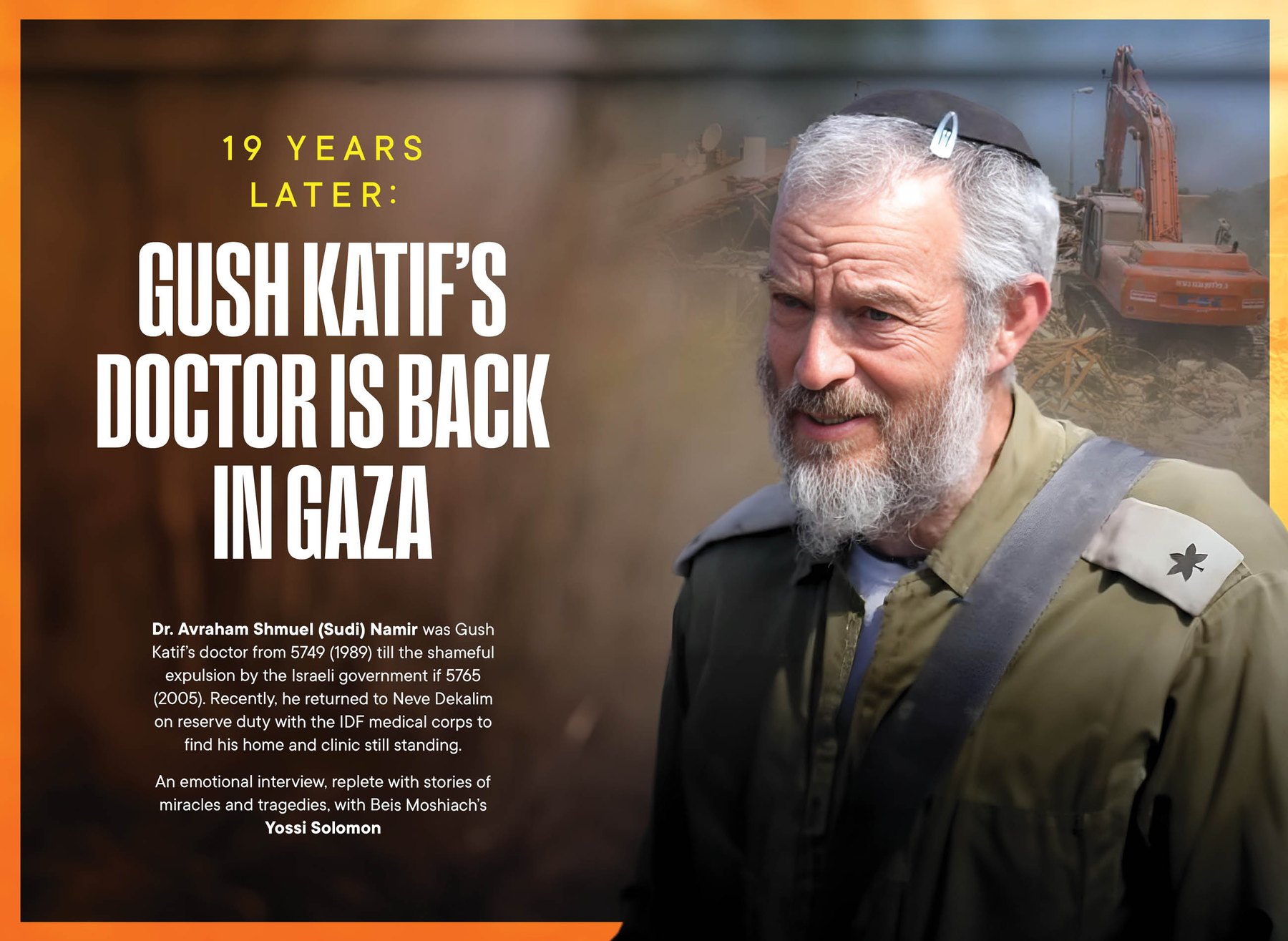
Dr. Avraham Shmuel (Sudi) Namir was Gush Katif’s doctor from 5749 (1989) till the shameful expulsion by the Israeli government in 5765 (2005). Recently, he returned to Neve Dekalim on reserve duty with the IDF medical corps to find his home and clinic still standing. An emotional interview, replete with stories of miracles and tragedies, with Beis Moshiach’s Yossi Solomon
Nineteen years have passed since those unbearable days, the expulsion from Gush Katif, when the Israeli government expelled about 9000 Jews from twenty-one yishuvim in Gaza and northern Shomron. The expulsion did not only cause great anguish to those who were expelled but tore a deep rift within the Jewish people who could not, and still cannot understand, how tens of thousands of soldiers and policemen expelled Jews who settled in Gush Katif with the consent of the Israeli government.
Dr. Sudi Namir, the doctor of Gush Katif, is one of the more familiar faces of Gush Katif. He shares with us memories of that difficult period, recounts miracle stories that the residents experienced daily, which he was witness to, and the expulsion.
It wasn’t easy getting to talk to Dr. Namir because he has been in Gaza for weeks without a phone. He described months of fighting that remind him of the army days of his youth, when there were no phones and no contact with family, although now he is 65 with a large extended family. He is married and is a father and grandfather. Five of his sons-in-law and three of his sons were drafted but within the family he is the most combat oriented.
The Army In Gush Katif Caved In To Terror
Dr. Namir was born in Canada. When he was eleven, his parents made aliya and settled in Ramat Gan. Then, because of his father’s job, the family had to move to London.
After high school, Dr. Namir made aliya independently and began learning in yeshiva in Chevron. He then married.
With the beginning of the settlement of Gush Katif, the settlement founders wanted him to join them since he is a doctor. They were looking for a doctor to be with the residents and provide them with services and help when necessary. That is how Dr. Namir and his family came to live in Gush Katif, becoming the well-known doctor whom everybody turned to for medical care and more.
“I arrived in Gush Katif when we were a young couple with two children and was expelled from there with a family of nine children and my wife in her final month of pregnancy. Basically, the main portion of my life when we raised our children and the family developed was in Gush Katif.
“My wife worked in education in the Gush while I was a doctor in a clinic. Most of the time was peaceful. It was a place with beautiful scenery that made one feel tranquil. We had a warm community around us and everything that a religious Jew could need: schools, shuls, and chavrusos. talmidei chachamim would often come to be with us, including my rosh yeshiva from Kiryat Arba, Rabbi Dov Lior; he would visit me every summer.
“If the government hadn’t been living under the illusion of peace, this pastoral existence could have continued if they had only reacted strongly against any terrorist that tried to hurt residents of the Gush. Unfortunately, the opposite occurred which is why we have reached the situation we are now in.”
I’ll remind you that it wasn’t exactly tranquil. There were quite a few serious terrorist attacks. How did you handle mortars and the constant terrorist attacks?
“First off the only weapon we had was prayer. Unfortunately, we were unable to change the army’s approach when it decided to capitulate to acts of terrorism.”
To what extent did the army decide to capitulate to terror?
“Just a few months ago, I met with a friend who had been posted in the emergency center and his job was to bring us out to treat people hurt in terror attacks throughout the Gush. During this meeting, he told me that the soldiers would tell their commanders that they see terrorists firing explosives at Gush Katif and they asked for permission to shoot at the terrorists, but the commander would say there was no permission to shoot.
“You can imagine how frustrated and restricted we were with these wicked laws that did not enable us to do anything against terrorism. They would tell us to put up cement barriers in order to defend ourselves and that was instead of attacking the terrorists and annihilating them so they couldn’t keep attacking.
“This was the daily reality in which we lived and all we could do was pray to Hashem to open the eyes of those who made the decisions so they would understand it’s forbidden to give in to terrorism.”
How do you maintain psychological stability in a situation like that?
“Our psychological stability came from fortifying ourselves. We repeated to ourselves that we are emissaries of the Jewish people to live in dangerous places, thus protecting the rest of the nation living in Eretz Yisrael. We would tell ourselves that no matter what, we would not give it to terror, even after our blood was declared free for the taking.
“The truth is that the number of injuries relative to the amount of attacks mounted against us was minimal. We saw countless miracles. It’s simply beyond credulity to what extent Hashem’s providence was upon us.”
Miracles We Saw Every Day
You say you saw many miracles. As a doctor, you must have seen these miracles from up close…
“There were many such instances, unfortunately, or fortunately, depending on how you look at it.
“One morning, they called me to come quickly to the hothouses at Yishuv Shalev. I got there and saw someone lying in a car who was losing a lot of blood from his chest. I asked the one in charge, ‘Who’s lying there? He looks like an Arab worker!’ The person affirmed that, saying, ‘He’s an Arab worker whose employer asked him to move his car for him from one place to another near the hothouses.’ The worker entered the car and just then, an Arab sniper shot at him from Rafah and hit him above the breastbone.
“We tried to save the worker but he died on the way to the hospital. The life of the Jewish employer was saved, considering that the car was his and he was the one who should have moved his car, but he was miraculously occupied at the time which is why he sent his Arab worker.
“Another story. In the area near Rafah was a terrorist who put on an explosive vest that contained dozens of kilograms of explosives. He set off the explosives as he stood not far from a Jew but the Jew was standing behind a cement pillar and this saved his life. I remember several stories like these.
“I remember that there were two children who sat on a bench. One of them said to the other, ‘Let’s go play. I don’t want to keep sitting here doing nothing.’ A few minutes after they got up, a rocket fell on the bench and it blew the bench to smithereens.
“It’s hard to imagine how many miracles we had in Gush Katif. There was an incident on Chanuka when a terrorist acted like a hitchhiker. He stood on the side of the road and when a car approached slowing down, he activated the explosives. Unfortunately for him, the explosives were behind his back and so he blew up and flew into the car but all the shrapnel bits were blocked because he himself had absorbed it all. All the people in the car were saved; they didn’t sustain even a slight injury.
“I can sit with you for hours and tell you miracles that we had every day.”
This Expulsion Was An Amputation
You tell of the miracles you experienced daily and yet, living daily with tension and fear that any moment a mortar, suicide bomber or sniper can attack is not at all easy. What made you continue to live in Gush Katif despite the serious acts of terror?
“Our Sages taught us that if you find it hard, that means you chose correctly. Western culture says that difficulties should be swept away under the rug and we should try to avoid them. ‘Life ought to be easy and pleasant.’ According to this view, when a marital relationship is difficult, you break it up, when something isn’t right with a pregnancy, you end it, and so on.
“When a person is in a situation in which he has to work hard and deal with difficulties, that’s the right place for him; it’s a place where he can grow. We understood deep down that this place, with all the danger, is where we needed to live.
“For me personally, this awareness was even stronger. I went to Neve Dekalim from distant Canada. I didn’t do this to pad my resume but to serve as a medical emissary to help people with any medical problem. Not for a moment did we have any doubt that perhaps we should cave in to terror.”
And then, Prime Minister Ariel Sharon announced his decision of expelling the Jews from Gush Katif. What did you think about that?
“At first, we didn’t believe it. We didn’t want to believe it until the last moment. Perhaps it was only the last month that we began realizing that it was really going to happen. It was hard to accept that someone would take such a step, certainly not someone who had invested so much to build up these yishuvim.
“But the moment we realized that Sharon was serious and he was going to carry out this terrible thing, we did all we could to prevent it, though nothing helped.
“I thought we ought to wear sackcloth and ashes like they did in the time of Mordechai and Esther, but R’ Lior told me that it wasn’t appropriate for a doctor in Israel to go about like that, so I didn’t do it.
“The expulsion was like having a limb amputated from you. Whoever didn’t experience it, can’t understand it, both on the physical plane and on the spiritual plane. I can say that as far as our efforts, our main work was spiritual. There were many prayers and tears to Hashem, but He decided otherwise.
“Tragically, the IDF managed to convince tens of thousands of soldiers to evacuate their brothers from their homes.”
Terrible Pain
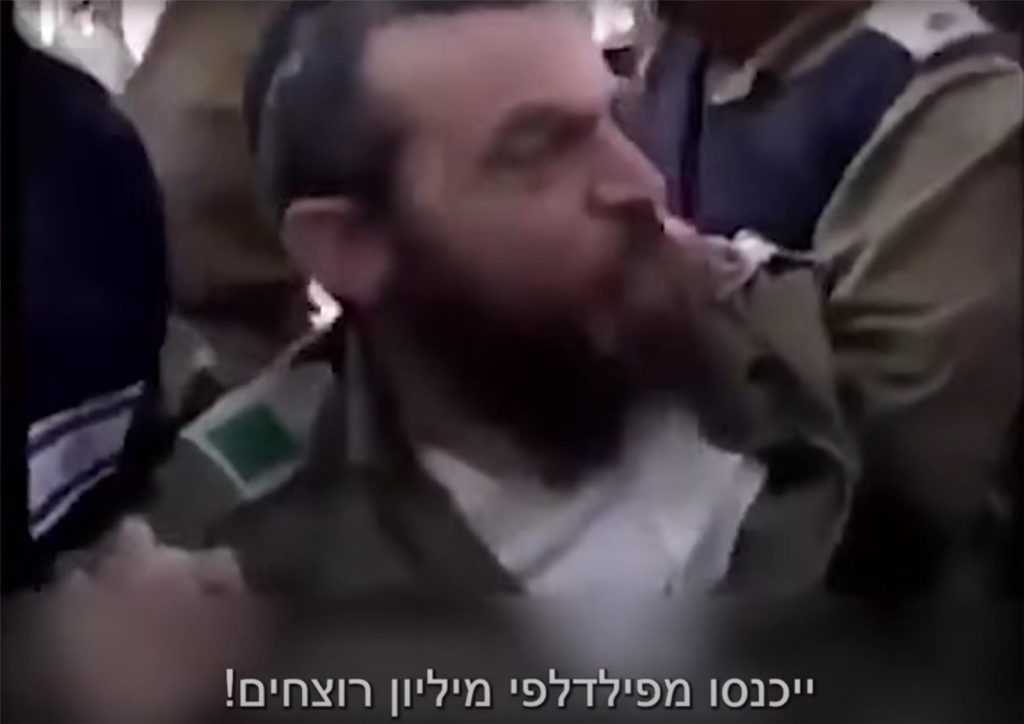
Dr. Namir and his family were uprooted from their home in Neve Dekalim while engaged in strong and heartrending resistance, as documented by those taking pictures. Namir himself, dressed in army uniform, was dragged from his home by several soldiers as he screamed and warned about the security tragedy that the expulsion would cause. Unfortunately, his prophecies came true.
Tell us how you felt when you realized that nothing would stop the expulsion.
“It was a time of great mourning. A father who was bereaved of a son and was expelled from Gush Katif, described the mourning like this, ‘I don’t know which is harder, a portion of the land for which you sacrificed your soul and were expelled from or a child that you sacrificed your soul to raise and he is killed.’ Both things are terrible and unbearable. To overcome this terrible feeling, you need to strengthen your emuna and know that in the end, everything is for the good.
“The first Shabbos after our expulsion, was Shabbos parshas Ki Savo. In the middle of the Torah reading, which we read in hotels where those who were expelled were placed, when the reader reached the part about the curses that would befall the Jewish people, he simply collapsed into himself and nearly fell from the bima in his great anguish.”
How do you strengthen yourself after something so terrible?
“Everyone understands that there are things in life that he looked forward to and they happened, and things he hoped for and wanted that didn’t happen.”
I Was In A Cage In The Expulsion From Yamit
Gush Katif wasn’t the first expulsion that Dr. Namir experienced. Long before that, he was expelled from Yamit in the Sinai.
“I experienced the expulsion from Yamit without my family. I saw how Menachem Begin sent the army to destroy Yamit. They put me in a cage, denigrating and trampling anyone who tried to prevent the expulsion from Yamit.
“Next to me in the cage sat Rabbi Yosef Mendelevich who went through all sorts of humiliation as a Prisoner of Zion in Russian prison. It was hard to see a Prisoner of Zion in such a state in Eretz Yisrael.
“As I said, not everything we want and ask for, do we get. Still, the spiritual world continues to be built and double itself many times over, and continues to grow and intensify.
“Over the years, when I tried to provide medical assistance, I had some failures. People whom I treated and tried to save, didn’t live, but over time I learned that even when I am successful, it’s all from Hashem. I have to do my part but the final decision is His,” said Dr. Namir, pointing heavenward.
“Emuna strengthens and galvanizes us. We understand that Hashem runs the world and He is the one who gives us success as well as the tests and difficulties. He chooses the time when they will come and He is also the one who wants what’s best for us even if we don’t always see it as open goodness.”
As someone who was expelled from Gush Katif, what special memories of Gush Katif will remain with you forever?
“It’s hard to pick a special memory out of such a long, special time of my life, but I’ll tell you two special memories of that time. A terrorist entered Gush Katif and murdered my rabbi, Rabbi Yitzchak Arama as he was traveling for a Shabbat Chattan in Netanya. The murder scene that I was called to was a terrible sight. For me personally it was a very difficult moment as R’ Arama had taught me so much.
“Another memory I have, has to do with the fact that I’m a mohel for over thirty years. One of the special brissos that I did was for a baby of a woman who had been attacked by terrorists and injured in her spine. Half her body was paralyzed and yet she became pregnant and gave birth to a son. The bris took place at the new shul in Kfar Darom. It was very moving for me since the terrorists tried to cut off life and not only did they fail but she went on to bring new life into the world.”
Seeing The House In Gush Katif Again
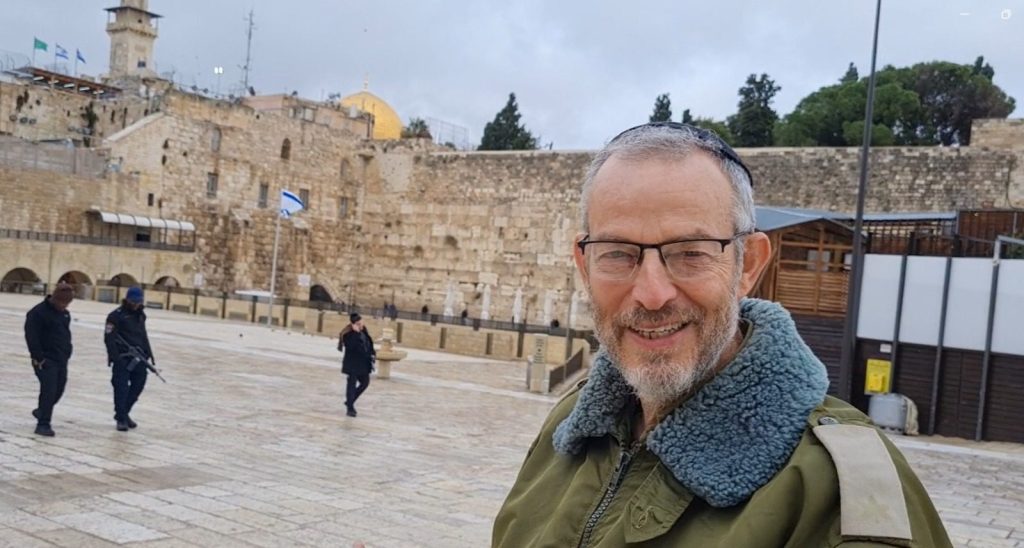
Although the State wanted to run away from Gaza, Gaza has pursued the State with all of its tools of terror and destruction. When Dr. Namir was called to serve as an army medic in the heart of the fighting in Gaza, he was back in the place which was previously his home. He knew Gush Katif like the palm of his hand.
The current war has provided him with some moving experiences that were a taste of the home which was destroyed. Three months ago, he was told that the brigade he was attached to was leaving Gaza. Dr. Namir was very disappointed and tried to find a way to get back there and save soldiers in Gaza.
“Within 48 hours I was back in Gaza with a Givati scout unit. I was one of the first soldiers to enter Neve Dekalim. On the screen of the Namer (armored personnel carrier ) we saw the shul of Gadid.
“Then we entered in a military maneuver into an open area in the north of Neve Dekalim, in the area of Yeshivas Yamit. In the morning, I saw from a distance of 300 meters (almost 1000 feet) where, in the field, stood our house, intact… It was a moving, tear-filled moment.” He photographed the place nonstop from the roof as shooting went on in all directions.
“From the distance, I also saw my clinic out of which they made a university of terror. Our neighborhood had turned into a field to grow vegetables. I’m sure that when I get there, I’ll discover the wall of the reservoir of my mikva. That’s surely there. It can’t be that they plowed that deeply.”
He considers this return, as temporary as it was, as the start of the atonement for the sin of giving away Eretz Yisrael and he hopes that the lessons were learned by those whose job it is to do so.
Seeing Miracles In Gaza Today Too
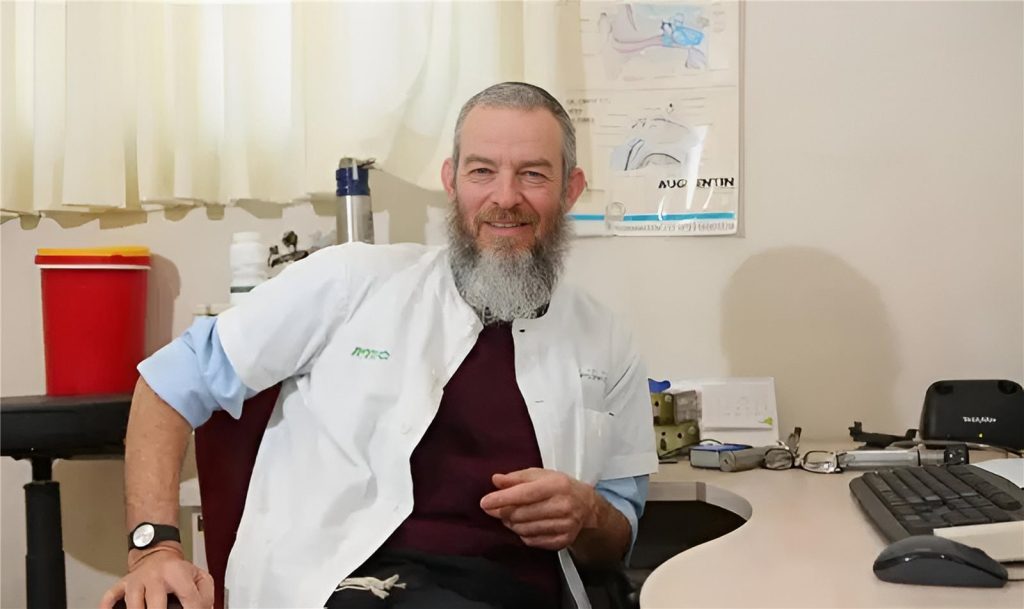
Dr. Namir, who presently lives in yishuv Yad Binyamin, is putting to use the emergency medicine know-how he picked up back in the day in Gush Katif.
“While we were in Gush Katif, we did nothing on the scene. Once upon a time, there was a mistaken perception that someone who was injured had to be dealt with right there, stabilizing him, bandaging and providing an intravenous infusion. In Gush Katif we had a different approach, that was ahead of the army by fifteen years. What causes the injured to survive? Specifically by doing nothing on the scene and not delaying. This way you save time; everything is done on the move.
“This is what we did with Ariel Yarad, for example, a one-and-a-half year old baby from Atzmona who sustained shrapnel to his head. He wasn’t breathing and had no pulse and today, boruch Hashem, he is learning more and more mesechtos. Today, the army does the right thing and realizes that from the moment there is an injury, it’s a race against time. We are in full gear 24/7 in order to be able to respond in seconds.”
I’m sure you’ve seen miracles in Gaza now too.
“Definitely! On Sunday, when I was at the side of Unit 101 paratroopers, we got an urgent message about injuries. What happened was that soldiers wanted to enter a room and they sent in a dog to check the house. As the dog crossed the threshold of the room, a pillar of smoke emerged. We traveled 150 meters until we reached our destination and were already thinking which stretchers to load when I suddenly saw the severely injured person. I said: This is the severely injured person? Wonderful, boruch Hashem. He was behind a wall and had sustained ricochet injuries from the intensity of the blast. The cement saved his life and the injury was mainly in the knees.”
Dr. Namir is also a talmid chacham who writes articles on halacha and medicine. He receives questions from the field, including questions from soldiers who are not yet religious.
“An irreligious soldier who experienced a big miracle, asked me whether to say the HaGomel blessing. He was conducting a search in a house and they saw a camera and took it down. Then another camera, and thought that was all. They said: Let’s go in. But then the soldier took a step forward and the entire building collapsed on his foot. ‘I’m so happy that I can talk to you from here,’ he said to me. I asked my rav, Rabbi Yitzchok Zilberstein and he told me that since there is a dispute regarding the wording of the bracha, when he gets up in the morning of the next day he should say ‘hagomel chasadim tovim l’amo Yisrael,’ in front of ten people. Why not the regular HaGomel? Because you say that when leaving the war for good.”
Many of the doctors in the field in Gaza are recent medical graduates and Dr. Namir’s presence, as well as that of other experienced doctors, is critical and saves lives.
“There is nobody there like me who was in Gush Katif for sixteen years. I treated soldiers and civilians who were injured by Hamas terror and nineteen years went by since then. The importance of the specialized knowledge of doctors is like a meis mitzva who has nobody to care for him; here too, it’s important that there be someone with a lot of experience; there is no substitute for that. If someone can replace me, fine; but it’s not the same thing when you face the kind of experiences that I went through. This experience saves lives.”
What’s it like to go back and serve the State in the place they expelled you from nineteen years ago?
“You go in and see up close the lawlessness that has prevailed over the years. Over the period of fighting, we entered hundreds of houses and in each house we saw weapons. This is their occupation. And there were pictures of their mosques. When you see this, you know whom you’re dealing with. As for my personal feelings, I feel pain and shame over the withdrawal executed by the government so that now we have to go back in.”
We Must Return To Gush Katif
“Everyone knows what they brought in through the Philadelphi Corridor; everyone knew and kept quiet. Now they are sending missiles and fleeing into their tunnels like rats. Let’s hope the lessons are learned. Quiet blinds us instead of solving the problem at the root.
“Gaza is not the problem. The problem is the rot of the government from when the state was established until today, which adopted a policy that assumed we cannot win over terror. Someone decided that defending the lives of Jews in Eretz Yisrael is not the top priority. They decided that we need to be nebachs and apologize for our existence. That’s weakness; that’s corrupt at its core and must change. I think the change will come from below, from the voters who are disgusted.”
Do you think there’s a chance we will return to Gush Katif?
“We certainly need to return to Gush Katif and in general to settle the entire land. The center of the country is already full to overflowing.” But in order for this to become a reality in the best way possible, Namir sets as a basic condition that there be a complete transformation of the safety consciousness that will stop what he calls, “the anarchy and neglect when it comes to Jewish lives,” which those in positions of responsibility have adopted today.
“I don’t think it’s possible to sustain Jewish settlement, not in Evyatar and not on any of the hilltops until the decision is made that a Jew has a right to take weapons and defend himself, that he has a right that not even a piece of gravel be thrown at him. Whoever plans an attack on us, needs to be thrown out of the country or put in the cemetery. The same goes for Gaza. We’re not going back to a situation in which we are hiding behind protective barriers and they shoot mortars at us. We’ll go back when the government does everything to ensure that no soldier or civilian is endangered.
“In addition, orders have to change regarding opening fire. The head of the first council of the Gaza Strip, Reuven Rosenblatt, whose biography I read during miluim, wrote that he wanted to collaborate with the mayor of Deir al Balah and other Arab neighborhoods on the Gaza coast. The moment that the first signs of disorder began, they told him: If you don’t shoot those who throw rocks, it will get out of control.
“Conversely, we’ve seen that where there is no Jewish settlement, there is an increase of terror which leads to the murder of Jews. That is a clear equation which speaks for itself, which is why it’s important that we have Jewish settlement all over the country. This is why I believe with all my heart that we will go back there.”
Dr. Namir yearns to go home and to his previous duties.
“The center of the country is not my natural place, the portions of our forefathers in Yehuda, Shomron and Gaza is. B’ezras Hashem, of course we need to return to Gush Katif and if they need a doctor I’ll be there, even though I’m retiring in two years.”
Until the time comes that his clinic will reopen in Gush Katif, Dr. Namir will soon be returning to his work at the clinics in Kedumim and Alon Moreh, to his rotation as senior doctor at the emergency room at Beilinson Hospital and as a lecturer at Ben Gurion University’s medical school.
At the age of 65, isn’t it time to retire from the reserves?
“This question is an old one,” he says with a smile, and he relays an answer he received from Rabbi Zilberstein when he was forty-nine, sixteen years ago, on the same subject.
“He brought proof from Kaleiv ben Yefuneh who said his strength was the same as when he was younger. If he could fight at age eighty-five, then we don’t have a problem if we are still fully functioning.
“It’s a zechus to be with these soldiers. You see the determination, the devotion, and the discipline of the soldiers. When I was with the Givati, they didn’t take off their shoes for 55 days. They were in the Namer for sixteen days in a row without a shower. How does a sane person keep his sanity? Well, these aren’t humans but angels, emissaries of the divine, so if I can save one of them, what would I not do to accomplish that? I intend on continuing as long as my soul is within me, modeh ani lefanecha.”
In conclusion?
“I can say with certainty that if there isn’t loyalty to the Jewish people and the Holy Land, then we pay a heavy price, unfortunately. During the churban, if they had only listened to the prophets who brought the word of Hashem, everything would have looked differently. Today, we have gedolei Yisrael, sifrei kodesh, and we need to listen to them.
“We must create unity in Am Yisrael and unity is when each side says: In order to unite, we don’t highlight that which separates us; we forgive that which separates us. Achdus is fighting together against the enemy. When we are truly discerning, we will find how much more there is that we have in common than areas of dispute. The Jew at his core is good, upright, and connected to the rest of the nation. If only the communication was the way it should be and would reflect the beautiful commonalities that we share, life here could be so much better.”
Beis Moshiach #1425 • pp. 22-32
© 2026 Beis Moshiach Magazine. All rights reserved.
This article originally appeared in Beis Moshiach #1425. You are welcome to share it with friends and family by email or in print, provided that you do not change, add to or omit any part of it, you credit the author and Beis Moshiach, and you include a link to archive.bmoshiach.org (written out in full in printed copies).
To republish this article in a newspaper, magazine, book or website, please request permission in advance at [email protected].