Bnei Brak’s “Hidden” Shliach
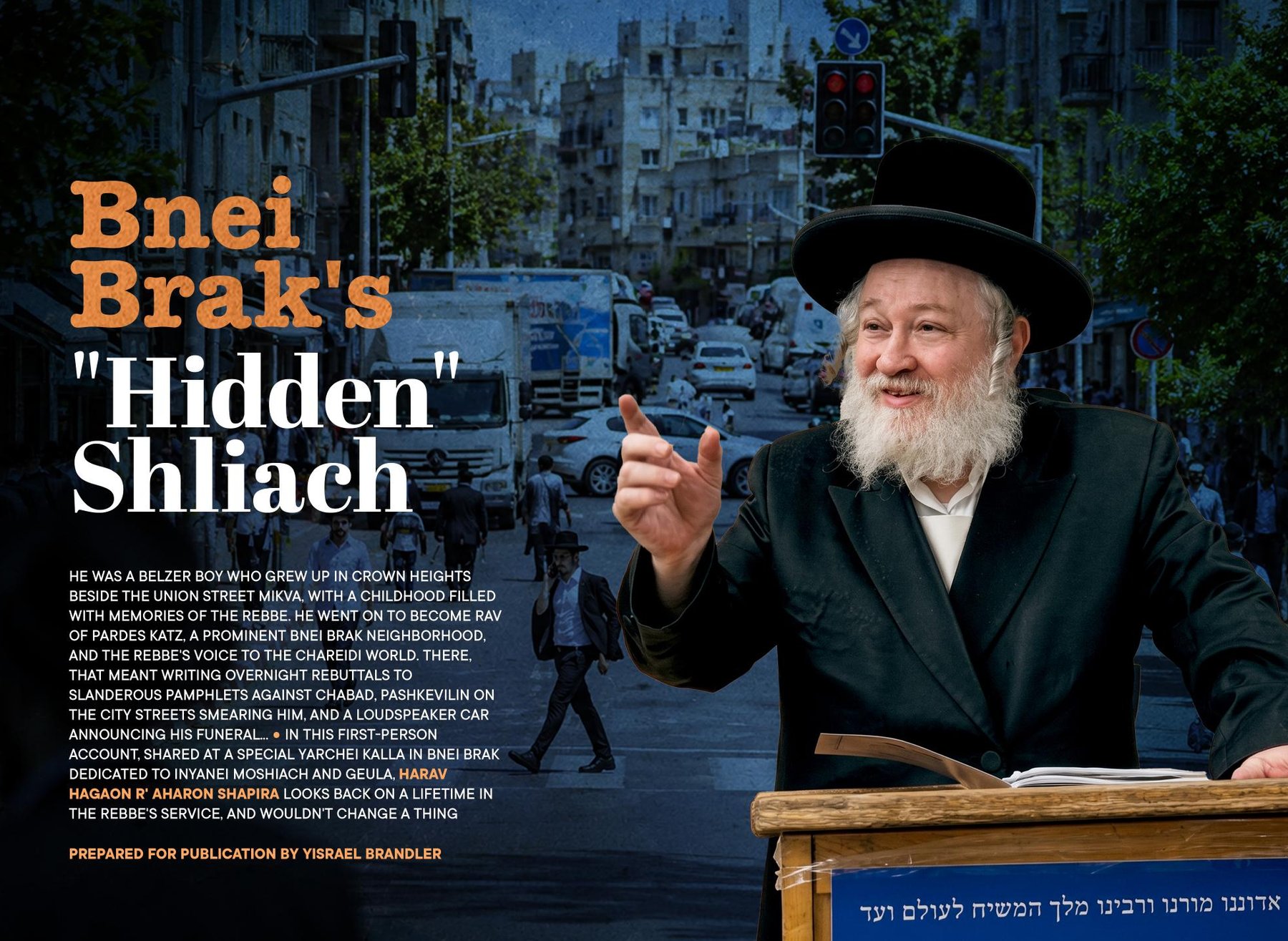
He was a Belzer boy who grew up in Crown Heights beside the Union Street mikva, with a childhood filled with memories of the Rebbe. He went on to become rav of Pardes Katz, a prominent Bnei Brak neighborhood, and the Rebbe’s voice to the Chareidi world. There, that meant writing overnight rebuttals to slanderous pamphlets against Chabad, pashkevilin on the city streets smearing him, and a loudspeaker car announcing his funeral… In this first-person account, shared at a special Yarchei Kalla in Bnei Brak dedicated to inyanei Moshiach and Geula, Harav Hagaon R’ Aharon Shapira looks back on a lifetime in the Rebbe’s service, and wouldn’t change a thing.
Rabbi Aharon Shapira, rav of the Pardes Katz neighborhood in Bnei Brak, shares fascinating memories of his childhood in the sixties in Crown Heights.
I was born in 5720 (1960) in Crown Heights. My father, Rabbi Yitzchok Isaac a’h, was a Belzer Chassid who lived in a neighborhood that, in my childhood years, was a magnet for yereiim u’shleimim from a wide range of circles. I don’t know how many of Anash can say that the Rebbe visited their home, but I can say that the Rebbe visited my parents’ home twice a month!
The Rebbe Asked if There was a Side Route or a Window to Leave Through…
Our house was attached to the mikva on Union Street, and my parents ran the mikva. As is well known, this is the mikva where the Rebbe immersed before traveling to the holy tziyun (the Ohel). In those years, the Rebbe generally traveled to the Ohel twice a month: on Erev Rosh Chodesh and on the 15th of the month.
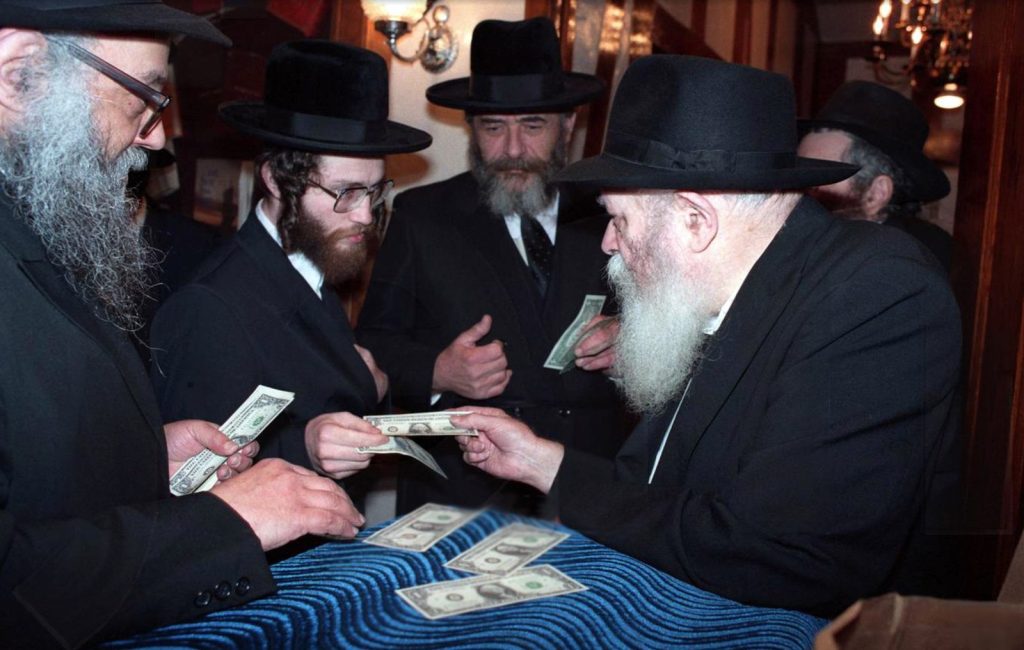
My father firmly refused to take money from the Rebbe for the immersion, but as a “Poilisher Chassid,” he recognized the zechus of a “tzaddik’s coin.” So although my parents did not stand there when the Rebbe entered, we children would hang around the place, and the Rebbe would give us dollars. Thus we had dollars from the Rebbe many years before the Rebbe began his famous distribution of dollars to the general public.
As I said, my father refused to accept money from the Rebbe, but such a refusal was hardly a foregone conclusion.” By letting the Rebbe into the mikva, he risked losing his livelihood. At that time the mikva was under the auspices of a modern American Jewish organization, which did not allow anyone into it except those for whom the mikva was intended, not even the Rebbe.
Once, in the late “yuds” (1950s), while the Rebbe was inside the mikva, the president of the organization arrived for a visit and conducted a surprise tour of the premises… While my mother, with great presence of mind, kept him occupied and pointed out things in the building that needed repair, my father hurried to the entrance of the mikva. Out of respect and decorum, he waited outside until the Rebbe finished, and did not dare, heaven forbid, to hurry the Rebbe.
When the Rebbe came out, my father, who was certain that the end had come for their livelihood and that they would be fired immediately, simply asked for a bracha for parnassa. The Rebbe responded with surprise and asked why he was so frightened, and whether there wasn’t a side route or a window (!) through which he could leave… My father pulled himself together and answered that there was indeed a route through the basement. The Rebbe did in fact leave that way, without the president of the organization noticing him…
Coming to the Rebbe at Least Once a Year
Already in the “chofs” (1960s), I attended the Rebbe’s farbrengens. In the “lameds” (1970s), I no longer came only to farbrengens, but would “sneak out” of the Belzer shul to take part in the davening in 770. My father knew about this, but for various reasons I had to do it in secret.
I had the zechus to take part in many tefillos in the Rebbe’s presence during the Tishrei Yomim Tovim. The scenes are etched deeply in my memory. I remember, for example, the ceremony of bringing the “Sefer Torah shel Moshiach” in 5730, and how, during the hakafos of 5734, the Rebbe began to sing “HaAderes V’haEmuna” to the tune of the French national anthem. Those were years full of special and uplifting moments that I had the zechus to experience up close, and to cleave more and more to the “tree of life.”
In 5736 I immigrated to Eretz Yisrael. First I studied in yeshiva, and later I married here. Despite the distance, I would come from Israel to the Rebbe at least once a year, and to my parents of course. At first I used to come in Tishrei, but from 5746, after I was appointed Rav in the Pardes Katz neighborhood and could not be absent during Tishrei, I generally came for Shavuos, and sometimes also for the days of Selichos. In later years, when the Kinus HaShluchim began to take place, I would sometimes come during the days of the Kinus.
Encouragement for the Shlichus from the “Maor V’Shemesh” Himself
Given the background I came from on the one hand, and my intense connection with the Rebbe on the other, I found myself with a powerful inner drive to connect the Charedi and Chassidic public to the Rebbe and to enlighten them about his wonderful derech.
I was pained, and I am still pained, by the fact that Lubavitch, which excels so much at publicity and outreach throughout the world, often acts with a lack of understanding specifically among the Charedi and Chassidic public. Often Anash do not understand their language and style, and do not spread the wellsprings in a suitable way.
The first time I undertook this shlichus was when I was still a boy, close to my bar mitzva. This was when Mr. Zalman Shazar came to 770 and the Rebbe kissed him in the manner of Chassidim. In Satmar, the tempers flared at the time. They argued: Is it conceivable that the Rebbe would kiss the “Zionist” president so affectionately? Out of Ahavas Yisrael, would the Rebbe kiss the Satmar Rebbe, R’ Yoel, that way too? These arguments sounded well-founded, and they caused me distress and confusion.
To ease my distress, I randomly opened the sefer “Maor V’Shemesh,” and on the very page where the sefer opened, I found a wonderful explanation of why Moshe Rabeinu kissed Yisro, even though he was a priest of idolatry: sometimes tzaddikim influence a person who is far away precisely through a kiss, in the sense of “attachment of spirit to spirit”… Truly fitting words!
Well, with great joy I took the sefer, went to photocopy the passage, even though this was very complicated in those days, both financially (since I couldn’t involve my father in the matter) and technically: the old copying machines required waiting for the pages to dry, so the copying process took time.
I distributed these pages secretly, tucking them under sefarim in shuls in Williamsburg. I like to say jokingly that just as the Rebbe answers Chassidim through the “Igros Kodesh,” so I received from the “Maor V’Shemesh” himself the first encouragement for my special shlichus…
Before the celebration of the first Siyum HaRambam in 5745 (1985), the Rebbe instructed that gedolei Yisrael and rabbanim from all circles be invited to the siyum, emphasizing that in every court one must speak and act in the language and style suited to them.
And indeed, from then on, for several years I accompanied the organizers in inviting the gedolei Yisrael to these events and speaking with them in the appropriate terms.
I merited to be very involved in this special shlichus of spreading the wellsprings and bringing the Rebbe’s light to the community of Bnei Torah and Chassidim. In the course of my activity I was in continuous contact with Roshei Alfei Yisrael: Rebbes, rabbanim and roshei yeshiva. I merited to bring several Rebbes and rabbanim to the Rebbe, and I even accompanied some of them myself. So it was, for example, with the current Vizhnitzer Rebbe shlita (who in those days was the son of the Rebbe, the “Yeshuos Moshe,” zt’l). I brought him to the Rebbe, and even accompanied him at the distribution of dollars on 20 Sivan, 5751. On that occasion, the Rebbe gave me an additional dollar, saying: “For the spreading of the wellsprings in Bnei Brak, very soon.” For me this was a clear reference to my unique shlichus.
As part of this shlichus, in those days I established a unique kollel in the central shul of Pardes Katz in Bnei Brak. About two minyanim worth of avreichim who were not from Anash studied there. The study schedule was divided: the first half of the day they studied Gemara, and the second half they studied Likkutei Sichos. I served as head of the kollel and also took care of its material upkeep.
Throughout, I reported to the Rebbe on my activities in this field, and I merited to receive many replies that included expressions of “thanks” and encouragement.
I received an important and sensitive shlichus from the Rebbe during the period of “ha’targil ha’meiriach” (as I call it, since the Rebbe taught us to use lashon nekiya). I received a phone call, and immediately afterward a fax from the Rebbe’s secretariat, on erev Shevii shel Pesach 5750. The Rebbe instructed that I personally approach each and every member of the Moetzes Gedolei HaTorah of Agudath Yisrael and explain to them his view on the matter then at hand. This concerned the Rebbe’s intervention, in which he expressed his opinion that a government should not be formed with Shimon Peres under any circumstances, despite the fact that the Moetzes Gedolei HaTorah had initially decided, in fact, to form a government with him.
The Response Booklet Printed Within a Day
An integral part of this shlichus often required defending the honor of the Rebbe against attacks and slanders directed at Chabad in those days, attacks that reached their peak during the stormy election campaign of 5749 (1988–89).
Anash did not always understand why it was so important to reply and respond to these claims; from their perspective, let them say what they will, who cares?! But to me it was absolutely clear that one must answer and explain as much as possible. One cannot ignore it.
I acquired strong chizuk for this approach from an incident that occurred in that period. In one of the polemical periodicals, they harshly attacked certain things the Rebbe had said about the miracle of Chanuka, that it involved an element of physical victory. They wrote insolently that this was contrary to “pure hashkafa,” and that this approach supposedly stems from Chabad’s connection with military personnel and with the general public, who attribute the Chanuka miracle to nationalism and physical heroism.
The claims were of course baseless. And then, by an awakening from Above, someone asked: why don’t we reply that in the sefer “Chayei Adam” it says the same thing? From this I learned two fundamental things: first, that one must, as a duty, answer and respond to the claims directed against Chabad and not leave them unanswered. Second, I learned the form of the answer: to show them from their own sources, for the author of “Chayei Adam” was counted among the opponents to Chassidus.
So it was also in the midst of the election campaign in which the talmidim of the Baal Shem Tov in general, and Chabad Chassidus in particular, were attacked.
One erev Shabbos, a venomous booklet appeared in the shuls bearing the title “The Truth About the Chabad Movement in the 1980s.” This booklet included photographs from Chabad publications, excerpts from sichos, and so on, almost all of which were taken out of context in a tendentious way in order to cast aspersions on Lubavitch and its Rebbe. I remember how one of Anash arrived in alarm and told us about the booklet. Immediately several Chassidim went out to collect these booklets from the shuls, and I decided on the spot to prepare a counter-booklet that would prove, one by one, the distortions and falsifications of the first booklet and present matters as they really were.
The goal I had in mind was that their booklet should not remain without a fitting response. I wanted a worthy response to appear by Sunday morning, the time when they would presumably distribute their booklet again (after it had been collected by Anash). For something a person sees and hears without any response, there is great significance, just as in halacha a court does not hear the claim of one party without the presence of the other party.
Rabbi Moshe Yehuda Leib Landau zt’l, the Mara d’Asra of Bnei Brak, urged me to work diligently on the writing, and told me not to worry that it was already Friday after midday, since the matter could not tolerate delay, all so that it would be ready to be sent to the printer on motzoei Shabbos.
Already on Friday I sat down to plan the structure of the booklet, and this occupied me throughout Shabbos. I sat with an entire bench beside me full of open sefarim, and that is how I constructed the booklet during Shabbos. On motzoei Shabbos I went immediately to the typist and the printer, and agreed with them that I would bring them the finished material toward midnight, and then I sat down to the work of writing itself.
I opened the booklet with a Belzer vort explaining the difference between the wise son and the wicked son in the Haggadah. Both of them say “What is this service to you,” so why is one answered with the halachos of Pesach and the other has his teeth set on edge? But it depends on the form and type of the question. Someone who comes only to provoke, there is nothing to answer and no point engaging with him; but someone who asks sincerely, one should speak with him and explain to him. The booklet is intended for these kind of people, those who seek the truth.
I deliberately began the booklet with a non-Chabad vort as I had understood from the Rebbe’s response regarding the “Chayei Adam.”
Close to midnight on motzoei Shabbos, which was roughly the time Shabbos ended in New York, I sent the typed material to the Rebbe for his approval, and immediately afterward we sent it off for rush printing.
On Sunday morning, the city of Bnei Brak woke up and found two pamphlets side by side in the shuls: the original slanderous pamphlet, and next to it the response pamphlet with a similar title: “The Truth About the Chabad Movement.” In this way, the attack on Lubavitch appeared with its antidote right beside it, and the entire sting of the first pamphlet was removed. It was received by the public with dismissal and ridicule.
The following week, they were forced to respond to the booklet I had written. On most of the points where I had proven their distortions, they of course had nothing to argue. They tried to cling to the claim about the Rebbe’s statements, that our Rebbes, the Nesiim, are atzmus u’mehus melubash b’guf (essence and being clothed in a body) etc., and attacked it furiously. In the booklet I wrote, I had brought sources for this idea from maamarei Chazal and from many sefarim. In their response, they tried to claim that “this is not relevant to our subject,” and offered strained distinctions.
It is interesting to note that the Amshinover Rebbe shlit’a, one of the Torah giants esteemed in all circles and a great friend of the Rebbe and of Chabad Chassidus, traveled specially at that time to the author of that article to explain that he was mistaken, and that the truth lay with what I had written, words whose foundations are in the holy mountains.
Since we have mentioned that machlokes publication, I would like to tell a story connected to me personally, in which the Rebbe k’vayachol (as it were) “justified” their claims…
In the issue of Sichat HaShavua published for Shabbos Parshas Vaeira, 25 Teves 5748, an interview with me appeared in the popular “Jewish Life” section, about the story of how I came to Chabad Chassidus. The interview itself was written tastefully, but when I received the issue and saw the main headline and the caption beneath it, my heart sank. The headline declared: “My Soul Was Drawn to Chabad,” and the caption beneath the photo read, in prominent letters: “From Belz to Chabad”…
I immediately remarked on this to the bulletin’s editorial staff. I explained to them that, first of all, as I understand it, the purpose of spreading the wellsprings is not that everyone should leave their own Chassidic groups and become Chabad Chassidim, at least not in the sectarian sense of the term. And in general, writing in such a manner simply pokes people in the eye and arouses unnecessary opposition. But what was done could no longer be undone.
In the bulletin of the misnagdim, they “celebrated” these headlines, and sought to prove from them that Chabad supposedly wants to “take over” the entire Chassidic public and persuade people to abandon the heritage of their fathers.
When the matter reached the Rebbe’s desk, his holy response was: “Zei hobn recht, un in di kumendike mol zol men hitn” [= They are right, and in the future, let them be careful]. The Rebbe asked that this be conveyed to R’ Menachem Brod, editor of Sichat HaShavua, and to R’ Aharon Dov Halperin, editor of Kfar Chabad.
Recently I heard that this guideline informs the decisions of the editor of Sichat HaShavua to this very day whenever he deliberates over advertising of similar content; and indeed it is fitting that this be in the forefront of each and every one of Anash who is involved in hafatza.
The Campaign in the Charedi Public Over Sleeping in the Sukka
During the Israeli elections of 5749 and in the period following them, the enemies of Chabad raised a claim that in Lubavitch they were, Heaven forbid, uprooting an explicit mitzva of the Torah, the mitzva of sleeping in the sukka. They based this on the well-known sicha (which the Rebbe had edited and published two years earlier) in which he explained the saying of the Mitteler Rebbe: “How can one sleep within the makifim of Bina?” and explained how this is also consistent with halacha.
Naturally, I very much wanted to respond on this topic too and reveal the truth, and a worthy opportunity presented itself:
I had compiled a kind of encyclopedia of the history of the great Chassidic figures, called Yemei Zikaron, which contains the life stories, histories, and divrei Torah of the tzaddikim of the generations. Understandably, in this encyclopedia our Rebbeim, the Nesiim, received a place of honor. Even in the entries of tzaddikim from other circles, I made a practice of adding notes and explanations from the teachings of Chabad Chassidus, as well as about the Rebbe’s mitzva campaigns, etc. In the volume for the month of Tammuz, which appeared at that time, I wrote the entry on Rabbi Alter Ezriel Meir Eiger of Lublin zt’l, where I included a wonderful story that I heard from his son:
Once, during Chol HaMoed Sukkos, the Lubliner Rebbe entered his Beis Medrash for Mincha and found several bachurim sitting and talking about trivial matters. He rebuked them and said: “Had you not entered the Beis Medrash at all, I would have kept silent, but once you are already in the Beis Medrash, you must make use of the time for Torah study!”
In the evening his grandson, Rabbi Avrohom, came to him, and the Lubliner Rebbe mentioned the matter again, adding that it also connects to inyanei d’yoma, the Yom Tov of Sukkos. The Mishna states: “One who sleeps beneath the bed in the sukka has not fulfilled his obligation.” Seemingly it would have sufficed to say lo yatza – “has not fulfilled,” so why say yedei chovaso –“his obligation”? Rather, the Lubliner Rebbe explained, many people are accustomed, even tzaddikim and Chassidim, to be lenient and not sleep in the sukka because they suffer from the cold and the like. But the entire permission applies only when a person does not sleep in the sukka at all; whereas one who sleeps beneath the bed, by sleeping despite the cold, has removed the permission from himself and brought himself into a state of obligation, and by sleeping under the bed he has not fulfilled the obligation that he has imposed upon himself.
The same applies to our issue: there is an obligation of “and you shall meditate on it day and night,” except that there is permission to neglect it for the sake of earning a livelihood and the like. But once one is already in the Beis Medrash, there is no permission to neglect Torah, and one is obligated to learn! This concludes the explanation of the Lubliner Rebbe.
Regarding this particular story that I included in the book, I planned to add a long note that would properly explain the matter of not sleeping in the sukka and would repel the claims of the accusers.
On Shavuos 5750, I was at the Rebbe. During the distribution of dollars on 10 Sivan, Rabbi Tzvi Kahana passed before the Rebbe and asked about the claims of the “bnei Torah” regarding the sukka. Unlike his usual way, the Rebbe responded forcefully, refused to enter into halachic explanations, and pointed to the hatred being spread under the guise of scholarly arguments, while all the gedolei Yisrael were not bothered by the custom which has existed since the days of the Alter Rebbe. (Incidentally, I know personally that there were “wise guys” among Anash who, when he asked them about this, were the ones who referred him to ask the Rebbe…)
In light of this development, I wondered whether perhaps, on this matter specifically, the Rebbe did not want the misnagdim’s claims to be answered. So I sat down that same day and wrote to the Rebbe about it, noting three possibilities. The first: that this is indeed an exceptional case in which one should not be drawn into answering their claims and explaining, but should rather respond in the way the Rebbe responded to that Rav. The second: perhaps I, as a private individual, should respond, especially in light of the encouragement and answers I had received from the Rebbe. The third: I dared to add that if I indeed should respond, I was enclosing the content of what I would say, and asked whether the Rebbe could approve it.
Within a short time the Rebbe’s answer came, whose content was that he approved that I should respond, and the Rebbe even gave his consent to the content of what I had written.
My response can be read in my sefer, and it is built as a progression, layer upon layer, with each part based on the sources. In my view, this is a guide to the right approach in explaining inyanim of this kind to the Torah-observant and Chassidic public.
“Rashi Sichos”: An Amazing Tool for Spreading the Wellsprings
The great importance of this shlichus to the Rebbe can be learned from his reply to me when I wrote about the great burden upon me: the yoke of the rabbanus in Pardes Katz, alongside my educational management of the Talmud Torah Chabad in Bnei Brak, and of course the shlichus toward the gedolei Yisrael and the Charedi public. In response, the Rebbe blessed me with success in all these activities, and noted regarding the shlichus that it has din kedima (it takes precedence).
Standing in the breach against the instigators of the machlokes against Lubavitch was not easy. I was “zoche” to an announcement by “Daas Torah” that I am “worse than television, because he is a hidden Chabadnik, which is the most dangerous”…
One day I even merited that a car with loudspeakers drove through the streets of the Pardes Katz neighborhood announcing that my funeral would be taking place that day… My children, who were then very young, were terrified.
They thought that this was the procedure, that before someone passes away they announce the funeral…
I was not shaken, and when I met the person who carried out this initiative, to his great surprise I gave him a warm and loving hug, because Ahavas Yisrael is the way to topple walls of hatred. And indeed, that Jew changed his derech after some time. Of his own initiative he invited me to speak in shuls in Pardes Katz to which he was connected, taking care to introduce me as “a shliach of the Lubavitcher Rebbe” and explaining to me that he wanted to introduce me specifically this way, and that it was a great honor for them that the Rebbe’s shliach would speak.
As mentioned, this shlichus was not simple, and it did not always bring contentment and joy, but it was what needed to be done.
Once I merited to receive from the Rebbe a “general-private” letter, and at the close of the letter the Rebbe added in his holy handwriting a special bracha which I felt related directly to these feelings. In the margin of the letter, before the word “With blessing,” the Rebbe added in his own handwriting: “With respect,” and after it added: “Including and primarily success in the holy work with joy and gladness of heart.”
On this matter of “holy work with joy and gladness of heart,” I felt that the Rebbe not only gave me an instruction but also gave me the way to fulfill it.
To me, the Rashi sichos are an enormous treasure that we merited to receive from the Rebbe, and they are a tremendous tool for bringing Jews close to his light. I myself, as a bachur who came from a non-Chabad home, was amazed at the immense genius each time the Rebbe delivered a “Rashi sicha.” The Rashi sichos helped, and still help, me to do this holy work and shlichus of mine “with joy and gladness of heart.” Through the Rashi sichos I give people from various circles a taste of the Rebbe’s light, including some who in the past strongly opposed anything with a whiff of Lubavitch.
I want to emphasize this message especially for Anash themselves. Anyone who looks through the kovtzim of haaros will see that over the years the “koch” of Anash in the Rashi sichos has declined, and this is a pity. The Rashi sichos are a boundless treasure that we must continue to learn and live. Not only the specific explanations the Rebbe gave, but the study method the Rebbe laid out, a method through which one can also learn Rashi’s commentaries on which the Rebbe did not explicitly speak.
It is interesting to note that specifically in the late 80s, after the Rambam takana initiative, in sichos dealing with Rashi the Rebbe often left questions open and concluded with “Give to a wise man and he will become wiser still.”
As mentioned, this is also a wonderful way of showing the Charedi public the Rebbe’s Torah greatness, and with the help of this limud one can accomplish great and wondrous things.
* * *
During the Yom Iyan at which Rabbi Aharon Shapira spoke, he said:
At a special gathering such as this, devoted to an entire day of learning inyanei Geula and Moshiach, it is important to emphasize that the learning is not for ourselves alone, but is in the category of “to learn and to teach”: to spread the sichos kodesh further, and to connect more and more Jews from all circles to the Rebbe’s light. ■
Prepared for publication by Yisrael Brandler
Beis Moshiach #1529 • כ״ו חשון תשפ״ז • pp. 10-19
© 2026 Beis Moshiach Magazine. All rights reserved.
This article originally appeared in Beis Moshiach #1529. You are welcome to share it with friends and family by email or in print, provided that you do not change, add to or omit any part of it, you credit the author and Beis Moshiach, and you include a link to archive.bmoshiach.org (written out in full in printed copies).
To republish this article in a newspaper, magazine, book or website, please request permission in advance at [email protected].