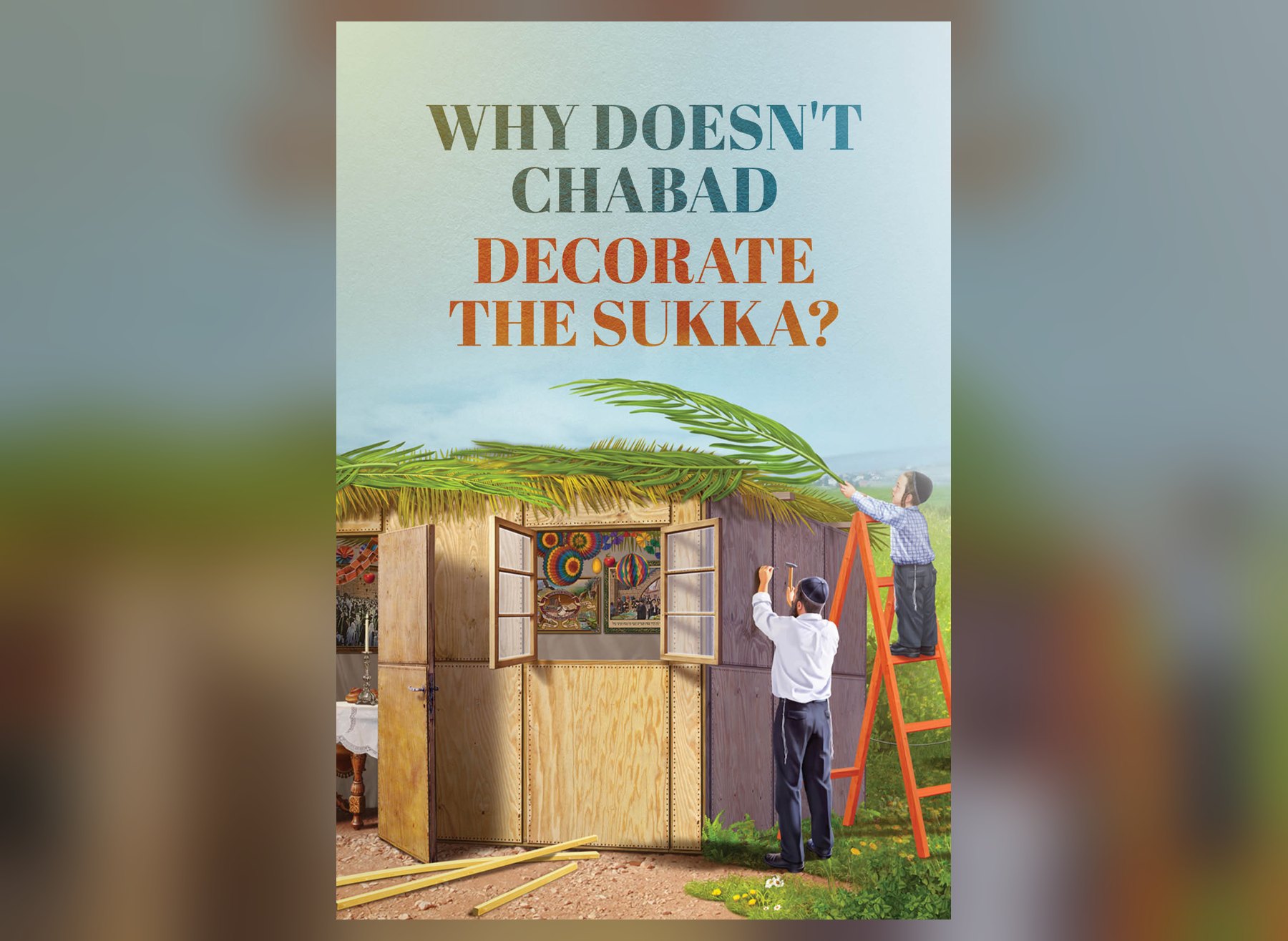
Why Doesn’t Chabad Decorate the Sukka?
A. The Custom and Its Source
The Gemara in Tractate Sukka (10a) discusses the issue of noi sukka – sukka decorations, based on the Mishna which states that one who spreads a sheet over the sukka to provide shade from the sun, or spreads a sheet under the schach to catch falling leaves – the sukka is pasul (invalid). However, Rav Chisda comments in the Gemara that if one spreads the sheet to beautify the sukka – the sukka is kosher.
The Gemara then brings the following beraisa: “If one roofed it properly and decorated it [the sukka] with embroidered hangings [Rashi: woven work such as colored garments] and sheets with figures woven into them [Rashi: with protruding designs like embroidery or weaving], and hung in it nuts, almonds, peaches and pomegranates, grape clusters and wreaths of grain stalks, wines, oils [Rashi: placed in glass cups for decoration] and flour, it is forbidden to use them until the conclusion of the last festival day of the holiday, and if he stipulated about them, all is according to his stipulated condition.”
The Sefer of Minhagim of Maharil (Laws of Sukkos) states: “And one must beautify it. And the Ashkenazic custom is a fine one, to spread sheets for decoration and to bring their vessels there. And for this reason as well, they make a wreath decorated with fruits and hang it inside the sukka. And it is called in the language of the Sages ‘noi sukka’.”
The Shelah wrote regarding this: “From here [this Gemara] it appears that this was their custom, to cherish the mitzva of sukka and beautify it with embroidered hangings and sheets and to hang in it notable fruits. Therefore it is proper to do so, and whoever increases in this is praiseworthy.”
And Rabbi Moshe ben Machir in his Seder HaYom (Seder Mitzvas Sukka) writes: “They are also meticulous to beautify it with everything that is beautiful for it, and this is the essence of all mitzvos – that a person should be happy and cheerful to merit in its performance, to the point that because of this he adds good things beyond what he was commanded, due to cherishing the mitzva.”
The Alter Rebbe’s Shulchan Aruch also mentions this custom: “And the world has the custom that all valuable items are hung in the sukka for decoration, such as decorated sheets and the like.”
B. Types of Decorations
In light of the above, many Jewish communities throughout the generations have practiced adorning and beautifying the sukka with various types of decorations: Some had the custom to hang in the sukka the seven species for which Eretz Yisrael is praised, based on the words of the Gemara (mentioned above in Maseches Sukka), which mentions grapes, pomegranates and olives [oil]. Some do so based on the words of the Arizal who says that the seven species correspond to the seven ushpizin (and other reasons were given for this as well).
Some had the custom to hang an esrog and explained that this is the only sukka decoration included in the mitzva of “This is my G-d and I will glorify Him,” since in the entire Torah we do not find the word “hadar” [beautiful] written except regarding the esrog which is called “pri eitz hadar.” Some had the custom to hang apples as sukka decorations and this custom is even mentioned in the “Customs of the Maharil,” and some had the custom to hang in glass vessels (small bottles): oil, wine, water and flour, and explained that this is done in remembrance of the menachos and nesachim that were offered in the Beis HaMikdash, especially the water which is closely connected to the mitzva of nisuch ha’mayim and the Simchas Beis HaShoeiva.
Some had the custom to hang in the sukka a decoration in the shape of a bird made from an eggshell or wax, and considered it especially important among the sukka decorations. And many more such customs were practiced in Jewish communities, including hanging fabrics (carpets, curtains and the like) decorated with beautiful flowers on the walls, and of course the popular “paper decorations” in various shapes and colors. In the courts of Admorim, the Chassidim would spend large sums on sukka decorations, and would decorate the Admor’s sukka with expensive ornaments. There were places that even brought special decorations from abroad for this purpose.
C. Halachic Caution
However, it should be noted that there are those who objected to the use of some of the aforementioned sukka decorations with various claims and arguments, including halachic ones. For example:
In the sefer Teshuvos V’Hanhagos (by Rabbi Sternbuch) he wrote: “What they added in recent times for decoration – to use lots of colored paper for decoration with paper chains, which is not done indoors in nice homes, it seems that this has no basis in the Shas and poskim, and I am concerned that they saw this among non-Jews who do this for decoration and they do so in the sukka among us, and I do not know if in this [there is an indication of] cherishing of the mitzva and that the sukka is pleasant to him.”
In Sefer Chassidim by Rabi Yehuda HaChassid (section 263) it states: “They said to someone, ‘Behold, many hang sukka decorations and you do not hang?’ And he said to them, ‘What is the benefit? The children will tear off the fruits, and the strings that the fruits hang from are torn on Shabbos, it is better that they do not sin because of me.’”
When Rabbi Avrohom Aharon Price published “Sefer Chassidim” with his commentary “Mishnas Avraham,” he was puzzled by this and raised the question:
“This requires examination – what Shabbos desecration is there in this, for there is no plucking here from something attached?” Rabbi Price then goes on at length to explain the matter with various explanations.
But it is interesting to note, that when he sent his sefer to the Rebbe, the Rebbe responded to him with brief comments on several matters including this one and explained simply (Igros Kodesh Vol. 11 p. 295): “The sin in this – one can say simply that it is moving muktzeh (and eating it) and untying a knot – I have now seen in Hagahos Mishnas Chassidim that he references Magen Avraham section 638, and Pri Megadim there. – See also Shulchan Aruch of the Alter Rebbe there section 18.”
[In other works they also warn about sukka decorations that are not kosher for schach that are hung under the schach – that it should not be too wide; the measure of its closeness to the schach; removing it on Shabbos. And more].
D. Reason for the Custom to Hang Sukka Decorations
From what is described above, it turns out that the custom to decorate the sukka was already practiced in the time of the Tannaim and Amoraim, and continued throughout all generations until our generation (albeit with some reservation – to be careful not to stumble in halachic prohibitions, as mentioned above).
The idea behind the custom to hang sukka decorations is apparently based on two directives of Chazal: 1) In Maseches Shabbos (133b) the Gemara learns from the pasuk (Shemos 15:2) “This is my G-d and I will glorify Him” – “Beautify yourself before Him in mitzvos.” That is, a mitzva should be performed in a beautiful, enhanced and praiseworthy manner. Therefore, one must also beautify and decorate the sukka. 2) In Maseches Sukka (28b) the Gemara learns from the pasuk (Vayikra 23:42) “You shall dwell in sukkos” – “Teishvu k’ein taduru [dwell as you live].” That is: Just as a person normally lives in his house, so should he fulfill the mitzva of dwelling in the sukka. Therefore, just as he beautifies his house, so should he act with his sukka.
E. Minhag Chabad
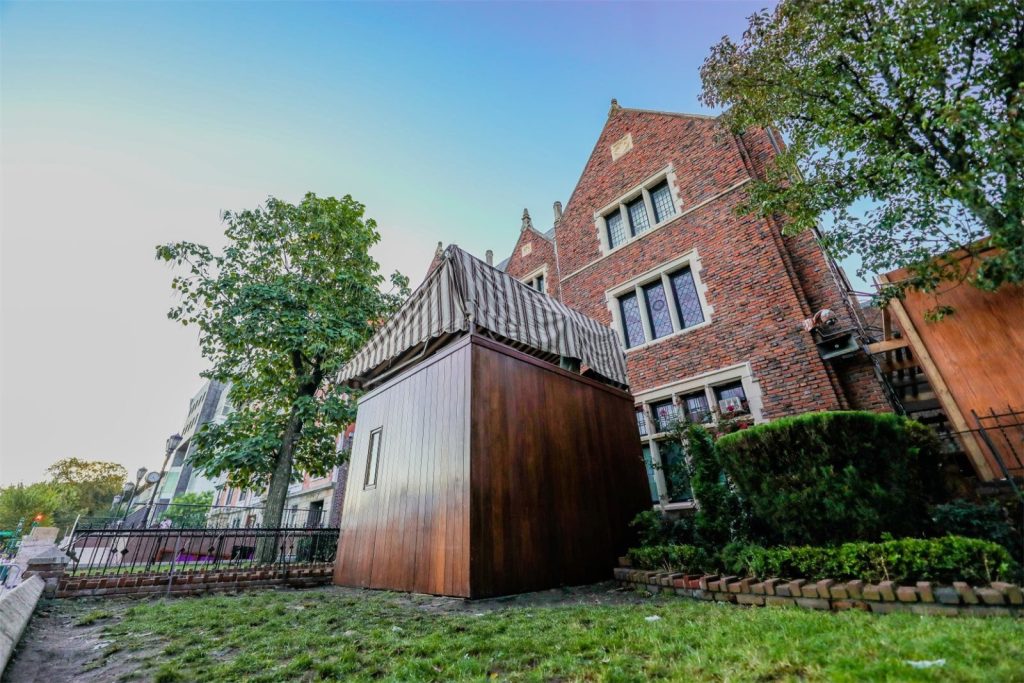
In Sefer HaMinhagim – Chabad, in the customs of Sukkos it is written: “Our custom is not to use sukka decorations.” And similarly the Rebbe wrote in HaYom Yom part two (which was not printed): “In Lubavitch they did not have the custom of decorating the sukka, neither hanging on the schach nor on the walls” [and this is based on the sicha of the Rebbe Rayatz, as will be discussed below].
Based on all that is mentioned and described above, a great wonder arises regarding our custom: Is it possible to disregard what is explicit in the Mishna, in the Gemara, and in what was brought as halacha l’maaseh even in the Alter Rebbe’s Shulchan Aruch?
The Rebbe himself expressed this wonder on the night of the first day of Sukkos 5730, and this is what is recounted: One of those present at the Yom Tov meal (which was held in the Rebbe Rayatz’s sukka) turned to the Rebbe and asked: Why regarding sukka decorations is it explicitly written in Sefer HaMinhagim that “our custom is not to use sukka decorations,” while regarding sleeping in the sukka it is not explicitly written that it is not our custom to do so?
And the Rebbe answered: Regarding sukka decorations I heard explicitly from my father-in-law the Rebbe, “It is not our custom,” whereas regarding sleeping in the sukka the language was that the Mitteler Rebbe said: “Vi ken men shloffen in makifim d’binah?!” [How can one sleep in the encompassing lights of binah?!]. And following this the Rebbe said: “Also our custom regarding sukka decorations is a great wonder, for this matter is mentioned explicitly in the Gemara!”
[Before we turn to see the explanation of the matter, we should note that the Chabad custom not to decorate the sukka was not so well-known in previous generations and there were Chassidim who did not know about it, and when it became known in our generation it was truly a chiddush. Here is an example from what was recounted by family members of the mashpia Rabbi Dovid Goldberg, one of the esteemed Chabad Chassidim in Yerushalayim:
“The absence of sukka decorations in Chabad had not yet reached the awareness of the people of Yerushalayim. Saba invested his time and energy and prepared sukka decorations with artistry and precision that no one succeeded in imitating. Every year he loved to innovate and add another decoration. When we learned that the Chabad custom is not to make sukka decorations, he of course stopped preparing and placing sukka decorations”].
F. Explanation of Our Custom
Following the Rebbe’s words during the meal on the night of the first day of Sukkos, the Rebbe addressed this and explained this topic at length in talks that were said afterwards on Sukkos and Simchas Torah of that year (5730). Here is a brief summary of what he said:
Between “Taduru” and “Hisnaeh B’mitzvos”
[1] Beautification of a mitzva is learned (in the Gemara Maseches Shabbos mentioned above) from the pasuk, “This is my G-d and I will glorify Him” and as the Gemara there states: “Beautify yourself before Him in mitzvos, make before Him a beautiful sukka, and a beautiful lulav, and a beautiful shofar, beautiful tzitzis, a beautiful Torah scroll, and write in it for His sake with beautiful ink, with a beautiful quill, with a skilled scribe, etc.”
That is: In the mitzva itself one must add and beautify, to beautify the mitzva itself! Beautiful tzitzis, or that the parchment should be more beautiful and superior and likewise the ink that one writes with, and so too with other mitzvos.
And similarly it is understood in this case: Beautification of a mitzva is in the body of the mitzva itself, that the sukka itself should be beautiful and pretty – from superior wood and the like. But not that the beautification should be expressed in external decorations (and side matters), for this has nothing to do with the definition of “beautification of a mitzva” which is in the essence of the object of the mitzva. The beautification of the sukka needs to be in the body of the sukka, and not through external things, which may even distract from the main mitzva (as will be discussed below).
[2] However, with sukka decorations there is an additional matter, which is learned (in the Gemara Maseches Sukka mentioned above) from “You shall dwell in sukkos” – “Teishvu k’ein taduru [dwell as you live],” from which we learn that a person should establish his temporary sukka as his permanent dwelling. “How so? If he had nice vessels he brings them up to the sukka, nice bedding he brings them up to the sukka, he eats and drinks and relaxes in the sukka and studies in the sukka.”
From this stems also the custom of hanging sukka decorations, in order to turn the temporary sukka into a nice place – “k’ein taduru.” But from this very definition it is understood that this depends on each individual according to his measure. There are those who need external decorations in order to turn the sukka into a nice house, and there are those for whom this is not necessary.
That the Mitzva Itself Should be Cherished by the Person
[3] According to this, the Chabad custom not to decorate the sukka with external decorations is explained, for Chabad Chassidus is all about teaching that the mitzva itself, as it is, should be cherished by the person. That the Jew should toil and work on himself that he should feel the holiness of the sukka, to the point that an external thing cannot constitute an addition to the sukka for him.
External Beauty Cannot Beautify a Mitzva
[4] In addition to this: According to what is explained here, one can say that not only is there no positive aspect in sukka decorations, but on the contrary there is reason to nix it. Since the schach and walls are the mitzva of Hashem, the schach itself certainly has kedusha from the Torah. Regarding the sukka it says “a festival to Hashem” and the Gemara says (Sukka 9a, Beitzah 30b) that this is like the kedusha of the korban chagiga when the Beis HaMikdash existed [and note, that this is the only thing that can be outside Eretz Yisrael, and in the time of galus, and at night, that should have the kedusha of a korban], and also the walls have kedusha m’derabanan. Would one think of taking something of “reshus” [optional] and use it to beautify the mitzva?
A sukka that has “ah gevaldige kedushah,” the kedusha of a korban, we should beautify with a beautiful garment or fruit?! When a person uses superior parchment and ink for writing a Torah scroll, he is fulfilling the mitzva of writing a Torah scroll in a more beautiful manner; and likewise when he takes a nicer garment and gives it to a poor person (“When you see… and you shall cover him”), he is fulfilling the mitzva of tzedaka in a more beautiful manner, etc.
(And this is also seen in the language of the Rambam (Hilchos Issurei Mizbeiach) “He should bring his korban from the nicest, most superior of that species” – and not that he should add something else external). This is not the case here, the sukka is already built and standing and everything about it is already present, so by taking beautiful clothing (not holy clothing, but physically beautiful clothing, which he likes) will he add to the mitzva?
The Difference Between the Early Generations and Later Generations
As far as what the Gemara tells about the noi sukka that was hung in the sukkos of the Tannaim and Amoraim, this is not proof that it should be the same for us – because there is a significant difference between the earlier generations and the later generations.
For them, they truly sensed that it wasn’t that the sukka became more beautiful by having beautiful fruit hung on it, but rather that the fruit was completely nullified to the sukka, becoming part of it (and in the same way as a beautiful Sefer Torah, here the walls and the schach itself became more beautiful). If so, for them, the beauty of the sukka was in the mitzva itself.
But for those who cannot reach this level, and the clothing or beautiful fruit takes precedence for them, it is possible that a person enters the sukka and instead of paying attention to the sukka itself, they look at the decorations. It turns out that the embellishment does not enhance the sukka; rather, it distracts from the sukka itself. Therefore, there is a reason to refrain from hanging decorations in the sukka.
(Consequently it is understood that, on the one hand, there is a source in the Shulchan Aruch for the beautification of the sukka, and on the other hand, not everyone is expected to do so.)
It is also understood that although a person may hang a nice curtain in their home to beautify it, they would not do so in their sukka, despite the principle of “you shall dwell in the sukka as you dwell in your home.” This is because the house does not have the kedusha of a korban chagiga, while the sukka does, and it is not appropriate to say that a beautiful curtain would make it more attractive.) Up to here is the content of his holy words.
Let’s summarize briefly:
In earlier generations, when they were on a high spiritual level, the decorations and embellishments did not distract them from the spiritual beauty; rather, they became a part of it (their ancient custom is indeed the source for the halacha in the Shulchan Aruch regarding hanging decorations in a sukka).
However, the Chabad Rebbeim draw our attention to the fact that in recent generations we do not stand on the spiritual level of our ancestors (and naturally, it is the external beauty that captures our attention), and therefore, we must be particularly careful and focus on the true beauty of the sukka, the beauty of holiness and spirituality. Therefore, we must avoid any external decoration or ornamentation that could distract us from the great kedusha of the sukka.
G. “The One Sitting in the Sukka is the Noi Sukka!”

According to this, we can understand an interesting saying by the Rabbi Rayatz.
On the night of the first day of Sukkos in 5704/1943, the Rebbe Rayatz spoke about the beauty of the sukka. Here is what he said as was printed in the Sefer HaSichos:
Question [that the Rebbe, asked his father-in-law, the Rebbe Rayatz]: Is it customary in Lubavitch to beautify the sukka?
And the Rebbe Rayatz answered: In Lubavitch, they did not decorate the sukka, neither under the schach nor on the walls of the sukka. Once, the Chassid, Rabbi Zalka Persitz from Moscow brought an artificial bunch of grapes to hang in the sukka, but they did not hang it. “By my father the Rebbe [Rashab], the beauty of the sukka was the person who sits in the sukka.”
The words of the Rebbe Rayatz that “the one sitting in the sukka is the beauty of the sukka” sound like some abstract Chassidic saying, which has no connection to the halachic definition of the beauty of the sukka – can a person really be considered “the beauty of the sukka?”
But after the explanation of the Rebbe, we discover a deeper meaning in the words of Rabbi Rayatz – that it indeed depends on the person themselves to feel the sanctity of the sukka itself, to the extent of complete bittul and unity with the mitzva of sukka, so that they truly embody the beauty of the sukka (as explained above, the enhancement is in the mitzva itself and not in the external matters that are secondary to it).
H. A Different Sort of Noi Sukka
In other sources we discover different types of noi sukka – not just decorations of shiny paper or fruit, but a “higher” embellishment – something more spiritual.
[1] What was mentioned previously, about what the Rebbe Rayatz revealed that “the one who sits in the sukka is the adornment of the sukka.”
[2] Simple Jews who cause joy Above – On the night of the first day of Sukkos in 5706/1945, the Rebbe Rayatz said: Our teacher, the Baal Shem Tov, said, “The beauty of my sukka is the simple Jews who accept the yoke [of heaven] and bring joy above with the joy of their mitzva stemming from simple faith.”
[3] That a Jew should not go hungry – it is told about the righteous Rabbi Chaim of Sanz that he would not allow his followers to waste money on decorating their sukkos and would even express his displeasure about it. The money from the pidyonos he received after Yom Kippur he would distribute before Sukkos to the poor for what they needed for Yom Tov, while his sukka remained simple and its walls bare. He would say: “The beauty of a sukka is that the poor won’t go hungry during the holiday!”
[4] Inviting another Jew into the sukka – In a conversation on the 13th of Tishrei 5737, the Rebbe said (translated from the Yiddish): “The sukka campaign is to enable as many Jews as possible to fulfill the mitzva of sukka, which is the true beautification of the sukka that he will have – the moment that he invites another Jew into his sukka.”
Parenthetically, it should be noted:
During one of the meals on Sukkos 5721/1960, the Rav of Kfar Chabad, Rabbi Shneur Zalman Garelik, asked the Rebbe: Why is noi sukka not our minhag? In response to his question, the Rebbe answered (differently from the above): “The matter of the sukka is a temporary dwelling, and if it has adornment, it will be like a permanent dwelling.”
Beis Moshiach #1430 • pp. 42-49
© 2026 Beis Moshiach Magazine. All rights reserved.
This article originally appeared in Beis Moshiach #1430. You are welcome to share it with friends and family by email or in print, provided that you do not change, add to or omit any part of it, you credit the author and Beis Moshiach, and you include a link to archive.bmoshiach.org (written out in full in printed copies).
To republish this article in a newspaper, magazine, book or website, please request permission in advance at [email protected].