The Stranger at the Door (4)
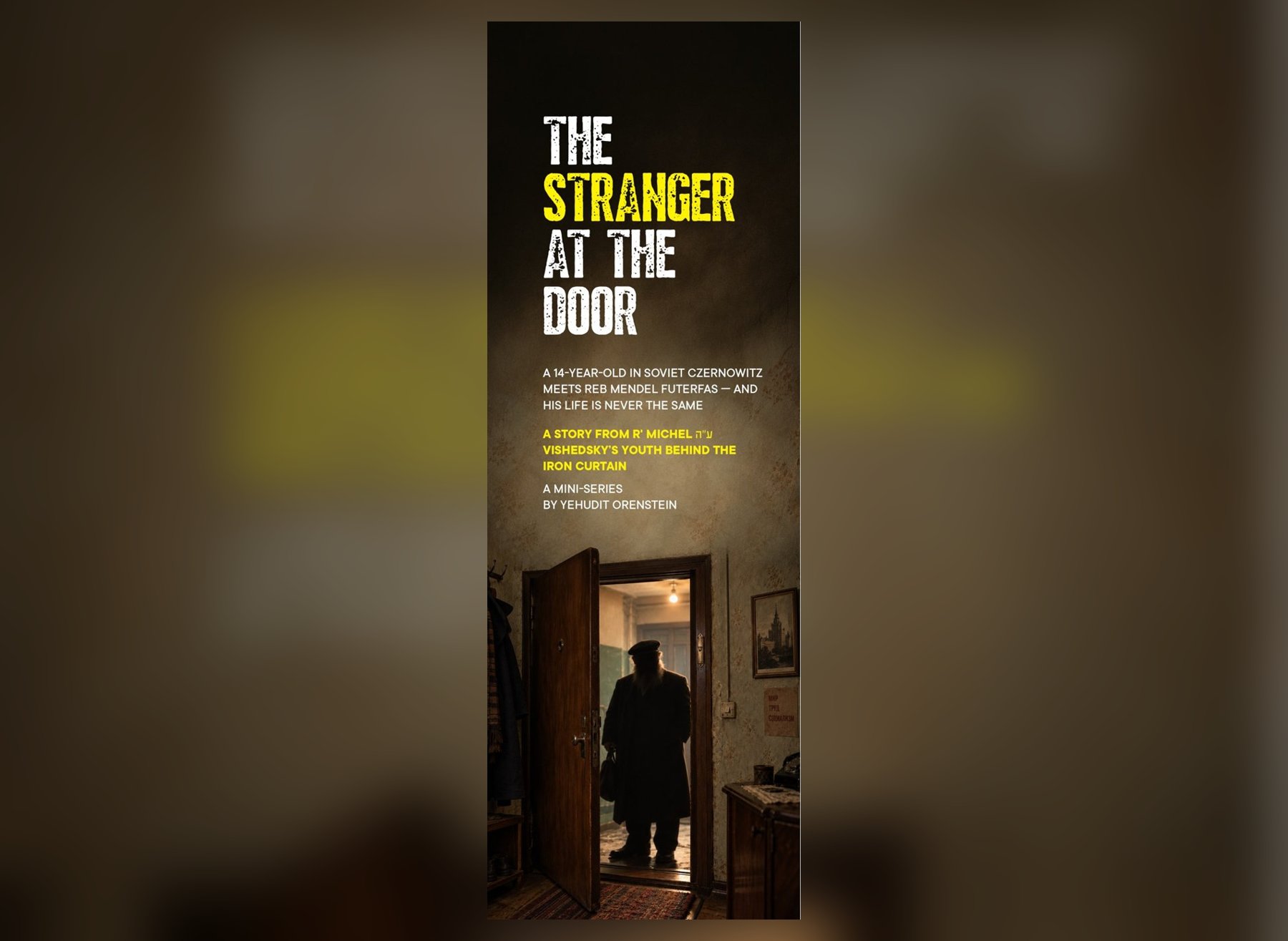
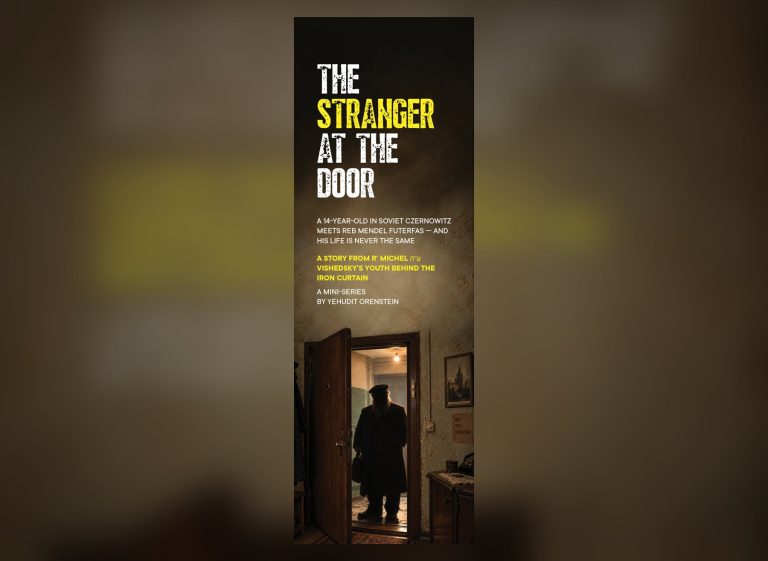
A 14-year-old in Soviet Czernowitz meets Reb Mendel Futerfas — and his life is never the same. A story from R’ Michel Vishedsky’s youth behind the Iron Curtain.
Previously: Michel’s first day working for Yashchuk is nothing like he imagined — hours of backbreaking pipe-digging, a dizzy spell from exhaustion, and an unexpected save when Michel talks a furious neighbor down using nothing but a gentle word. He staggers home that night having missed his Chassidus learning for the first time since his father returned from prison.
L’chaim
Czernowitz, 5717 (1957), after a year of working for Yashchuk. Age sixteen.
9:32 p.m. Yud-Beis Tammuz. The home of Rabbi Chaim-Shmuel Lebenhartz.
My hand presses down on the door handle. Sharp, black eyes lock onto me; they have to be Reb Mendel’s.
My own eyes move over the people at the table. He’s not on the side near the bookcase, and not at the head of the table either—that’s where Lebenhartz is sitting. My father, Reb Chaim Zalman Kozliner, and…
There he is! Motioning for me to come closer.
* * *
“Oh-ho!” His warm, strong hand clamps around my arm, near the elbow. “Sit next to me.” He pours Stolichnaya into an ordinary water glass, then raises his voice. “Now you come for Yud-Beis Tammuz?!”
I bring the glass to my lips. Oh, the smell…
“I came as soon as I could,” I say.
“Only now you could?” Reb Mendel pours me another glass. “Yud-Beis Tammuz! We’ve been here since five.”
Right—I have to finish the first glass. I empty my l’chaim in one shot, filling my mouth. Cold and bitterness shoot through it; I’m careful not to twist my face. No need to look like some misnaged who can’t handle a drink. It goes down. Warmth in my throat, seeping… Ah, it burns.
* * *
“I didn’t miss the whole farbrengen, just part of the farbrengen…” I wave a hand dismissively. “What’s so terrible?”
“What’s so terrible?!” Reb Mendel bangs on the table, and a dozen pairs of eyes lock onto him. “Oy…” he sighs. “If you weren’t learning so much history and mathematics, you would have come today and said to Yashchuk: ‘Yashchuk, today is a Yom Tov!’” Reb Mendel declares. “You have no shtoltzkeit [Inner strength, Yiddish]!” He bangs again. “And how does one get shtoltzkeit?”
Silence. Oh—perfect time to flush my l’chaim! I drink two glasses of water and add herring with a pickle. Reb Mendel’s gaze makes me stop midway through the second herring. How do you really get shtoltzkeit?
“You have to learn Chassidus,” answers Reb Chaim Zalman Kozliner, in my place.
“Ah!” Reb Mendel pours me a third glass. “So, Michel, why aren’t you learning Chassidus?”
“Reb Mendel?!” I protest. “I learn Chassidus with you in the afternoon.”
“First of all, even for that learning, you need a lot of prayers,” Reb Mendel scolds. “But what about you? ‘Perek echad ba’boker u’perek echad ba’erev’!” (One chapter in the morning, one chapter in the evening) His palm taps the table on morning and evening, underlining the words. “Why all that?!”
“I come home tired from work.”
“Ay, yay-yay… Mottel the fisherman was tired too—but he got up at four. He had shtoltzkeit!” Reb Mendel leans back, and I turn my chair to look him in the eyes. “If you had shtoltzkeit as well, you’d leave Yashchuk early and come to learn Chassidus. And anyway…” Reb Mendel pours me another glass. “Anyway, you have to say l’chaim, and take upon yourself that tomorrow you come home at five!”
“I can’t ask Yashchuk to let me go at five.”
“You must!”
* * *
A niggun. Ashrei mi she’lo chata, ashrei mi she’lo chata—Blessed is he who has never sinned. Bread with herring and a pickle. U’mi she’chata… and he who has sinned—l’chaim. U’mi she’chata yashuv, yashuv—and he who has sinned shall return, return… A whisper from Reb Mendel: This requires a decision of mesirus nefesh. Yashuv, v’yimchol lo—He will return, and will be forgiven.
* * *
“Michel, wake up!” Reb Mendel shakes my shoulder. “Do you know what Reb Itche der masmid said to the married men in his Chassidus shiur? Whoever misses—won’t live out the year!”
I almost throw up the herring. Won’t live out the year?! He’ll die before Rosh Hashana!
“I’m not on the level of Itche der masmid,” Reb Mendel smiles. “It’s okay. But still—you have to wake up!” He shakes my shoulder again. “Someone who doesn’t learn Chassidus is considered asleep, Michel. The ruchniyus affects gashmiyus.”
* * *
At two in the morning, my head droops onto my hand. My eyes are half closed.
Reb Mendel shakes me. “Michel, are you sleeping? Didn’t you hear what Reb Itche said?”
I turn my head to the side. He smiles.
“When I was your age, I used to go to the mashpia, Reb Zalman Meyshe, every day to learn, Michel,” he says quietly, just to me. “He had one loaf of bread a day, Michel. One a day! It was a time of hunger… And Reb Zalman Meyshe would cut the loaf in half—give half to the bachurim who came to learn, and half to his children,” Reb Mendel’s hand slips off my shoulder.
“Reb Mendel, do I look like a mashpia to you? Do I look like a yeshiva bachur?” My voice is low, my eyes downcast. “I’m a simple bachur, R’ Mendel. I have no shtoltzkeit,” I sigh. “I don’t have even a hundredth of that kind of mesirus nefesh.”
He nods. “Do you want such mesirus nefesh?”
“Of course.”
“For mesirus nefesh like that, you only need to decide that you’re coming home at five,” he says softly, like a secret. “You don’t need to think: How will I do it, what will I say…” He tilts his head from side to side. “You also don’t need to actually come home at five. You just need to decide, with all the absolute truth of the neshama, that you will come—”
“I can’t!”
His tone drops even further. “When a Jew truly takes on a hachlata tova, it has to work,” he says, and bangs on the table —for the third time that night.
* * *
A few more minutes pass. I stare into space; before my eyes stands Reb Zalman Meyshe, handing out slices of black bread to the people around the table. My slice slips from my hand. Oy…
I close my eyes. Tomorrow I’ll come home at five, the words echo in my head. Tomorrow I’ll come home at five, they ring in a dozen different voices—all the farbrengers of Czernowitz.
Will I really come home at five tomorrow?
I will come home at five tomorrow!
“I will come home at five tomorrow!” I shout, banging on the table with each word. “Tomorrow I’ll speak to Yashchuk!”
For inquiries, feedback about the story, or writing services (including magazine pieces, greetings, speechwriting, writing guidance, and life stories), please contact: Yehudit Orenstein +972-55-307-5722 [email protected]
Beis Moshiach #1527 • י״ב חשון תשפ״ז • pp. 30-33
© 2026 Beis Moshiach Magazine. All rights reserved.
This article originally appeared in Beis Moshiach #1527. You are welcome to share it with friends and family by email or in print, provided that you do not change, add to or omit any part of it, you credit the author and Beis Moshiach, and you include a link to archive.bmoshiach.org (written out in full in printed copies).
To republish this article in a newspaper, magazine, book or website, please request permission in advance at [email protected].