Ring of Fire, Circle of Light
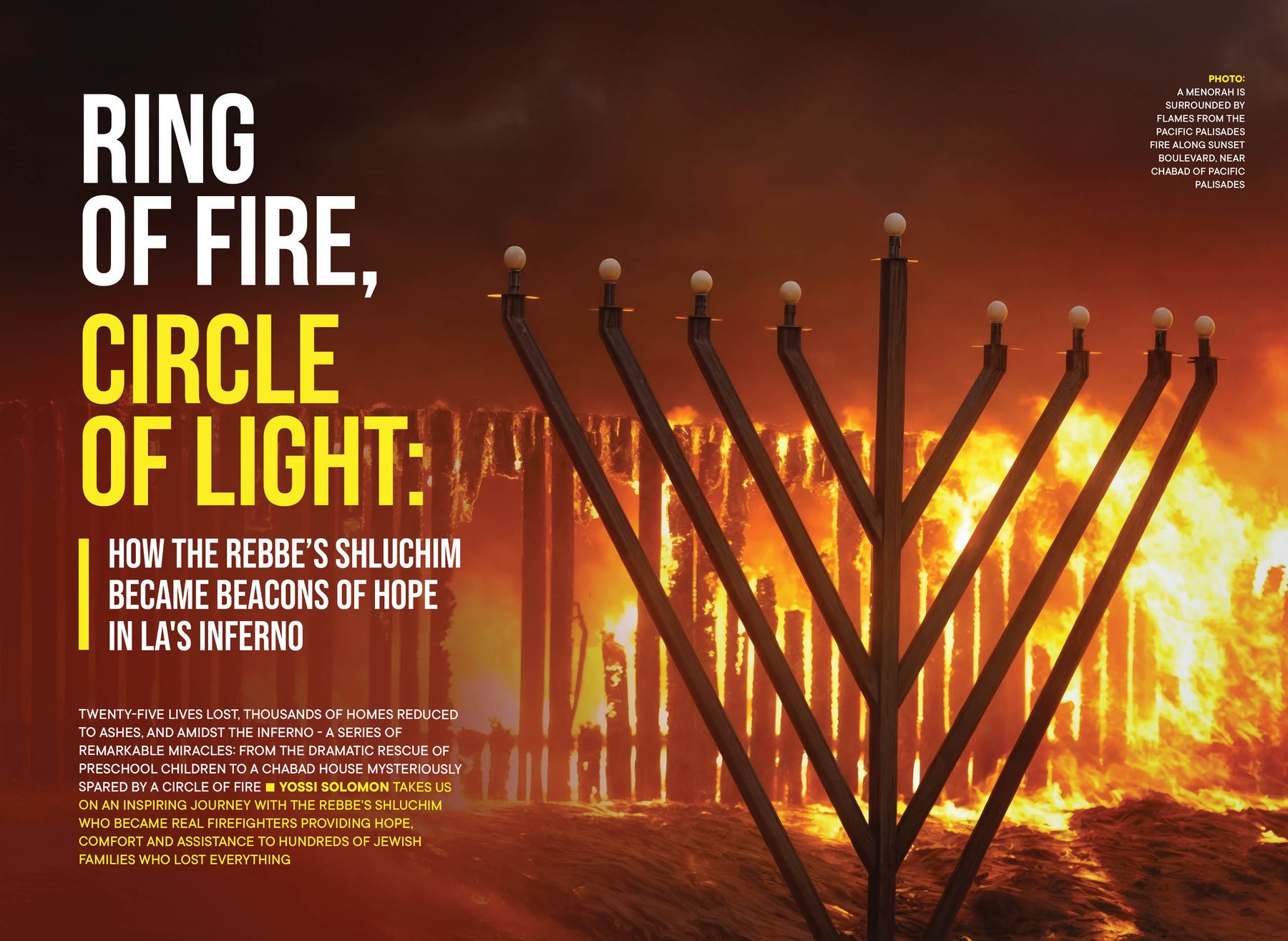
Twenty-five lives lost, thousands of homes reduced to ashes, and amidst the inferno – a series of remarkable miracles: from the dramatic rescue of preschool children to a Chabad House mysteriously spared by a circle of fire. Yossi Solomon takes us on an inspiring journey with the Rebbe’s shluchim who became real firefighters providing hope, comfort and assistance to hundreds of Jewish families who lost everything
The terrifying flames of the fire were reflected powerfully in the window of Mushka Lightstone’s home in the La Brea neighborhood of Los Angeles. The thick smoke began to spread through the streets, and the sound of fire engine sirens shook the air. In those moments of panic, when the evacuation order arrived and she was required to quickly decide what to take from her home, Mushka’s hands moved almost instinctively toward the Shabbos candlesticks.
These were decorated copper candlesticks, brought by her grandmother from a town in Ukraine and passed down through the generations. They carried with them a story of a hundred years of Jewish history. “There is something so symbolic in this choice,” shared her son, Rabbi Mordechai Lightstone. “Just like in the shtetl in Eastern Europe, when the fire came near and people had to flee, the Jews grabbed the tallis, the tefillin, and the Shabbos leichter.”
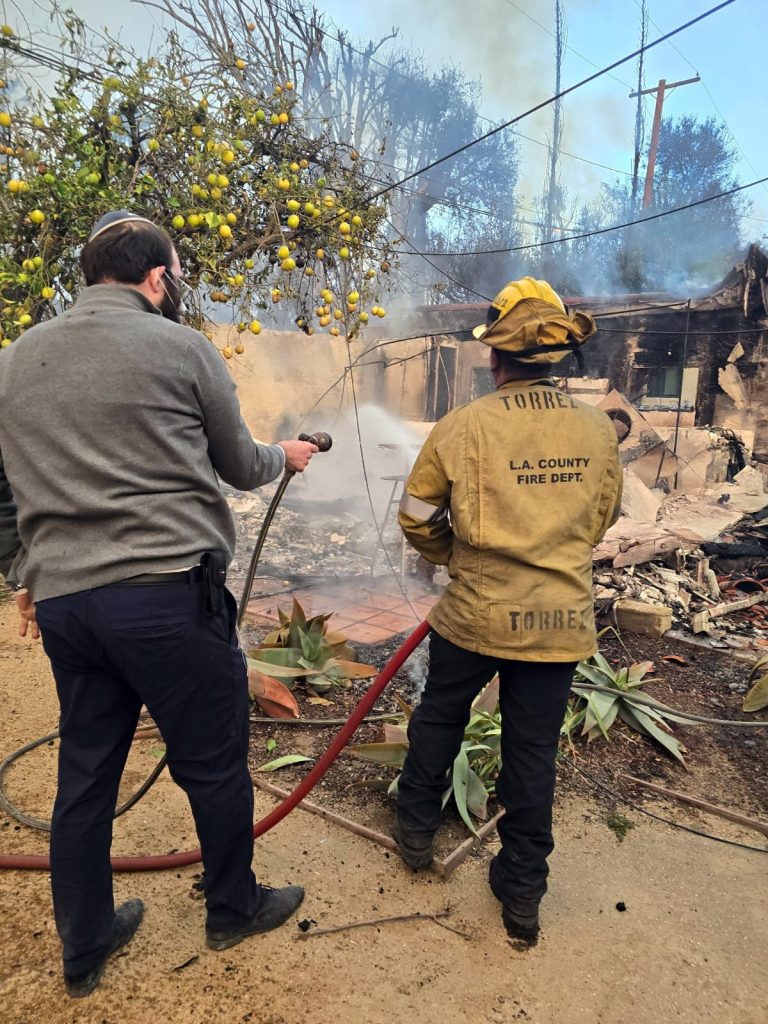
The scenes witnessed last week in Los Angeles unexpectedly echoed those historical moments: Jews fleeing their homes, holding the holy objects dearest to them. In many communities, members were seen leaving the shul with Sifrei Torah in their hands, moving away from the danger zone.
“Physical things come and go, but spirituality is what sustains us,” says R’ Lightstone, as he watches videos of the burning hills his mother sent him on WhatsApp. He knew these hills well, the same hills where he spent his childhood, watching the pink sunsets, now consumed by massive flames. But amid the chaos of the rushed evacuation, the Shabbos candlesticks his mother saved symbolize that small light that continues to shine even in the greatest darkness.
This story is one of many that unfolded during the dramatic days of the Great Los Angeles Fire, which, as of the writing of this article, has not yet ended. It has already destroyed more than 10,000 buildings, claimed the lives of twenty-five people, and forced around 180,000 residents to evacuate their homes, with an additional 200,000 under evacuation warning. Yet, in these moments of crisis, the unique strength of the Jewish community was revealed, particularly the shluchim of the Rebbe in California, who worked tirelessly to save lives and property and, most importantly, to preserve the Jewish spark that continues to burn even within the flames.
Shlichus Under Fire
The skies of Los Angeles are usually clear and blue, but these days they are covered by a yellowish-gray smoke blanket. The wails of sirens remind everyone that the city is in a state of emergency. On the way to Pasadena, to the Chabad House of Rabbi Zushi Rivkin, groups of Chabad, volunteers are seen distributing water bottles. Another day in burning Los Angeles.
In the early hours of Tuesday morning, nothing hinted at the drama that was about to unfold in Los Angeles. R’ Zushi Rivkin, the Rebbe’s shliach in Pasadena, began his day as usual – Shacharis with a minyan, preparations for the weekly Tanya class. Strong winds were blowing in the area, but that’s a common phenomenon in California. Even when the first smoke appeared on the horizon, no one could yet fathom the magnitude of the disaster that was rapidly approaching.
By 6 PM, the flames were clearly visible on the nearby mountains, just five miles from R’ Rivkin’s home. “I started receiving messages from people living north of us who were evacuating their homes,” he recalls. “The fire and rescue teams had already begun evacuations.”
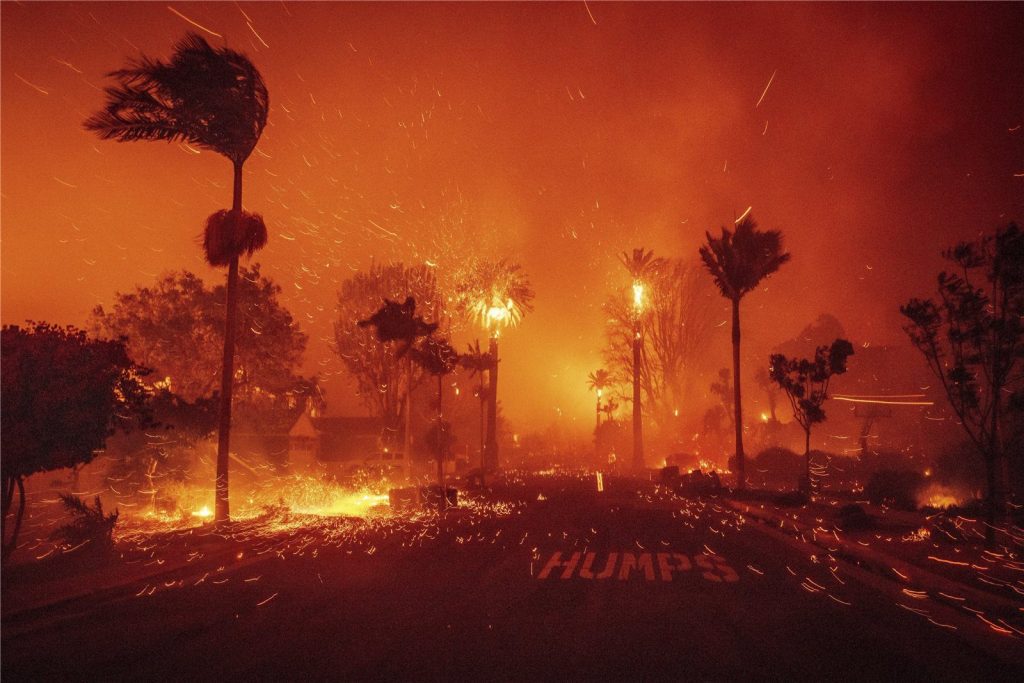
The scenes were horrifying. Massive flames over 50 feet high were devouring the skies, and thick smoke covered the city. The fire’s temperature reached hundreds of degrees – such intense heat that a two-ton metal statue melted completely… Homes and neighborhoods vanished as if they never existed, leaving only ash and soot behind.
R’ Rivkin realized there was no time to waste. He quickly organized an emergency response of the Rebbe’s shluchim in the area. “I called the catering service and asked for four hundred meals,” he recounts. “I knew people would need hot food.” Within hours, the shluchim’s homes turned into makeshift shelters, each hosting four or five people who had fled their homes.
That night was long and tense. Every half hour, the shluchim woke up to check the progress of the fire. The shocking numbers continued to rise: 10,000 homes burned, 130,000 people evacuated, twenty-five dead. But amid the chaos, the strength of the united Chabad community was revealed.
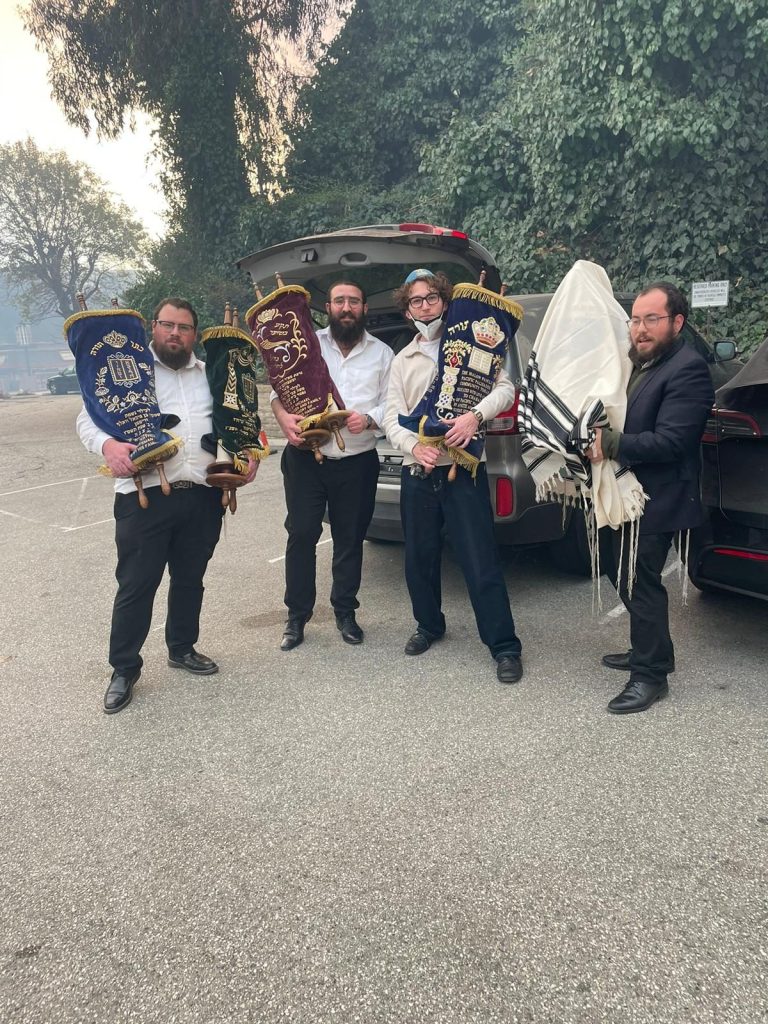
“In times like these, you understand what it truly means to be a shliach,” says R’ Rivkin. “It’s not just about teaching Torah or organizing events. It’s about being there for people in the hardest moment of their lives, being the address they turn to when everything around them is burning.”
Drama At The Chabad Kindergarten
“I have to leave!” The frantic voice of one of the mothers came through on the phone. “But I’m stuck in traffic and can’t get to the kindergarten!”
Minutes after the fire was detected near Rabbi Sholom Ber Diskin’s Chabad House in Pacific Palisades, a race against time began. The Chabad kindergarten housed almost one hundred toddlers, and the fire trucks filling the streets created massive traffic jams, preventing panicked parents from reaching their children.
The story began like any other day. At 11 AM, when the first smoke appeared, no one imagined the scale of the approaching disaster. “We saw smoke, but that’s not unusual for us,” recalls R’ Diskin. “There had been times before when we saw smoke from fires 150 miles away.” But within hours, the reality dramatically changed. The strong winds, blowing at speeds of nearly 65 miles an hour, turned the local fire into a raging beast that spread with frightening speed.
R’ Diskin stood at the entrance of the Chabad House, directing emergency operations. “I stood at the entrance and directed traffic,” he recalls. “It was crucial to avoid more traffic jams so parents could arrive as quickly as possible.”
Meanwhile, inside the kindergarten, the teachers tried to maintain as calm a routine as possible, despite the increasing smoke outside. The teachers showed remarkable courage – some of them knew their own homes were in danger, but they continued to care for the children until the last parent arrived.
The most complicated situation was with the smallest infants, those left in daycare before anyone had thought about the fire. “That was the scariest situation,” recalls one of the caregivers at the Chabad House. “We had babies whose parents had left them at daycare in the morning, before anyone even thought about the fire. When the flames came closer and the roads were blocked, the parents couldn’t get there. The phones wouldn’t stop ringing and we could hear the panic in their voices.”
In some cases, when parents couldn’t make it in time, the shluchim themselves took on the rescue mission. Rabbi Avrohom Moshe Cunin, for example, came to the aid of a mother who was stuck in traffic as the fire neared her car. “She had to abandon her car,” he recalls. “I drove there and brought her to safety.”
After successfully evacuating the kindergarten, R’ Diskin quickly rushed against time to save the Sifrei Toah and tashmishei kedusha from the Chabad shul.
When it became clear that the air was too polluted for the children to play outside, the kindergarten was closed for several days. But the work didn’t stop. “We held a meeting with the teachers and a psychologist,” says shlucha, Mrs. Gitty Rivkin. “We learned how to talk to children who have experienced trauma. We have two children in the preschool whose parents lost all their belongings in the fire.”
A few days later, when the situation had calmed down slightly, the staff organized a special outing for the preschool children. “We wanted to give them a chance to play together, to feel some normalcy,” explains Mrs. Rivkin. “We brought them food, clothes, but mostly – we gave them the feeling that someone cared for them.”
Chabad House Saved By A Miracle
The road to the Chabad House in Pacific Palisades passes through entire neighborhoods that have turned to ash. The charred skeletons of houses stand like black gravestones, silently telling the story of lives abruptly interrupted. But amid this destruction, the Chabad House stands almost untouched – a story of a miracle that’s hard to believe.
“The fire made a sort of circle around the Chabad House,” describes R’ Sholom Ber Diskin about the miracle in Pacific Palisades. “Naturally, there’s no reason or logic as to how it didn’t burn. The fire destroyed some classrooms and caused millions of dollars in damage, but the main building itself remained standing – it’s an open miracle!
“My private home burned to the ground,” he says sadly. “It took a day from the flames breaking out, but in the end, there was nothing left.” Despite this significant personal loss, R’ Diskin and his family continued to act tirelessly for the community. “This is what Hashem and the Rebbe want from us now,” he says simply.
His father-in-law, Rabbi Zushe Cunin, who has been the Rebbe’s shliach in the city for over thirty years, adds: “I was born and raised in California and have seen many fires, but this is truly unimaginable.” He points to the large menorahs at the Chabad House that were completely burned. “But the main thing is that everyone is safe and healthy.”
In the days following the fire, the Chabad House became a hub of assistance for the entire community. “We’re less focused on financial help,” explains R’ Diskin, “as this is a relatively wealthy area and people have resources. But we do provide something that is sometimes even more important – a smile, a hug, emotional support; the feeling that someone cares.”
The loss of their private homes actually made the shluchim more connected to the community. “When you go through the same thing yourself,” says R’ Diskin, “you understand others’ pain better. It’s not just the loss of walls and furniture – it’s the loss of memories, of a sense of security.”
But the miraculous rescue of the Chabad House itself gave everyone hope. “It’s as if Hashem said, ‘This place needs to continue shining,’” concludes R’ Cunin. “We can lose private homes, but everyone’s home – the Chabad House – remains standing. This is a message for us to continue our shlichus with greater vigor.”
‘The Brave Rabbis’ Fought The Fire
During the long nights of the fire, the Chabad House wasn’t the only thing to merit special divine providence. In the burning streets of Pasadena, another miracle occurred that demonstrates the wonderful combination of human resourcefulness and heavenly kindness.
“I was in the car with my brother-in-law, Rabbi Leibel Hanoka,” relates Rabbi Rivkin. “In another car were my father-in-law, Rabbi Chaim Hanoka, and a community member named Ofer. Although we drove separately, by amazing divine providence we arrived at exactly the same moment to a street where eighteen families lived.”
The sight that met their eyes was horrifying. The entire street was completely burned, except for two lone houses – one belonging to a non-Jew and one to a Jewish widow who was a mekureves of the Chabad House. “When we arrived at her house, we saw that the garage was starting to burn. We tried to use the water hose, but the water was disconnected… Suddenly, a brilliant idea came up – to use sand from the many planters in the yard. And so, turning over planter after planter, we managed to extinguish the fire. To this day she calls us ‘the brave rabbis.’”
A Community Of Kindness In Times Of Crisis
Evening falls on the disaster-stricken city. The setting sun paints the smoky skies in dramatic orange-red hues, as if the heavens themselves reflect the tragedy unfolding below. On the way to Hancock Park, the scenes change. Here, at a safe distance from the fire, an entire community has organized into an impressive aid operation. Volunteers unload trucks with water and food, small children help sort clothes donated from across the United States, and women cook in a makeshift kitchen. This is the story of a community that quickly united in times of crisis.
“You know what helps me cope the most?” asked psychologist Jeff Stein, who had just discovered his house had burned down. “Helping others…”
R’ Rivkin repeats this as an example of the special spirit that came to the fore in the community. “People didn’t want to receive help, they wanted to give it. Actually, when you let someone help others, that helps the most.”
Within a few days, an impressive aid system was organized. The Pasadena Chabad House became a logistics center, where hundreds of hot meals were distributed daily. “On the first day it was simple to provide hot food,” R’ Rivkin recalls. “By the second day we already needed to provide clothes; and when I say clothes, I’m talking about people who are used to wearing only clothes they buy themselves – so we arranged gift cards so they could shop for themselves…”
When it became clear that the contaminated tap water in Pasadena was undrinkable, the shluchim drove around distributing cases of water to hotels where evacuees were staying. But beyond physical needs, there was also a need for technical and administrative support. “We noticed that people whose homes burned down needed a new address for mail,” R’ Rivkin explains. “So we offered the Chabad House as a mailing address.”
But assistance wasn’t always about convenience or support. Sometimes, it was the difference between life and death. In one of the peak moments of drama, the heroism of community members themselves was revealed. “We had an elderly woman in an apartment building,” R’ Zushe Cunin recounts, “who was the only one unable to evacuate from the building. Rabbi Avi, a shul congregant who lived in the same building, took on the mission. While the flames approached, he calmly coordinated the rescue with emergency forces. They arrived at the very last moment. When I saw her safely descending from the rescue vehicle, I realized I had just witnessed a miracle with my own eyes!”
One idea was to connect families who had just lost their homes with those who had gone through a similar experience in the big S. Rosa fire in California eight years ago. “They could give the best tips and guidance from their personal experience. It gave people hope to see that it’s possible to recover and rebuild.”
The assistance extended beyond demographics. When the Conservative temple burned completely, the Rebbe’s shluchim extended a helping hand. “Their preschool burned down,” relates Mrs. Rivkin. “The families called us asking to accept their children into our preschool. Of course, we immediately worked with the authorities to make it possible.”
Even in the most difficult moments of crisis, the shluchim were careful to preserve the dignity of those needing help. “These are people who are used to giving, not receiving,” R’ Diskin explains. “We had to find a sensitive way to help without hurting their dignity.”
R’ Cunin summarizes: “In times like these you see the true beauty of community. It doesn’t matter what background you come from, it doesn’t matter how much money you have – everyone unites. This is what the Rebbe taught us – that every Jew is a diamond, and in times of crisis this diamond shines with all its intensity.”
High Tension In Hancock Park
From Pasadena we continue to the Hancock Park neighborhood. Here, although the fire hasn’t physically reached the area, the heavy smoke is felt in the air. This vibrant Jewish neighborhood, usually full of life and activity, is today shrouded in tension. The fire is raging less than three miles away, and residents live in constant fear that the wind might suddenly change direction, turning the flames toward them.
At the entrance of the ‘Maayon Yisroel’ institutions, I meet Rabbi Reuven Wolf. “Wednesday evening, the fire burned just a little over two miles from our area,” he relates. Fire services had already notified nearby areas to prepare for possible evacuation. “I decided to pack the most essential items – tefillin, Sefer Torah, and even the microphone for the weekly ‘Dvar Malchus’ lesson I give on Zoom watched by hundreds of people.”
R’ Wolf describes the tension that prevailed in those moments: “Although here in the neighborhood we didn’t receive an official evacuation notice, the WhatsApp groups were buzzing with activity. When I drove to the gas station, the place was full of people rushing to fill their vehicles fearing a mass exodus from the city. We all saw the fire burning in nearby Hollywood Hills.
“We had great hashgacha pratis,” he emphasizes. “The night before the fire there were very strong winds. If, G-d forbid, they had been blowing on the night of the fire, the flames could have reached us too. Hashem protected us.”
Hope Grows From The Ashes
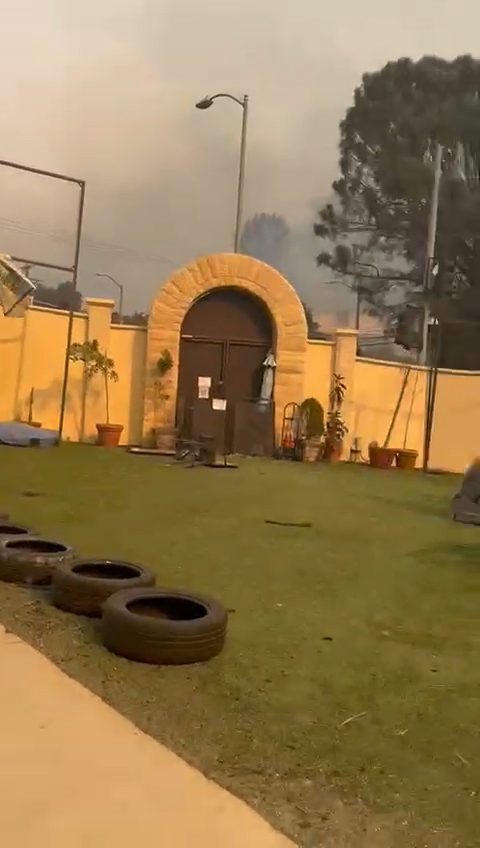
Though the fire has subsided in most areas, hearts are still burning. Emergency vehicles park in the streets, and volunteers move constantly between houses, distributing aid wherever possible.
On the way to the shul, where the community gathers for a unique Kabolas Shabbos and Maariv, we pass families hosting one another, proving that even within destruction, the Jewish community strengthens and unites.
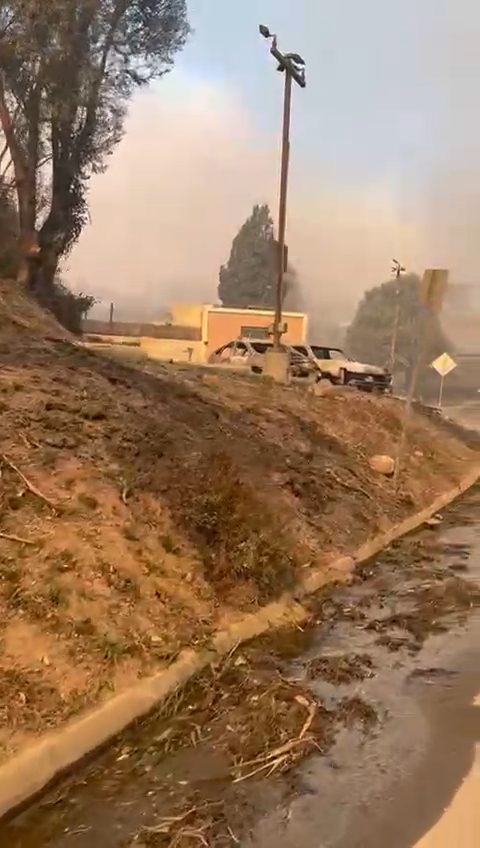
Within the chaos and loss, there were also moments of light. One of them was the special story of a bar mitzva boy who refused to let the great fire prevent the celebration of his entrance into the yoke of mitzvos.
“The original plan was to celebrate in Malibu,” the boy’s father relates. “But when the area was evacuated, we thought we’d have to postpone. Then R’ Rivkin arrived with the Sefer Torah he had saved from the Pasadena shul.” The event took place in a private home, surrounded by smoke and reports of the fire’s advance, but the atmosphere was especially uplifting. “It was symbolic,” says the Rabbi. “The very Sefer Torah that was saved from the fire was used to bring another Jewish child into the yoke of mitzvos. We saw this as a sign; life continues, tradition continues, and no fire in the world can extinguish the Jewish spark.”
“We don’t want this Shabbos to be one of depression,” R’ Rivkin declared to the congregants on Friday evening, while columns of smoke still rose from the charred houses around them. “We want this Shabbos to be full of hope.” Indeed, although many of the congregants had lost all their possessions – money, childhood memories, and important documents – the shul filled with song and niggunim, in a special atmosphere of faith and hope.
In the days following the fire, a new concept emerged in the community, the ‘emergency kit.’ “Everyone prepared a bag with the most essential items in case they needed to leave quickly,” R’ Rivkin explains. “Over Shabbos, we discussed the deeper meaning of this – being always ready for change, being able to leave material things behind and focus on what’s truly important.”
The community also mobilized for emotional support. “On Sunday we held a workshop with a psychologist,” R’ Rivkin relates. “People cried, shared, strengthened each other.” The shluchim themselves held personal conversations with community members, talking about faith and trust. “It’s a great challenge,” he admits. “To explain to someone that nothing bad comes from above, right after everything they invested in their whole life has burned.”
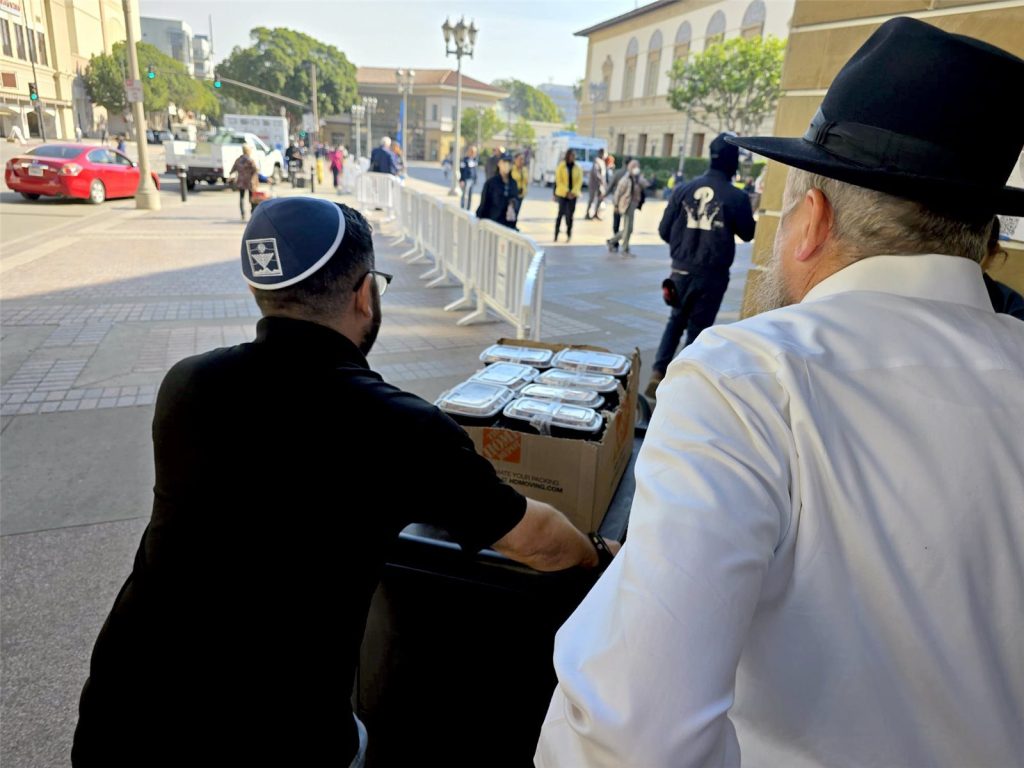
But especially from within the destruction, seedlings of hope emerged. Communities distant from one another, united. People who never thought they would need help discovered the warmth and love of a supportive community. “This whole week is one big miracle,” says R’ Rivkin. “While I can’t explain to people why their home burned, there’s no doubt that G-d is leading us to a better place.”
R’ Cunin concludes: “This fire has entered history as one of the most destructive California has known. But what will remain in memory is not the destruction, but rather the building; building connections between people, strengthening faith, and understanding that even when everything burns, the Jewish spark continues to burn.”
After the past week, Los Angeles looks completely different. Not just because of the scorched landscape and smoke that still rises here and there. Something deeper has changed. Among the ruins and ashes, between burned houses and blocked streets, a city was revealed where people rediscovered the inner meaning of community. Perhaps this is what the Rebbe meant when speaking about turning darkness into light; that precisely in the greatest moments of darkness, the light within each person is revealed.
When the Rebbe spoke of Geula, he always emphasized that it would come specifically from within darkness, “the advantage of light from darkness.” This is what we saw in Los Angeles this past week – how from within the great fire, specifically from within destruction and loss, the true power of the Jewish people is revealed: unity, faith, and light that can never be extinguished. Because ultimately, just as the fire couldn’t extinguish the light in the Chabad House, no force in the world can extinguish the divine spark that burns within every Jew; a spark destined to ignite into the flame of the true and complete Geula.
Beis Moshiach #1446 • pp. 24-33
© 2026 Beis Moshiach Magazine. All rights reserved.
This article originally appeared in Beis Moshiach #1446. You are welcome to share it with friends and family by email or in print, provided that you do not change, add to or omit any part of it, you credit the author and Beis Moshiach, and you include a link to archive.bmoshiach.org (written out in full in printed copies).
To republish this article in a newspaper, magazine, book or website, please request permission in advance at [email protected].