Shabbos & Sensors
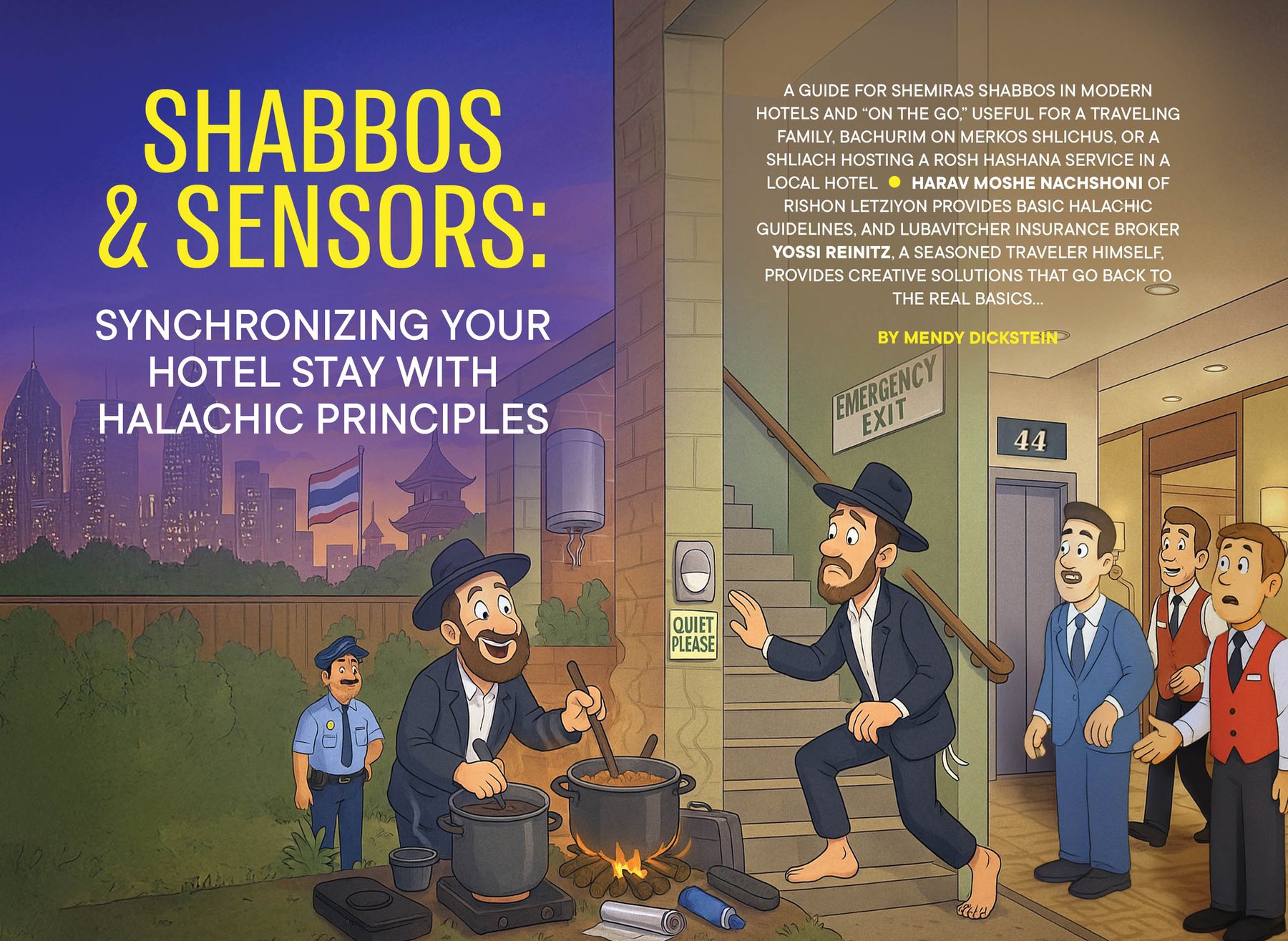
A guide for shemiras Shabbos in modern hotels and “on the go,” useful for a traveling family, bachurim on Merkos Shlichus, or a shliach hosting a Rosh Hashana service in a local hotel. Harav Moshe Nachshoni of Rishon Letziyon provides basic halachic guidelines, and Lubavitcher insurance broker Yossi Reinitz, a seasoned traveler himself, provides creative solutions that go back to the real basics…
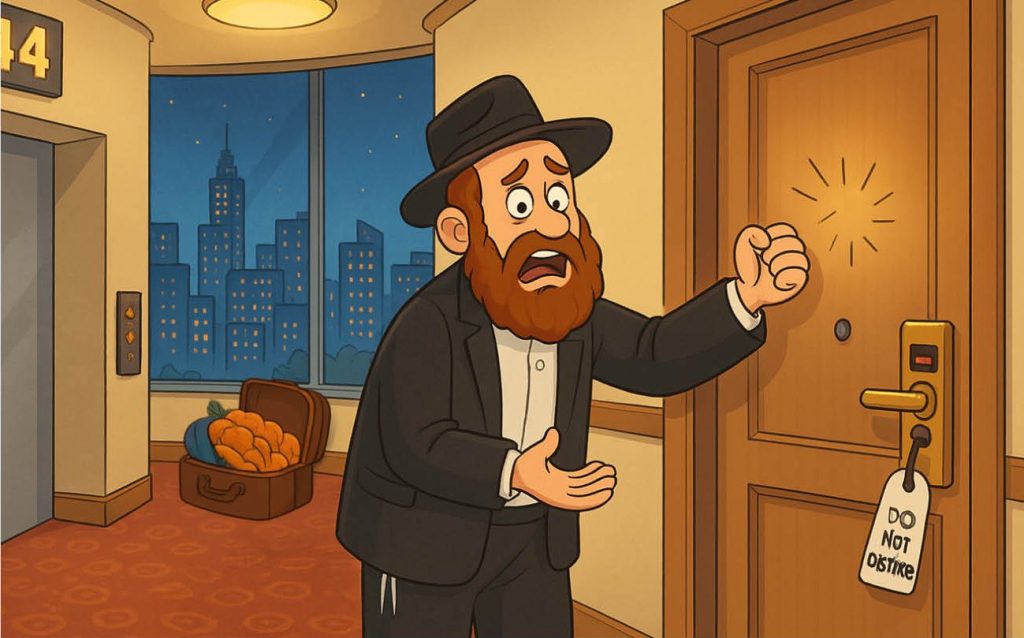
The clock shows 9:15 PM, the sun has long set behind Bangkok’s skyscrapers, and R’ Chaim the traveler, who stepped out of his room for a brief moment, found himself locked out of his room in a luxurious hotel in the heart of Thailand. His room’s electronic keycard left him stranded outside his room in the corridor of the 24th floor. Not only that, but the sensors that turned on the lights in the hallways prevented him from accessing the emergency stairwell when he wanted to go downstairs.
And so, knowing he couldn’t ask anyone for help, began one of the longest nights in the life of R’ Chaim, a veteran Yerushalmi traveler, who learned the hard way what it means to observe Shabbos in a hotel that wasn’t geared for it.
R’ Chaim’s story is not unusual. Tens of thousands of frum Jews from around the world travel abroad for vacation every year. Indeed, there’s a different atmosphere there, magical landscapes, rushing rivers, and breathtaking cliffs. There’s nothing like a change of scenery.
However, a significant portion of them discover, in the most difficult way, the unique challenges that observing Shabbos away from home presents.
Is there a way for a Jew – certainly one who observes Shabbos according to halacha – to go and “make Shabbos” in a hotel? What became a nightmare for R’ Chaim can become a pleasant and successful experience for someone who knows how to prepare properly and anticipate problems.
We spoke to a rabbinic authority entrusted with hotel kashrus supervision, namely the Gaon Rabbi Moshe Nachshoni, one of the rabbanim in Rishon Letziyon. We also spoke with Rabbi Yossi Reinitz, a Chabad insurance agent and renowned nature photographer who has accumulated many years of experience traveling around the world, and has personally experienced most of the problems that can arise. The stories in his repertoire could fill a heart-stopping thick book.
“My awareness of the challenges of observing Shabbos in hotels began the moment I started traveling to hotels,” he recounts. “Only when you come to a hotel on Shabbos do you begin to understand all the complexity inherent in this operation.”
I’ll start with the obvious question – is there a fundamental difference between hotels in Israel and hotels abroad?
“Generally, there’s no difference. Advanced technology is the source of problems for Shabbos observance. When I usually travel to places abroad that are considered more ‘third world’ and less technological, then naturally there are fewer problems on Shabbos because there’s less technology. If you stay in Europe or even in Israel in better hotels, that’s where the problems begin.”
The paradox is that the more advanced the hotel and the better, more pleasant and convenient service it offers, the greater the challenges for someone who observes Shabbos. Luxury hotels in Europe with advanced smart systems might be impossible to stay in on Shabbos, while a simple cabin in Africa might be completely comfortable.
What are the main problems that a hotel visitor encounters on Shabbos?
“The first and immediate problem that arises is the electronic keycard for rooms. Specifically in Israel, there are hotels where you can still ask them before Shabbos for a key to replace the electronic key. They take a credit card as collateral or ID, and give you a regular key (wait, we haven’t talked about eiruv problems yet). Most hotels in Israel are familiar with the problem and are willing to help, but abroad the situation is more complex.”
The common solution that Reinitz recommends is simple but effective: “Tape the lock tongue with tape so the door won’t close, and leave a ‘Do Not Disturb’ sign on the door handle on the outside. Of course, you need to make sure it’s strong tape, as there are locks with springs that are too strong…”
Like any creative solution, there are amusing stories here too. “Once I taped the tongue, and hotel staff who noticed this thought the lock was broken… When I came to the room, I found one of the hotel workers outside with a toolbox fixing the door,” he smiles.
In Israel, there’s still awareness of Shabbos and shomrei Shabbos. Do hotels abroad know how to cater to Shabbos observance?
Reinitz recalls one of the interesting stories he had, which happened in Hungary. “I corresponded with the hotel on their booking site, wrote that I want the option of a room with a regular key. The clerk answered that there’s no problem. Since I was afraid he didn’t understand my request, I clarified again that I’m talking about a simple metal key, not an electronic card and not a lock with codes. He answered again that there’s no problem.”
But when Yossi arrived at the place, he discovered there was still a digital code. “Half an hour later, a worker came with a toolbox, and with great skill dismantled the entire electronic lock, installed a regular lock, and finished the work saying: ‘I know you Jews have a problem with locks on Shabbos. I already know what you’re talking about, and I change electronic locks to manual ones almost every week…’”
Are there problems that still haven’t been resolved?
“Elevators,” says R’ Yossi forthrightly. “The only solution is to try to find lower floors.” From his perspective, Shabbos elevators are not a solution at all. This is why even in hotels abroad he uses only stairs.
But even stairs can become a problem… In China, for example, he encountered a strange situation: “Most stairs in hotels are emergency stairs (Which guest wants to go up or down stairs when there are fast elevators?). Therefore, the place is dark all the time. However, the moment someone goes up or down the stairs, there’s a sound sensor that picks up the noise of climbing and automatically turns on the electricity for you. The best solution I found for this is to go barefoot and walk slowly and quietly so as not to indirectly turn on the electricity…”
Sensors All Around
So far we’ve dealt with moments when the person-vacationer – who has already become almost a slave and not a person seeking rest and vacation – is at the stage before entering the room. Even if you got a regular key to the room, the problems haven’t ended. Sometimes they’re just beginning…
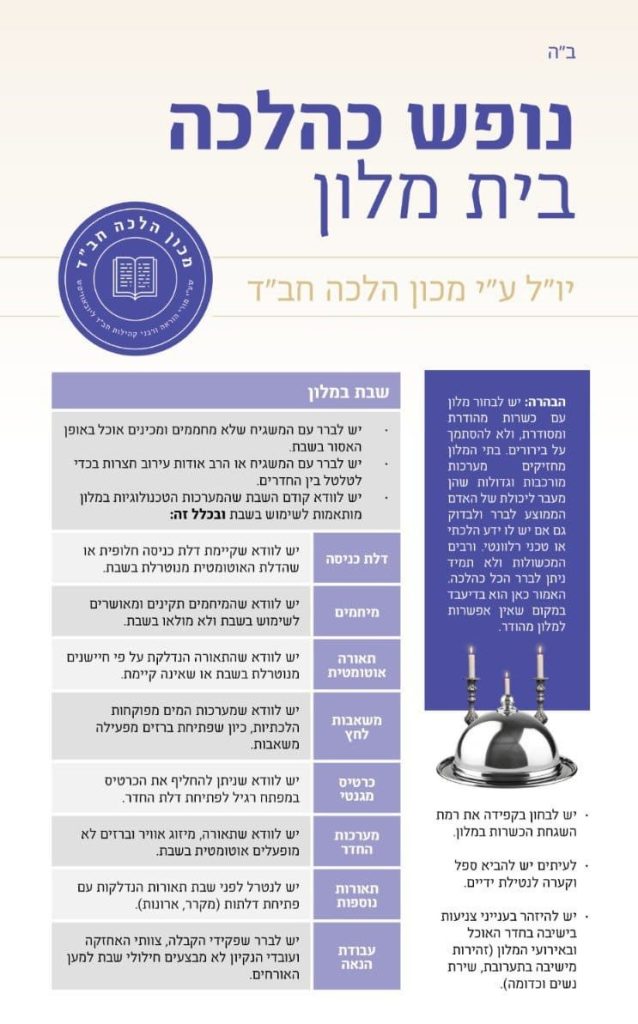
“In many places there are sensors in the room that ‘know’ if someone is moving around inside the room, and they adjust the room’s condition (air conditioning, lighting, etc.) to whoever is in it. Therefore, you need to ensure that the systems in the room work on ‘Shabbos mode,’ and that opening the room door doesn’t automatically turn on the air conditioning,” warns Reinitz.
“In many places, when you enter or leave the room, there are sensors that turn on the light and air conditioning for your convenience. There are also places where you need to insert the electronic card into its slot inside the room, because without it, the electricity in the room simply won’t turn on and the air conditioners won’t work.
“In certain places, there’s also a light in the clothes closet the moment you open the door, not to mention sensors in water faucets that activate water flow the moment they detect hands extended for washing. Even if you decided to be strict and stay in the room all Shabbos, in this case you won’t wash your hands all Shabbos?!”
What can really be done in such situations?
The technical solution requires advance preparation: “You need to bring ahead of time a kit containing aluminum foil, masking tape, or some strong adhesive. It’s best to close all these vulnerable points in advance. For this you need a lot of experience and familiarity with all the sensitive points.”
In general, Reinitz’s wise and experienced advice is advance planning:
“You need to visit the hotel and ask to see the room enough time before Shabbos, and during the visit go all around and check, and see all these things up close. It’s not a good idea showing up at the last minute.”
And if you found that it’s not possible to stay in the hotel without risking ‘confrontation’ with various sensors?
“Look for an alternative hotel…”
Much Thought Must Be Dedicated To Every Detail
Rabbi Moshe Nachshoni is a world expert in kashrus in general, and in vacation hospitality in particular. In a special conversation with Beis Moshiach he shares with us the essential halachic guidelines for the mitzva-observant traveler.
Rabbi Nachshoni presents from his extensive experience a complex and challenging picture of staying in a hotel on Shabbos. The central message is thorough advance planning and careful checking of all details. In many cases, the recommendation is to completely avoid staying in hotels on Shabbos, and only in cases of real necessity, to try to deal with the challenges while maintaining careful observance of halacha.
The rabbi’s guiding principle is: “Much thought must be dedicated to every detail. And when there’s doubt, it’s better to be strict and stay in the room rather than endanger shemiras Shabbos.”
What about staying in a hotel without kashrus in Israel or abroad, when the need is only to stay there without meals?
The Rav opens with a clear principle: “Even in cases where people come only for sleeping without needing meals, it’s preferable not to go to a place without a hechsher. But if you have a b’dieved situation with no other choice, you must be careful about every single detail with extra caution.”
Let’s start with the sensor problem. How can this be dealt with halachically?
“Today almost all hotels operate on sensors. When you enter or leave the room, the light and air conditioning turn on, the entire electrical system in the room is built on sensors.”
The halachic solution as proposed by the rabbi is “to speak to hotel staff in advance, and ask them to disconnect the systems, or ensure for ourselves that we don’t activate them. If you arrive at the hotel a few days before Shabbos, I recommend the traveler make a note for himself to handle this issue well in advance because if it’s not handled before Shabbos, he won’t be able to leave the room all Shabbos.”
Is it possible to ask a non-Jew to open the door for us, or turn on air conditioning?
“That is amira l’akum (telling a non-Jew), and of course that’s forbidden.”
And regarding using emergency stairs when they have sound or motion sensors?
“Generally forbidden. If this is the only option to go up and down on Shabbos, then one must stay in the room all Shabbos. In very special cases, there’s a possibility to go up or down with a non-Jew when he’s not doing it specifically for you, and there’s no kind of ha’arama (work-around trick) here. But you need to ask and clarify each case on its own merits.”
I understand there are carrying problems on Shabbos even within the hotel itself?
“The hotel is rabbinically defined as a reshus ha’rabim (public domain), and therefore you cannot carry from the room outside and vice versa. Since there are non-Jews in the place, an eiruv won’t always help either.
“What I do in hotels under my supervision – I receive power of attorney from the owners that I have ownership of the entire hotel, and the ability to enter any room. This way it’s possible to make an eiruv chatzeiros in the hotel.”
Rabbi Nachshoni points out another problem that isn’t always considered: “There are hotels where the Shabbos atmosphere isn’t maintained at all. During Shabbos, ‘cultural’ events are held in a central place in the hotel, and guests have no way to avoid hearing the music or mingling with mechalelei Shabbos. There’s no doubt that no frum family, let alone a Chassidishe one, would want to experience such a ‘vacation…’”
Along with the discussion about Shabbos observance in hotels, the rabbi raises additional ‘hotel problems’ that should be considered on all days of the week:
“In very many hotels there are swimming pools which are right in front of the rooms, and they’re mixed swimming, with all that implies. Therefore, already when booking, you should ensure to request a room that doesn’t face the pool or the sea. Often, even in the hotel lobby there are immodest sights or even parties that aren’t suitable for a shomer mitzvos, and this should be considered.
“Even when going to a hotel abroad with a hechsher, there are rabbanim who declare in advance, ‘I’m only responsible for the food and its kashrus, but not for other things,’ and this results in very serious stumbling blocks.”
Old And Primitive Is Best
After we’ve settled in the room, covered the sensors and taped the lock properly, we can start breathing; after all, it’s a vacation, right?!…
Wait, there are still many problems – we’ve just started…
What about lighting Shabbos candles? Where can they be lit properly without arousing the wrath of smoke detector sensors? And what about food? After all, oneg Shabbos…
“As a matter of principle, I always bring food for Shabbos with me. Of course I also bring a hot plate that keeps the food warm. There’s no need to explain that it’s not standard for a guest to prepare or heat food in his room, and this also requires ingenuity and resourcefulness,” explains Reinitz.
As an example, he tells a story that happened to him in Madagascar, an island in southeast Africa.
“We came to the hotel early before Shabbos, and discovered there was no possibility to connect the hot plate to electricity in the room. It turned out the entire hotel operates on solar electricity, and therefore, inside the rooms the electrical current is minimal for lighting bulbs only, but not suitable for an electricity-consuming device like a hot plate.”
When he asked the hotel to allow him to leave the hot plate with warm food in the kitchen, he encountered sharp and surprising refusal: “When the hotel manager heard that we cook separately, he really got angry and said that under no circumstances do people cook here privately. He even went so far as to shout that ‘if you don’t eat my food, you can leave here…’”
Well, Shabbos is approaching and the situation becomes tense and pressured. The situation forced the Yiddishe kup to improvise something quickly. The solution they found was creative and daring: “Walking around the courtyard we saw that next to each room complex there’s a large boiler, like a hot water boiler, and under the boiler there are logs that heat the water in the most primitive way possible.
“Having no choice, I decided to take advantage of the situation and cook my Shabbos meals on real fire: I waited for the guards not to notice, and sneaked over there; I placed the pots over the coals, wrapped some eggplants in aluminum foil, and cooked the food that way. But gradually the fire died down, and I realized that the food hadn’t finished cooking yet.”
The situation took a surprising turn when one of the guards discovered this:
“We heard shouts and thought he was angry that we were using the fire for cooking. He asked what we were looking for there, and we told him the fire was starting to go out. The guard, one of whose jobs was also to ensure the hot water wouldn’t cool and would always be accessible to the public, went to bring more logs and increased the fire, so the food finished cooking properly before Shabbos…”
The main problem was keeping it warm deep into Shabbos: “We couldn’t heat it on Shabbos. Therefore, even before Shabbos entered, we wrapped the pots in towels and thanks to that we had warm food on Friday night.”
Heating food on Shabbos is indeed one of the most problematic issues.
“The only option is like at home – to place the food on a hot plate,” says Reinitz. “But you need to be careful that no one sees the hot plate, since the vast majority of hotels forbid this. Personally, I have a small hot plate that doesn’t attract attention, and this is the only option to heat food on Shabbos – or of course to eat cold food…”
Why can’t you ask to leave a hot plate in the hotel kitchen itself?
“Going to the hotel kitchen requires dealing with goyim. Problems of amira l’akum can come up, and in certain cases ‘meat that was hidden from sight,’ and other Shabbos and kashrus problems. They don’t really understand what you want from them, and this can lead to cases of misunderstanding and chillul Hashem. In my opinion, it’s not worth entering hotel kitchens abroad at all.”
Since we talked about kitchens abroad, Reinitz tells about an unpleasant kashrus incident he witnessed:
“We sat, a group of frum Jews, and ate from the food we brought from home. On the tables were orange juice bottles, and one of the travelers poured from it into his cup and asked if I also wanted to drink. I said I preferred not to drink from an open bottle that went in and out of the kitchen, and instead drank from a machine that squeezes fruits in front of you.
“He started laughing and saying there are Chabad obsessions he doesn’t understand, and what’s the problem with simple squeezed juice, etc. Later one of the waiters passed by, and when he saw the guy drinking the juice, he inquired whether he was enjoying the hotel’s special juice. The guy was shocked and asked, ‘What’s so special about your juice?’ and the waiter answered proudly ‘We mix wine with the orange juice…’”
BEGINNER’S TRAVEL GUIDE
I asked Rabbi Yossi Reinitz if he could give a kind of short guide for the novice traveler: what’s worth bringing or preparing in advance if staying on Shabbos in a hotel not adapted for Shabbos.
Advance Planning
First, I want to emphasize that traveling abroad while observing Shabbos is not mission impossible, but it definitely requires thorough preparation, advance knowledge, and mental flexibility. The more technologically advanced the hotel, the greater the challenges will be. But as mentioned, with proper planning, even the most complex experience can be turned into a beautiful and meaningful memory.
The guiding principle is always to arrive early, check everything out before Shabbos, bring appropriate equipment, and not rely on help from hotel staff. With a little creativity, a lot of patience, and proper preparation, any frum traveler can enjoy a successful vacation abroad without compromising their Shabbos observance.
Dealing with Hotel Staff
Generally, it’s better not to deal at all with the hotel’s non-Jewish staff, unless it’s a hotel located near a Chabad house or in an area with many frum Jews, and then the chance is that the staff already knows about Shabbos and knows all the sensitivities. But with those who don’t understand it, it’s a tried and true recipe for problems.
Essential Tool Kit
I have a special kit that I bring with me everywhere. It contains aluminum foil, scotch tape, thick and strong binding glue, and a small current tester with which you can disconnect electricity in the room’s refrigerator.
Of course, I also bring disposable dishes for food, as needed.
Advance Room Inspection
It’s always important to arrive early and check the room, because there are surprises and you encounter some technology you didn’t know existed. Of course, you need to learn how to bypass it. Even in cases where there’s something familiar, you need time to handle it before Shabbos.
Therefore my recommendation is to arrive early, do a sweep of the place, see what the problems are and find solutions for them. Someone who doesn’t know and isn’t versed in the hotel world might not notice other details he didn’t even know existed.
Route Planning
On Shabbos you obviously can’t use the phone and get help from Google Maps, etc. Therefore it’s worth making a tour around the hotel before Shabbos, and if there’s a nearby Chabad house or shul, walk the route and ensure you know the way well. If you do this for the first time only on Friday night or even on Shabbos morning, you can easily get lost.
Carrying
You need to take into account that you can’t carry. Therefore, there’s no possibility to take clothes or a siddur to shul. If you want to have your own siddur in shul, or you prefer not to walk in the street with a tallis on your shoulders, you need to put them in the shul before Shabbos begins.
Choosing Appropriate Destinations
The more primitive the place, the better from a shemiras Shabbos perspective, since most Shabbos problems don’t exist there. No one there has heard of sensors, and rooms have simple keys and not smart cards. The simplest places sometimes offer the best solutions.
Sometimes, returning to basics – real fire, a regular key, and a little creativity – are the secret to a successful Shabbos even in the most distant places.
Yossi, who runs an insurance agency, of course doesn’t forget his professional hat: “Most importantly, don’t leave Israel (or your home country) without insurance!”
Shabbos in Cuba; Shabbos in Thailand
One of Yossi Reinitz’s stories has to do with cooking food for Shabbos for Jews in Cuba. The story shows the complications of preparing for Shabbos in countries with unusual economic conditions.
Reinitz and some friends who were visiting in Cuba, arranged joint meals with some local Jewish families.
“I did the most routine of tasks; I sat with local Jews and together we made a shopping list. We made up that they would take the list with money I prepared and they would do the shopping in the local market.”
The problem in Cuba is that, like every place where communism has reigned for many years, things are all over the place. “In Cuba, it’s somewhat complicated to buy things. There are no stores that carry everything. You buy onions in one store, potatoes in another store, and water in yet another store. That’s why we preferred that the locals do the shopping.”
The hitch was the shopping list was made by Israelis with big ideas as they came from an advanced country, while the shopping itself took place in a poor, third-world country.
“The next day, I called to ask what happened and whether we could come and start cooking. We were told that the cost of the products was much higher than we estimated and the money was used up and half the items weren’t bought.”
What started out as a problem, turned into a fascinating experience of cooking for an entire community as Reinitz goes on to describe.
“I brought them more money and they went shopping again. This time, the supply was relatively less than the demand. It was fascinating to see how the small Jewish community got organized. One brought three potatoes from one place. His wife brought some more from somewhere else, and so on. We prepared food for 35-40 people. We had three lavish Shabbos meals, to the delight of the locals who told us afterward that they had never eaten such abundance and variety before.”
***
One of the important lessons that Reinitz learned is the need for careful planning as far as time-management. He tells of a tense experience in Thailand:
“Some friends and I once visited Thailand. We were shopping and didn’t realize how late it was. About two hours before Shabbos we decided to take a cab back to the hotel. What we didn’t take into consideration were the endless traffic jams in this crowded city. The clock was ticking and we were still traveling very slowly.
“At some point, I took out my wallet, took out a $100 bill and said to the driver, ‘I don’t know how you’ll do it but if you’re at the Chabad House in half an hour, you’ll get this bill.’
“The driver understood our urgency and began driving on the sidewalk, going the wrong way – against traffic, through red lights, basically, he drove like a maniac, and he got us to the Chabad house two minutes before sunset.”
Yossi learned that you must always leave more than enough time and get to the hotel long before Shabbos in order to enter into Shabbos calmly and not find yourself in similar unforeseen predicaments.
Beis Moshiach #1476 • pp. 18-27
© 2026 Beis Moshiach Magazine. All rights reserved.
This article originally appeared in Beis Moshiach #1476. You are welcome to share it with friends and family by email or in print, provided that you do not change, add to or omit any part of it, you credit the author and Beis Moshiach, and you include a link to archive.bmoshiach.org (written out in full in printed copies).
To republish this article in a newspaper, magazine, book or website, please request permission in advance at [email protected].