Colors on the Spectrum
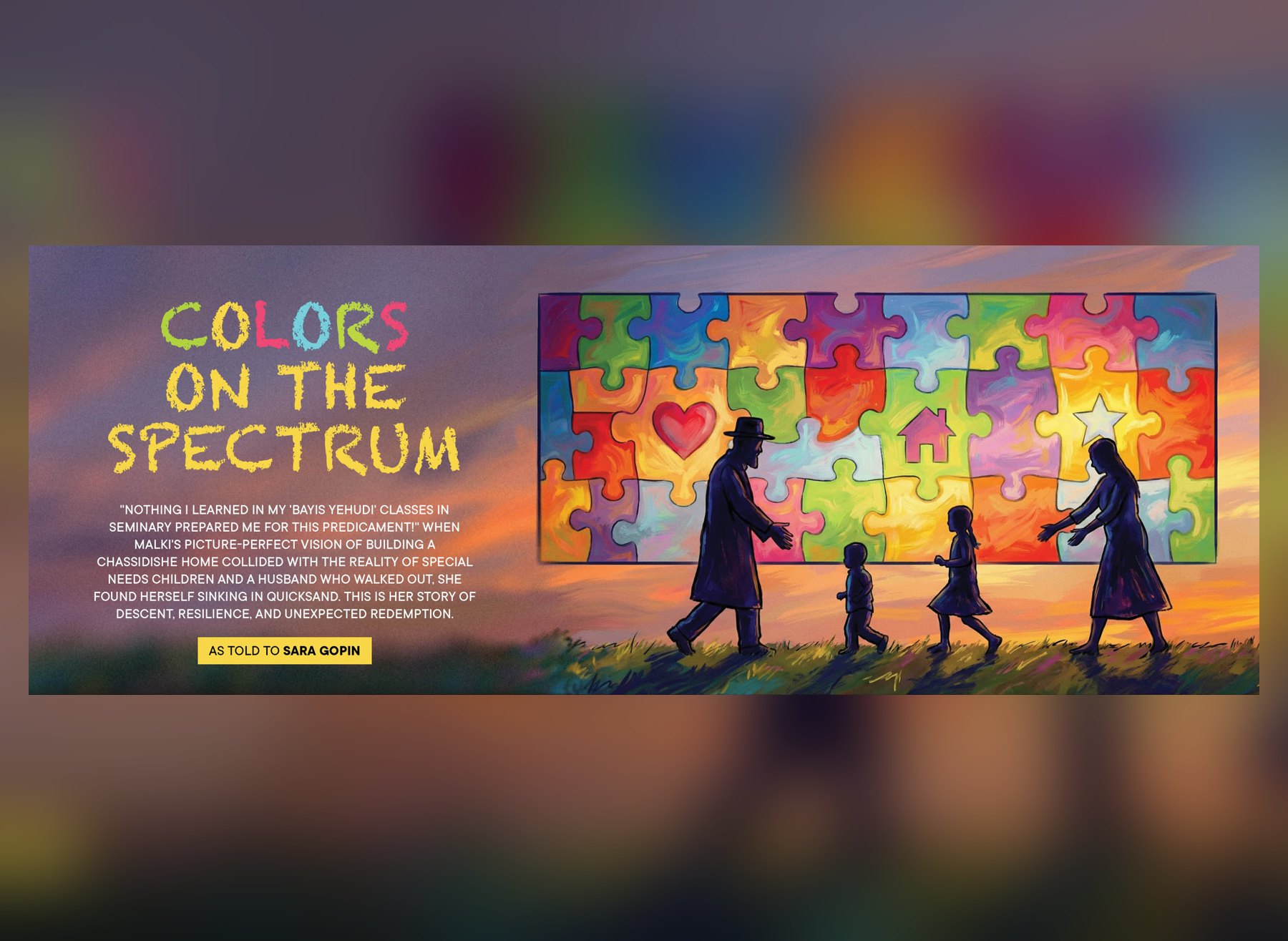
“Nothing I learned in my ‘Bayis Yehudi’ classes in seminary prepared me for this predicament!” When Malki’s picture-perfect vision of building a Chassidishe home collided with the reality of special needs children and a husband who walked out, she found herself sinking in quicksand. This is her story of descent, resilience, and unexpected redemption. As told to Sara Gopin.
“Like all Lubavitchers growing up learning Tanya, I always tried to improve my character traits. In seminary I focused on preparing myself for the next stage in my life, building a Chassidishe home. But nothing, besides the wedding itself, went as planned, and before I knew it, I was about to sink in quicksand…” Malki (a pseudonym) shares her story of personal growth. “Boruch Hashem I’ve come a long way…
“Although we had our ups and downs, my husband, whom I’ll call ‘Avi,’ and I were getting used to married life,” she says. “We were both overjoyed at the birth of our first daughter, whom I’ll call ‘Sari.’
“I slowly began to notice that she was a little in her own world and didn’t always respond to her name or smile back after a smile. There was something about her that wasn’t as happy as babies usually are. When she turned three I became more concerned, but I had no energy to get her evaluated because I was already pregnant with my second child, whom I’ll call ‘Ruvi.’
“Ruvi was a handful, to say the least. From the very beginning I noticed that he had a difficult temperament and that his reactions were intense. No matter how much I would try to soothe him, it was hard for him to calm down from his crying spells, which were quite often. I was told that at three months babies get easier, but Ruvi was increasingly irritable.”
She pauses and adds emphatically, “Nothing I learned in my ‘Bayis Yehudi’ classes in seminary prepared me for this predicament!”
Abandoned by my Husband
“I was trying to keep myself in good spirits, especially when Avi came home from work,” Malki continues. “He was usually stressed-out, and had no patience for our two crying, frustrated children. Sometimes he’d walk out soon after arriving home, slamming the door behind him. What hurt most is when he told me that had I been taking care of our children properly they wouldn’t be so irritable.
“The more Avi blamed me, the less energy I had to perform household tasks. To put it bluntly, the house was a mess. When the children finally fell asleep, I was out for the night too. Somehow, I was still managing to hold down my job as a substitute teacher. I knew that if I lost my job I’d feel like a failure on all fronts.
“In the midst of one particularly stressful evening Avi impulsively packed up a suitcase and walked out on me. I’ll never forget that moment of helplessness, of abandonment. Apparently, he’d been thinking of leaving for a while. Later I found out that in the days before he left, he took over a dozen photos of the heaps of unfolded laundry and the toys strewn all over the floor. He was preparing for battle.
“I called a friend who helped calm me down, but I didn’t call my parents for fear they might blame me too. After several days passed that Avi didn’t return home, I realized that he might not be coming home at all. I spoke to my mashpiah, and I’ll never forget what she said, ‘What does one do if they find themselves in a kitchen that’s in a state of total disarray? They take out one dish at a time from their sink full of dirty dishes, clean it with a soapy sponge, and then go on to the next dish.’ Then she added gently, ‘Malki, the first thing to do is to help yourself!’
“The truth is, since Ruvi’s birth I was in a state of disquietude, had difficulty concentrating, hardly had any appetite, wasn’t sleeping well, and had lost my zest for life. This was a red line that I knew should never be crossed, since nobody would be there to pick me back up.
“I went to my doctor that same day, and she referred me to a psychiatrist. It wasn’t an easy step to take, and I was also aware that it was another strike that Avi could use against me. But I didn’t care anymore. I started taking anti-anxiety medication, and after about six weeks I was sleeping well again, was more relaxed, and much more capable of dealing with my children’s needs.
“At the time I’d received a notice from the Beis Din that my husband had filed for divorce. But the future of my marriage was too much for me to think about… First and foremost, I had to get Sari diagnosed. There was no point in avoiding hearing the truth any longer.
“I was told that she was ‘on the spectrum,’ exhibiting characteristics of ASD, autism spectrum disorder. That’s what I was afraid of… But I remembered reading a letter of the Rebbe MH”M saying that a diagnosis can be very limiting. Rather, we should see the individual, with all their unique strengths. It was too early to predict how Sari’s life would unfold; I could only do my part by handling her with utmost sensitivity.
“A year later, when Ruvi was four, he was diagnosed with ADHD, which explained his low frustration tolerance. This was no surprise to me. When the brain has difficulty in regulating emotional responses, even the most minor setback triggers a major meltdown.
“So, there I was, all alone, and trying my best to have unlimited patience for my two children, while simultaneously enforcing boundaries in order for our home to have a semblance of normalcy. I learned the hard way that we were better off not visiting anyone, especially my parents. They were from the ‘old school,’ thinking that had I been more authoritative as a parent my children would behave normally. To me it was clear that this approach would have crushed these two sensitive souls that entered the world with a brain that worked a little differently than the rest of us.
“In the afternoons we’d go to the park, where Sari enjoyed sitting alone under the trees, and Ruvi ran around happily until getting tired out. I’d sit on a blanket spread out on the grass and look up at the clouds moving slowly across the sky. They were carried away by the wind, just as I was… Nothing was in my control.
“Once a week Avi came to take the children out, and once a month he deposited money in my account to help with their expenses. We barely said two words to each other when he picked them up. I was hurting inside, but had no strength to fight to save the marriage. It was hard enough maintaining a relaxed and pleasant atmosphere at home.”
An Unexpected Reunion
“After two years of resolving disputes in the Beis Din, we were given a date for our divorce two weeks before Pesach,” Malki shares. “Yet I wasn’t feeling like a failure anymore. I’d done my best to save what was most important, which was the mental health of my children, and of myself.
“One week before we were scheduled to divorce, I received a call from Avi’s brother, which was very surprising, because I’d had no contact with anyone in his family since he walked out. He told me that Avi was having second thoughts and wanted to postpone the date for the divorce. I didn’t expect this at all and couldn’t figure out why.
“On Erev Pesach, Avi’s brother called again and asked if Avi could tell me something. I agreed, and he said, ‘Malki, you’re really doing a great job helping our children grow.’ After a long pause that seemed endless, he said softly, ‘My hope is that we can give our marriage another chance.’
“Just as I never believed that Avi would suddenly desert me and the children, I never expected him to come back either. We began meeting with a marriage counselor and it was very helpful. What was hardest was the inner work that I had to do to forgive him.
“One year later, just before the next Pesach, Avi was back home. He admitted to me that he must have low frustration tolerance himself if he had taken off so abruptly, so how could he have been so judgmental of his own children?!
“It was a totally new beginning after a low point in which we’d almost lost everything. Avi has much more patience for Sari and Ruvi and is learning to appreciate them. Sari began playing songs on the organ by ear. We’re amazed by her natural talent, by the brilliant ‘colors on her spectrum.’
“Over the years Ruvi was in and out of yeshivas, but presently he’s doing very well in one that combines agricultural work. The hands-on experience suits him, since he has good, strong hands.
“We were blessed with three more children. They have extraordinary patience and understanding for their older sister and brother. It’s so sweet how they always find the right words to make Sari and Ruvi feel good.”
Yesh – Ayin – Yesh
After a contemplative moment, Malki concludes, “I’ll sum up my story by relating it to the Chassidic concept of ‘yesh – ayin – yesh.’ In order for someone to be elevated from one reality to a level that is way above it, and in no way connected to the previous one, there must first be a descent to an in-between stage of ‘ayin.’ So, too, after our descent in this long galus, ‘ayin,’ the kedusha of the Third Beis HaMikdash will be incomparable to what was beforehand! May it be b’karov mamash!”
Beis Moshiach #1487 • pp. 48-51
© 2026 Beis Moshiach Magazine. All rights reserved.
This article originally appeared in Beis Moshiach #1487. You are welcome to share it with friends and family by email or in print, provided that you do not change, add to or omit any part of it, you credit the author and Beis Moshiach, and you include a link to archive.bmoshiach.org (written out in full in printed copies).
To republish this article in a newspaper, magazine, book or website, please request permission in advance at [email protected].