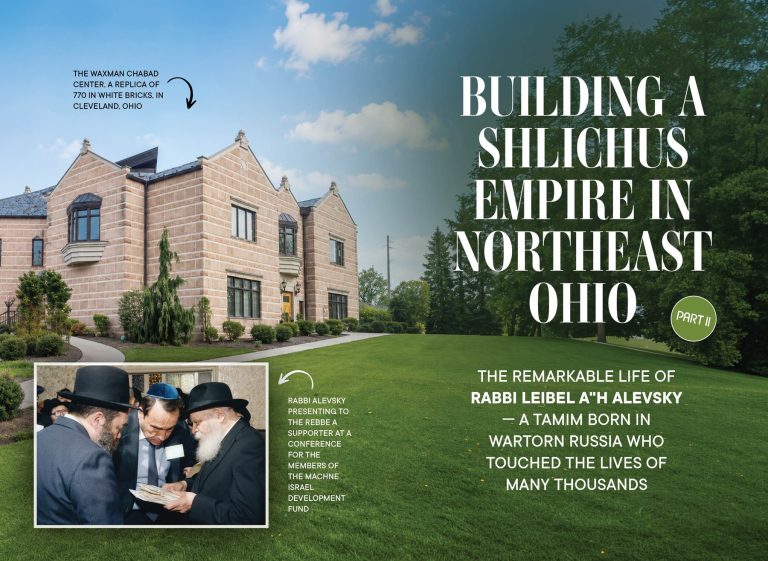
The Tamim Who Almost Became a Yevsektzia Interrogator…
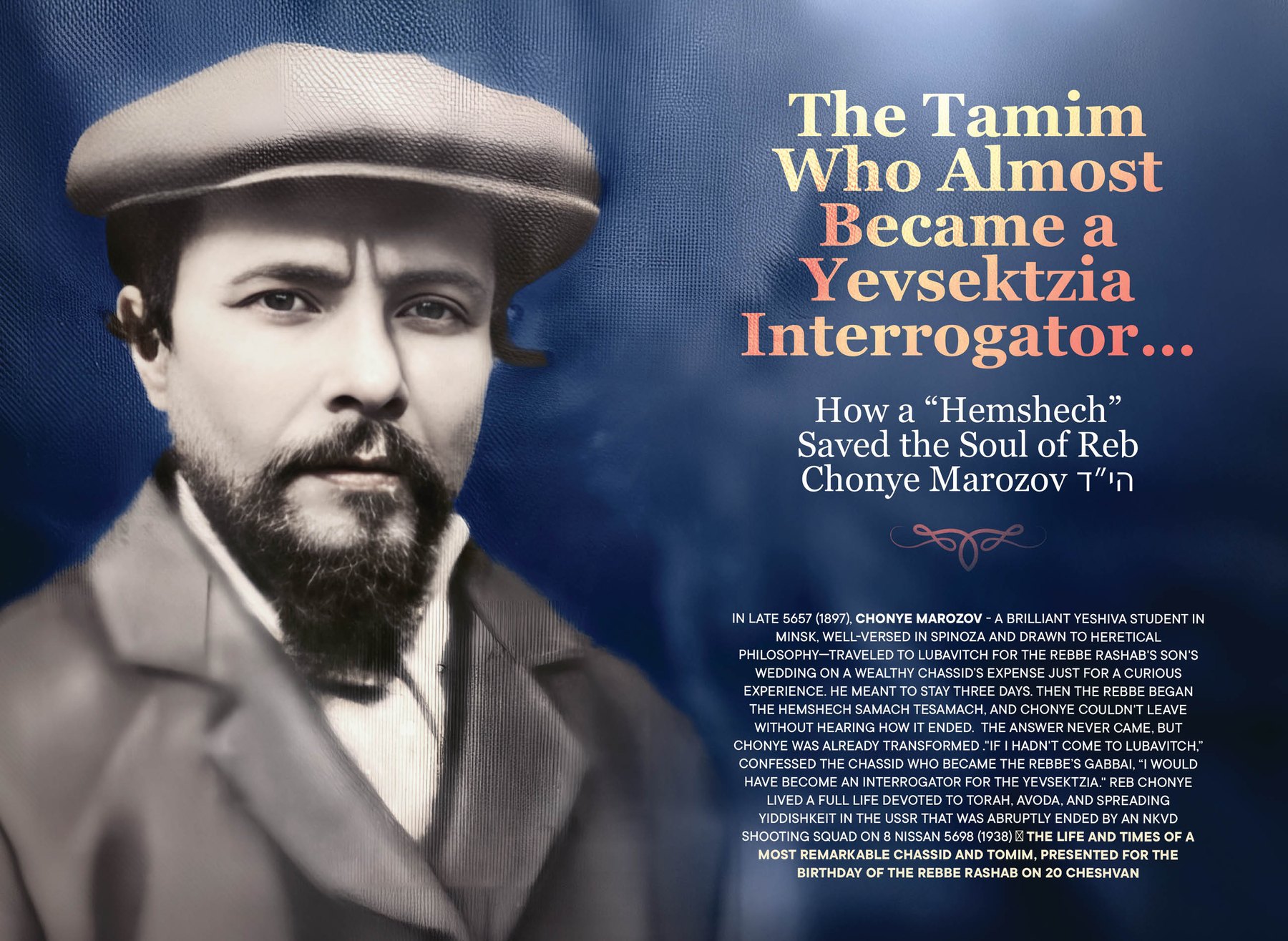
In late 5657 (1897), Chonye Marozov – a brilliant yeshiva student in Minsk, well-versed in Spinoza and drawn to heretical philosophy – traveled to Lubavitch for the Rebbe Rashab’s son’s wedding on a wealthy Chassid’s expense just for a curious experience. He meant to stay three days. Then the Rebbe began the hemshech Samach Tesamach, and Chonye couldn’t leave without hearing how it ended. The answer never came, but Chonye was already transformed… “If I hadn’t come to Lubavitch,” confessed the Chassid who became the Rebbe’s gabbai, “I would have become an interrogator for the Yevsektzia.” Reb Chonye lived a full life devoted to Torah, avoda, and spreading Yiddishkeit in the USSR that was abruptly ended by an NKVD shooting squad on 8 Nissan 5698 (1938). The life and times of a most remarkable Chassid and tamim, presented for the birthday of the Rebbe Rashab on 20 Cheshvan.
The Chassid, Rabbi Elchanan Dov (‘Chonye’) Marozov was born on 5 Kislev 5638 (1877) in the town of Yuzbeka near the city of Cherkassy in Ukraine. His parents were not Chassidim but they were true yerei shomayim.
His father passed away when he was young, when Chonye was around Bar Mitzva age. His widow, Rochel Leah, noticed the great spiritual decline that was occurring in those times, and she decided to overcome her compassion and send her young son to a place of Torah learning, to the yeshiva of the esteemed Rabbi Yerucham Yehuda Leib Perlman in the city of Minsk.
What was not known then to the mother and son was that even a large portion of the yeshivos did not provide true shelter from the winds of Haskala (so-called Enlightenment). Study of secular books was commonplace, and there were also those who went far afield and read books of kefira (heresy).
The sweeping movement did not pass over young Chonye, and he too began to show interest in such philosophy books and others.
The Journey to Lubavitch
In that same city, Minsk, young Chonye met a Chassid named Reb Peretz who suggested he join him on a journey to Lubavitch, to the wedding of the only son of the Rebbe Rashab. He was even willing to pay for his travel expenses. Chonye agreed to this, figuring he was, after all, a poor young man, and the journey to distant Lubavitch was expensive, and who knows when he would have another such opportunity?
The two arrived in Lubavitch in the middle of the month of Elul, just in time for the wedding of the Rebbe Rayatz, which took place on the 13th of Elul of that year. Suddenly R’ Chonye was exposed to a new world, none of which he had known until then. More than anything, the deep discourses that the Rebbe Rashab delivered in those days captured his heart. This was a wonderful series of maamarim known since then as “Hemshech Samach Tesamach 5657.” The concepts were foreign to him, and therefore also incomprehensible, but the lack of understanding did not prevent him from being curious and drawn after Toras HaChassidus with strong bonds.
“If I Hadn’t Come to Lubavitch …”
In vibrant words, R’ Chonye later described this to his son, the mashpia R’ Mendel a’h: “The maamarim amazed me greatly; I heard here a new way, a new method, an entire philosophy that I had never heard of before. This Chassidic haskala amazed me greatly. I would go to the chazara (review) once and twice and ask for explanation of everything. Clearly I wasn’t capable of understanding everything on my own; they gave me to understand that many things I could understand only in the course of time, when ‘I would enter to the inside.’”
Later he summarized the journey pithily: “If I had not traveled in 5657 to Lubavitch, and if I had not remained there – who knows if I would have remained in my Yiddishkeit!” Once he even expressed that had he not traveled, he would have become an interrogator for the Yevsektzia…
The mashpia, Reb Mendel Futerfas once said that R’ Chonye heard the Rebbe’s question at the beginning of the ‘Hemshech’ and wanted to hear the answer. He waited for the continuation of the maamar delivered on the following Shabbos, but even then the answer was slow to come. Thus the maamar continued on and on, and he waited and waited, and meanwhile became ‘Chonye Marozov.’
The Decision – Lubavitch!
During the sheva brachos, on the 15th of Elul, the Rebbe Rashab announced the establishment of a new yeshiva where students would learn not only Nigleh but also Chassidus. Although R’ Chonye had not yet thought to enter the yeshiva at that time, one of the Chassidim saw that he was a ben Torah and directed him to study in one of the ‘chadarim’ in the Rebbe’s court. Later R’ Chonye would claim that he was actually the first ‘Tamim’ appointed in Tomchei Tmimim…
During Tishrei, Chonye was in doubt about where to turn. On one hand, he considered returning to the shiurim of the renowned “Minsker Gadol” at the yeshiva in Minsk, but on the other hand – the Hemshech had not yet ended… Additionally, the sublime atmosphere he had experienced in Lubavitch was new and appealing to him.
At the end of Tishrei, the aforementioned R’ Peretz asked him whether his plan was to return with him to Minsk or to remain in Lubavitch. When R’ Chonye shared his dilemma with him, R’ Peretz promised that when he wanted to return to Minsk, he should write to him about it, and he would finance the travel cost. This offer tipped the scales toward continuing to stay in Lubavitch. R’ Chonye had no choice but to arrange with R’ Peretz that his letters to his mother and from his mother would pass through his home address in Minsk, so she wouldn’t notice that he was staying in the Chassidic court…
Meanwhile, he requested to be accepted to the new yeshiva. Since he was close to twenty years old, he was counted among the older students of the yeshiva.
The Mother Joined
At a certain stage, they suggested a shidduch for R’ Chonye with Esther Pevzner, sister of one of the talmidim in yeshiva, Avrohom Dovid Pevzner (Klimovitcher), who was a great ‘maskil’ in Chassidus and was one of the chozrim of the Rebbe Rashab
The Rebbe Rashab gave his consent and blessing, and the shidduch was made. Upon finalizing the shidduch, he hurried to write the good news to his mother, and she hurried to Lubavitch and remained to live near the couple who established their residence there, until her passing in the month of Tammuz 5663. She also merited to be buried in Lubavitch.
Later the Rebbe Rashab commented on the mother coming from her home to Lubavitch, that it was like what is said about Yaakov Avinu when he went down to Yosef his son in Mitzrayim – “and Yosef shall place his hand on your eyes.”
The Rebbe Rashab Honored as Sandek
In the year 5663, at the request of the Rebbe Rashab, R’ Chonye began to learn Chasidus with the Rebbe’s only son, the Rebbe Rayatz. “I have not found among all of them a pnimi as he; Elchanan is a pnimi,” the Rebbe Rashab said about him.
On Yud-Tes Kislev 5668, R’ Chonye was appointed as mashgiach in the yeshiva during the study of Chassidus. In a letter the Rebbe wrote to the yeshiva about his appointment as mashgiach, he expressed: “I hereby inform you that our friend R’ Elchanan has been appointed as mashgiach over dach, to examine and supervise each and every one – with which of the mashpiim he should study, and what the study should be, and to know each one how his study and knowledge is in the subject he studies. I request and warn you that you should be devoted to him, and to him you shall listen to all that he tells you, and if you do so, everything will be arranged, G-d willing, in proper order… and Hashem will be in his aid, and he will succeed in his work, and will fully realize the true kavana…”
During these years his children were born – Dovid Leib, Rochel Leah, Sarah, Shmuel, and Pinchas. At Shmuel’s bris, the Rebbe Rashab was honored to serve as sandek. At Pinchas’s bris, his son, the Rebbe Rayatz, was honored.
After the bris, the Rebbe Rashab asked R’ Chonye why he wasn’t honored a second time, and he answered that his conduct was based on the known practice that one doesn’t honor the same person with sandekaus twice. The Rebbe Rashab answered: “It doesn’t apply to us…” and explained that this is practiced only when the sandekaus is an honor for the sandek, but when the honor is for the baby, then they can do it a second time.
His son, R’ Mendel, would explain in his father’s name that it’s explained in the sefarim that there’s a connection between the bris and the ketores. The ketores was usually divided among all the kohanim so that each one would have the merit of offering it up at least once – but the Kohen Gadol was entitled to offer ketores whenever he wished. So too regarding sandekaus, they usually try to honor various people with it so they merit this wonderful privilege (as it’s known that the sandek’s sins are forgiven, etc.). It’’s different when dealing with a ‘Rebbe,’ a Kohen Gadol, who himself doesn’t need this and the honor is only for the baby. If so, why should this baby lose out?…
Merchant of Talleisim
In those years R’ Chonye worked for his livelihood in copying maamarei Chassidus of the Rebbe Rashab. In the yeshiva hall hung an announcement that maamarim and kisvei kodesh could be obtained from R’ Chonye in beautiful and clear handwriting. Even the Rebbe Rashab directed his son the Rayatz to R’ Chonye for copying his writings for the talmidim of the yeshiva…
In addition to this, R’ Chonye was involved in manufacturing talleisim. The Rebbe Rashab even asked him to prepare tzitzis for him.
During this period he would travel from place to place for the tallis business. On one occasion, when he returned from Warsaw, the Rebbe Rashab asked him whether he had visited the courts of the Polish Admorim in the city. When he replied in the negative, the Rebbe Rashab told him that on his next trip to Warsaw it would be worthwhile to visit one of the Admorim.
The next time, R’ Chonye attended the ‘tish’ of one of the Admorim. Since he didn’t want to approach the Admor to give ‘shalom aleichem,’ he stood aside and observed the Rebbe’s conduct. He noticed how the conduct was completely different from what he had known until then. When he returned to Lubavitch and told of his impressions, he added that he got a lot out of it, since he saw the difference between ‘here’ and ‘there.’
Gabbai of the Rebbe Rashab
In the year 5674, the gabbai, R’ Nachman Mariashin passed away, and in the Rebbe’s house they began to consider a suitable replacement. The Rebbe Rayatz approached R’ Chonye and asked if he would want the position of gabbai. R’ Chonye refused emphatically, but the Rebbe Rayatz only responded: “It’s not out of the question.”
After about half an hour, R’ Chonye was called to the holy room of the Rebbe Rashab. R’ Chonye, who immediately understood what it was about, entered the Rebbe’s room. When he stepped on the threshold, he felt dizzy and his whole body trembled. The Rebbe Rashab didn’t ask him anything, and only began to define for him the role of gabbai…
When the Rebbe finished speaking, R’ Chonye gathered courage and said to the Rebbe: “The world says that a gabbai cannot be a Chassid.” The Rebbe thought for a brief moment and replied: “True, but what should I do?” and immediately the Rebbe began to enumerate the shortcomings of the previous gabbai, all of which stemmed from his being ‘too much’ of a Chassid.
Following his appointment as gabbai, the Rebbe Rashab told him: “My door is always open to you. And what doesn’t sit right with you, you can ask.”
His son, R’ Mendel, related that his father always wanted to use this closeness to ask the Rebbe to teach him all of Tanya or maamarei dach. Had he done so – he would have been answered, but every time he entered the holy place, he didn’t dare open his mouth…
R’ Chonye later told his sons that although as a result of serving as gabbai he was lacking in the matter of being a ‘Chassid,’ all this was worth it to see the Rebbe Rashab recite the bedtime Shema every night. Sometimes he would also describe to them the Rebbe’s Shema in Shacharis of Shabbos. He would tell how the Rebbe would sing the niggun “Likras Shabbos” of the Alter Rebbe on the pesukim of “Shema Yisrael” and “V’ohavta es Hashem Elokecha.”
R’ Chonye, who himself was a wonderful singer, would sing this to his sons, but when he reached the word “Echad” at the end of the pasuk, he had difficulty imitating the “Ai…” at the end. He would say that he succeeded in imitating the entire tune exactly as the Rebbe sang it, but the “Ai…” he couldn’t manage…
Later, R’ Mendel Marozov said that the greatest miracle with the Rebbe Rashab was that there were many miracles – but the public didn’t talk about them.
Once the Rebbe Rashab called R’ Chonye and quoted to him the pasuk: “And be a blessing,” and explained – “when you bless another Jew, it should be fulfilled…”
R’ Chonye later related that he heard with his own ears the Rebbe Rashab turn to a certain young man and tell him: “Believe me, what I am telling you is as if you are hearing it from the Divine mouth. Know that Hashem has removed your sin.”
R’ Chonye didn’t tell to whom the words were said, but later on, Chassidim said that the words were said to R’ Chonye himself, who was studying – by the Rebbe’s instruction – the sefer Derech Chaim, and as he learned it he would cry very much with a broken heart, until it affected his health. About this the Rebbe told him the aforementioned sentence, and instructed him to stop studying Derech Chaim.
In that same yechidus, the Rebbe said the pasuk, “‘And your iniquity shall depart and your sin shall be atoned’: Here is the place,” i.e. meaning the Rebbe’s room, for the Rebbe is united with atzmus u’mehus.
When the Rebbe Sighed, R’ Chonye Didn’t Sleep
Despite the rare closeness he received from the Rebbe Rashab, the difficulty of his work as gabbai was great.
On one of the days of receiving people for yechidus, it seemed to him that according to the remaining time, it was possible to add several more people to bring them into the holy inner chamber.
At the end of the day, when he entered to the Rebbe Rashab, the Rebbe told him: “This time you tired me too much.” After R’ Chonye heard these words from the Rebbe, he couldn’t close his eyes all that night from great sorrow…
Sometimes the opposite happened – in certain cases, when he saw the need to thin out the number of people entering for yechidus, the Rebbe asked him afterward if there was anyone who was prevented from entering. And when the Rebbe heard that there were those who were refused entry, he sighed and said: “Ah… too bad, that one you should have let in.” On those nights too, R’ Chonye’s sleep was restless…
The Rebbe Rashab Teaches Niggunim to the Bachurim
In the early years of Tomchei Tmimim, the Rebbe Rashab would sit with the tmimim and teach them the ten niggunim of the Alter Rebbe and other niggunim. R’ Chonye, who was gifted with a special musical sense, absorbed all the niggunim in their details.
Thus the Rebbe Rayatz writes about him in a letter to the HaTamim editorial board: “R’ Elchanan has a special advantage, that my father the holy Rebbe taught him the ten niggunim of the Alter Rebbe. Also that he, R’ Elchanan, knows the ‘tenuos’ and niggunim that my father, the holy Rebbe would sing in his davening on weekdays and Shabbos.”
In later years the Rebbe Rayatz requested of R’ Chonye that since he learned the ten niggunim from his father, he should transcribe them into musical notation and send him the writings. R’ Chonye found a chazan who agreed to write the musical notes as he heard them from R’ Chonye, section by section. Afterward, when the chazan sang the niggunim from the notation sheets, R’ Chonye was not satisfied and asked him to play exactly as he heard. When the chazan sang a second time, again it didn’t sound accurate to R’ Chonye. Finally the chazan told R’ Chonye that the subtleties in the niggunim cannot be written, since there are no notes for them. Having no choice, he sent the notation sheets to the Rebbe Rayatz.
The Loss of His Wife
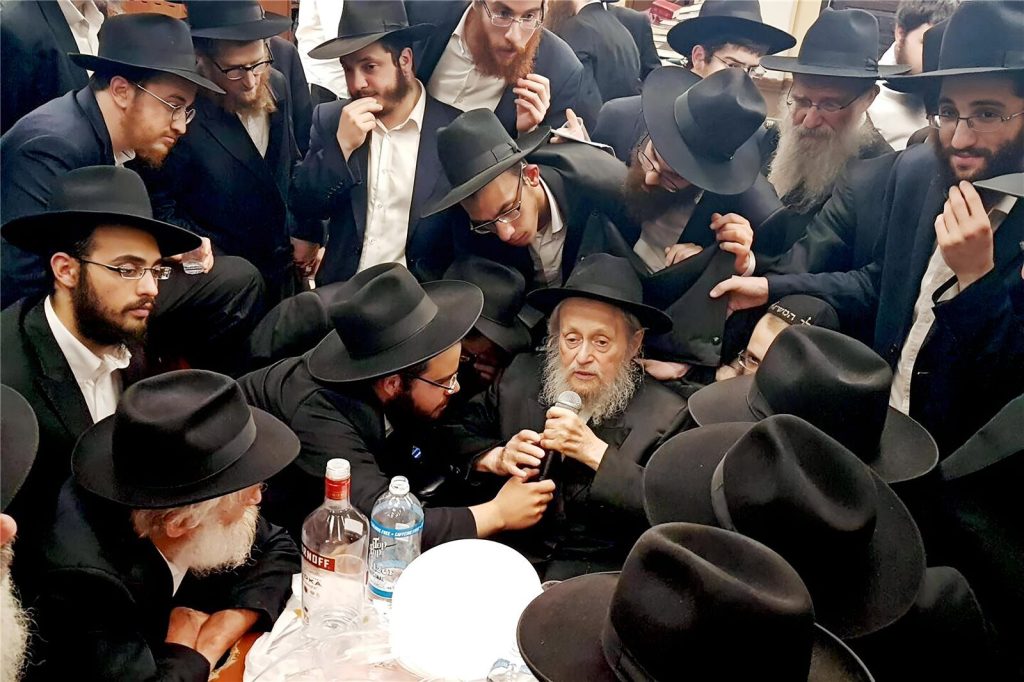
On the night of Shabbos, Parshas Vayechi, 16 Teves 5665 (1905), after lighting the candles, his wife passed away after suffering from a severe illness. She left behind her husband with five young orphans.
After her passing, the Rebbe Rashab expressed his sorrow that there was no permanent doctor in the town, as otherwise it might have been possible to save her. At the Shabbos meal in his home, the Rebbe Rashab expressed compassion for R’ Chonye and his family who were left without a mother.
A short time later, his brother-in-law R’ Avrohom Dovid approached him and suggested he marry his orphaned cousin, Chaya Bracha, the young daughter of R’ Dovid Mendel Katz from the town of Potchep. The shidduch was successful.
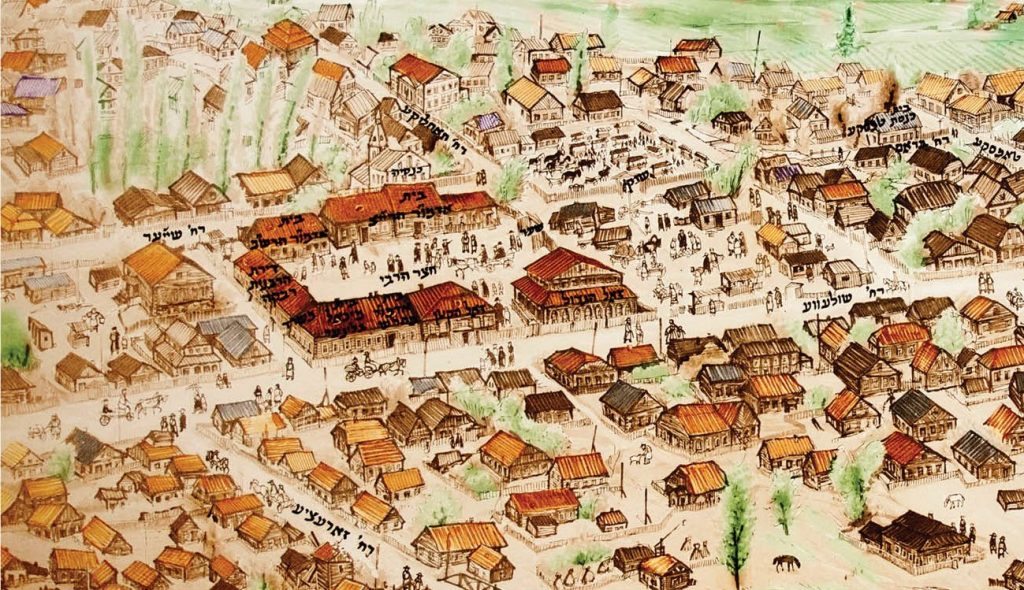
The Fire in Lubavitch
One night, shouts were heard about a fire that broke out in Lubavitch, spreading rapidly among the flammable wooden houses. The panicked residents quickly evacuated their families while simultaneously trying to extinguish the flames.
R’ Chonye’s new wife, who was then in her first pregnancy – was also frightened by the cries and searched for her husband who had been in the area just minutes before, but couldn’t find him. She had no choice but to cry for help. With the neighbors’ assistance, she managed to rescue the five children, not understanding where her husband had disappeared to during such moments of danger.
Several hours later, after they managed to overcome the fire and by Hashem’s chessed, the house remained standing, R’ Chonye returned home. When asked where he had disappeared during that critical hour, R’ Chonye explained that as soon as he heard about the fire, he was struck by thoughts about the Rebbe’s house and the kesavim of Chassidus. He didn’t think twice but ran immediately to the Rebbe’s house to help save the manuscripts…
Wanderings of War
On the 16th of Mar-Cheshvan 5676 (1915), due to World War I, the Rebbe Rashab was forced to leave Lubavitch and later established his residence in the city of Rostov.
Due to an expected birth (of his son R’ Mendel), R’ Chonye and his family did not join the Rebbe and his family on the journey. Only later, when they understood that the situation in Lubavitch did not permit the Rebbe’s return, did R’ Chonye and his family move their residence to Kremenchug.
Mesirus Nefesh to Reach the Rebbe
R’ Chonye continued to serve as gabbai to the Rebbe even in the month of Tishrei of 5677. His son R’ Mendel related:
“During this period when we were distant from the Rebbe (in Kremenchug and later in Yekaterinoslav), the situation was very dangerous. There was a tangible fear of being outside due to the rioters who rampaged in the streets. Members of various parties were killing each other, and among them all, the Communists (may their name be erased) were the least bad…
“Throughout all these years, my father would travel to the Rebbe in Rostov alone with mesirus nefesh, out of deep hiskashrus. On one occasion he was injured to such an extent that they had to take him to a doctor who cleaned his wounds. I was then a small child, and I remember what my sister told me, that this happened as a result of the goyim throwing him from the train in the middle of the journey… By hashgacha pratis, the train was traveling slowly at that exact moment and he remained alive.
“Once, the Chassid Reb Shmarya Sassonkin related that on one occasion there was another Chassid with them. The three of them decided that whatever would be, they were traveling to the Rebbe no matter what.
“In the middle of the journey, gentile inspectors boarded to check tickets and documents. R’ Shmarya had documentation, and thanks to it they allowed him to continue the journey, but R’ Chonye and the other Chassid had no documents. They ordered them to get off the train immediately and not continue the journey, warning them not to dare continue, and if they did, they would throw them from the train. R’ Chonye was forced to get off, but the second Chassid didn’t want to do so. Later in the journey, inspectors boarded again and threw him from the speeding train, and he was killed.
“When R’ Shmarya reached the Rebbe Rashab, he told him all the details of the incident, and finally expressed his concern that he didn’t know what happened to R’ Chonye. The Rebbe Rashab contemplated for a while and replied with his ruach ha’kodesh: ‘Chonye is already home…’
“After getting off the train, he said to himself that from the perspective of danger, there was apparently no difference between returning home and traveling to the Rebbe, so he decided to wait for the next train to Rostov… Meanwhile, a goy with a gun approached him and shouted: ‘You’re a Jew! I want to kill you!’ My father pleaded with him to at least let him pray before his death. After giving him permission, he began to daven Mincha. He davened at length, as was his way, and when he finished davening, the goy got ready to shoot him. At the very last moment, another goy ran to him shouting: ‘What are you doing?!’ and struck the gun which fell from his hand, and both of them fled from the place.
“Thus he was saved, and immediately returned home.”
In the Moment of Truth, the Apostate Women Proved Their Loyalty
In 5678 (1917), after the Russian Czar’s regime was overthrown and power passed to the Communists – while the revolution and World War continued with full force – R’ Chonye’s family moved to live in Yekaterinoslav.
In this city, the friendship between R’ Chonye and his family and the family of the city’s rav, Rabbi Levi Yitzchok and Rebbetzin Chana – the Rebbe’s father and mother – grew strong, to the point that Reb Levi Yitzchok and R’ Chonye established a chavrusa to learn together.
Interesting testimony to this relationship emerges from the following story:
Rebbetzin Chana, who was good friends with R’ Mendel’s mother, complained to her friend that her son – the Rebbe [the future Lubavitcher Rebbe] – was eating too little. Mrs. Marozov said to him: “Mendel! You need to eat, if you don’t eat, you won’t grow…”
After all the years of hunger and war, when Mrs. Marozov emerged from the valley of tears, when she had yechidus with the Rebbe for the first time, immediately upon her entry, the Rebbe stood to his full height, looked at his shoulders and asked with laughter: “Nu.. bin ich untergevaksen?” (Nu, did I grow?).
The family continued to live in Yekaterinoslav for several years while R’ Chonye continued his work in the tobacco business with the Chassid R’ Shmuel Gurary.
In Shevat 5680 (1920), another son was born to the couple and was named in Yisroel Yosef Moshe (‘Moishke’). The sandek at the bris was Rabbi Levi Yitzchok, the Rebbe’s father.
About this period, R’ Mendel Marozov related:
“During this time, ‘pogroms’ by the Cossacks occurred in the area, and they would go around killing Jews r’l. My family then lived in a house that was part of a courtyard with several houses. In that same courtyard also lived two girls who had converted r’l, and the Jews didn’t want to be with them, and would even spit whenever they passed by their house.
“Due to the pogrom, everyone hid in the basement. At some point, my little brother began to cry, and the Jews were very afraid. They feared they would be discovered. This reached a situation of pikuach nefesh and they wanted to kill him, but my mother watched over him so he would stop crying and no harm would come to him.
“The Cossacks were going house to house asking if there were Jews. If they swore by the ‘cross’ that there were no Jews, they would continue on. When they reached our courtyard and asked if there were Jews, the [converted] girls came out to them and despite all the insults they had endured all those years, they swore by the ‘cross’ that there were no Jews, and thus saved all the Jewish families from mortal danger lest the truth be discovered.
“From then on, the attitude toward them changed from one extreme to the other, as everyone understood that ‘even though he sinned – he is still Yisrael.’”
Histalkus
In the winter of that year, the Rebbe contracted typhus that was raging at that time, and as R’ Chonye himself described the situation: “In the middle of winter 5680, various diseases began to spread, lo aleinu, throughout the country, ‘typhus,’ ‘chest (i.e. scrub) typhus,’ and more, r’l. The cold and hunger intensified. In addition to this, a life of fear and terror prevailed all around because of all the gangs, most of whom were making pogroms against Jews, may Hashem have mercy.”
Regarding this period, they relate in the name of R’ Chonye: One morning during that time, while he was in the Rebbe Rashab’s room, Rebbetzin Shterna Sarah entered the room in a tizzy and said to her husband the Rebbe that she needed to speak with him. The Rebbe asked her to tell him what she wanted, but she didn’t open her mouth, hinting that R’ Chonye’s presence was bothering her, but the Rebbe immediately answered her that she could speak, “because Chonye is one of our own.”
And the Rebbetzin began to tell:
“Last night I dreamed that I was in a shul filled with a crowd of people. Suddenly I see Rebbetzin Rivka (the Rebbe Rashab’s mother) entering the shul, running to the Aron Kodesh, opening it, taking out a Sefer Torah and fleeing outside. The crowd of people present there tried to take the Sefer Torah from her, but the Rebbetzin fought and wouldn’t give it up. Finally R’ Shmuel Gurary overcame her, took the Torah from her forcefully, and hugged it with both hands so she couldn’t take it from him. But the Rebbetzin continued to struggle and again took the Torah in her hands and ran out from the shul, with the entire congregation, including me among them, chasing after her, until we reached a river. There in the river I entered the water, immersed myself, and woke from my sleep…”
The Rebbe, not wanting to worry her excessively, calmed her by saying: “Nu, water, that’s a good sign…”
Not long after, the Sefer Torah was snatched away. On Monday, Beis Nissan 5680, the soul of the Rebbe Rashab, nishmaso eden, departed.
(These stories are from the ‘Teshura’ “Mendel Chonye’s,” published for the wedding of the Axelrod-Goldberg families, by the tamim Simcha Bunim Goldberg).
Beis Moshiach #1480 • pp. 10-19
© 2026 Beis Moshiach Magazine. All rights reserved.
This article originally appeared in Beis Moshiach #1480. You are welcome to share it with friends and family by email or in print, provided that you do not change, add to or omit any part of it, you credit the author and Beis Moshiach, and you include a link to archive.bmoshiach.org (written out in full in printed copies).
To republish this article in a newspaper, magazine, book or website, please request permission in advance at [email protected].