Jews Don’t Run!
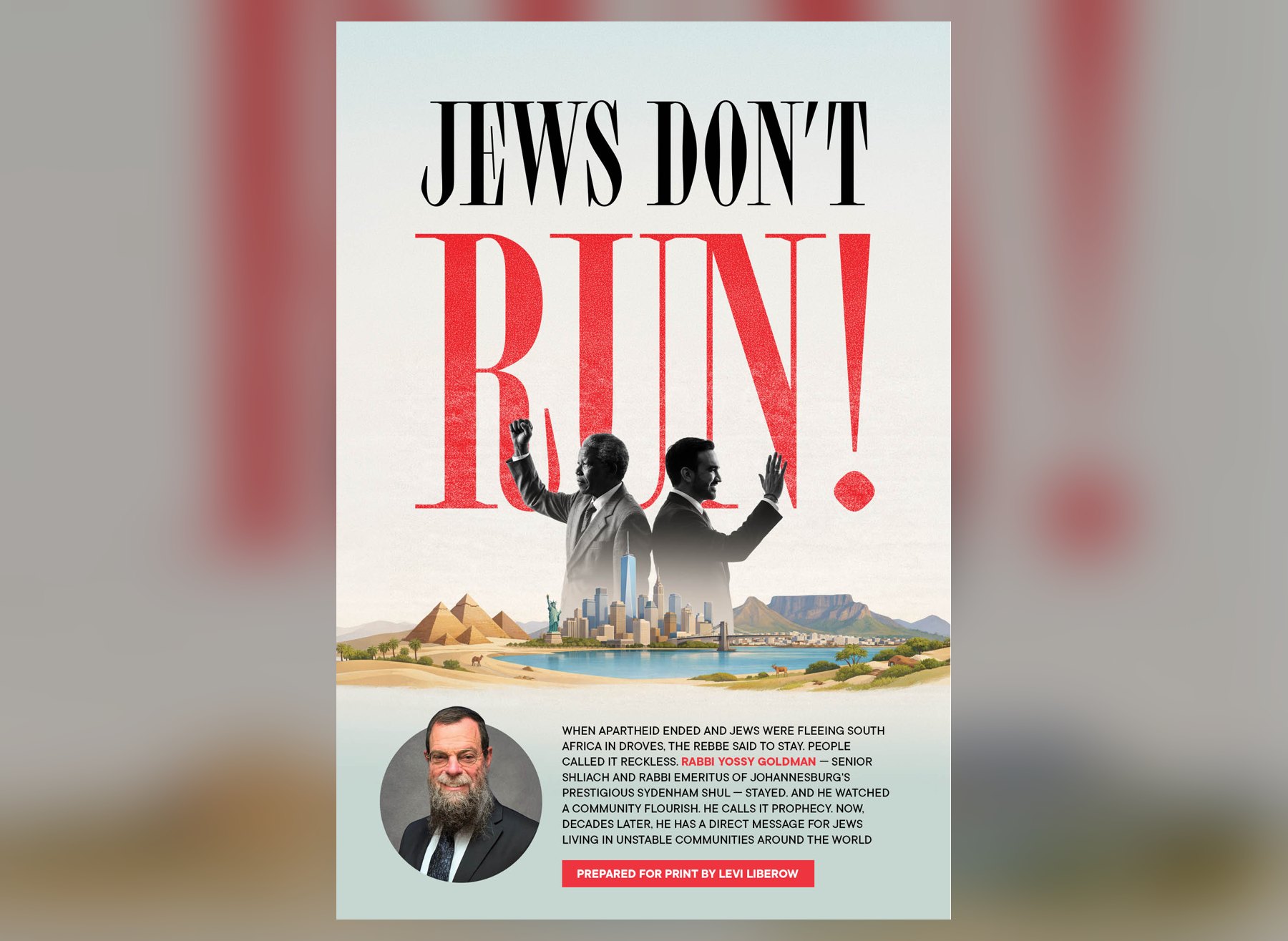
When apartheid ended and Jews were fleeing South Africa in droves, the Rebbe said to stay. People called it reckless. Rabbi Yossy Goldman – senior shliach and rabbi emeritus of Johannesburg’s prestigious Sydenham Shul – stayed. And he watched a community flourish. He calls it prophecy. Now, decades later, he has a direct message for Jews living in unstable communities around the world.
It’s always a risk to invite a pulpit rabbi to speak. They can go on and on.
In my shul in Johannesburg, there was a congregant named Mr. Berkowitz who fell asleep during every single sermon. Once, I got up to the bima and, before I had even opened the Chumash, there was Mr. Berkowitz – already asleep. I said, “Mr. Berkowitz! I haven’t started yet.” He opened one eye and said, “Rabbi, I trust you.”
A Wrestling Match and a Message
Either way, you can’t keep a pulpit rabbi away from the parsha. And this week’s parsha [Vayishlach] speaks directly to our moment.
One of the most dramatic scenes in the entire Torah is Yaakov’s wrestling match with the Sar shel Eisav – the angel of his brother Eisav. The Rashbam, a grandson of Rashi, offers a striking explanation for why Hashem arranged this painful, all-night encounter: Yaakov had developed a habit of running away.
He fled home when Eisav threatened to kill him. He fled from Lavan. And now, with Eisav marching toward him with four hundred armed men, Yaakov was contemplating escape again.
The Rashbam says Hashem declared: Enough. Stand your ground. Confront the challenge. Deal with it. Don’t run away.
That message flows directly into the anxieties of Jews today – in New York and across the world.
Recently, when I gave this lecture at another New York community, a man told me he was planning to leave New York. His reason? He was unhappy with the newly elected mayor. I asked him where he planned to go. He wasn’t sure. And so I asked a harder question: What happens when the next place also elects someone you don’t like? Will running become a way of life?
Consider what we’re talking about. New York is the largest Jewish city in the world – more Jews than any city in Eretz Yisrael. Even its secular culture has a distinctly Jewish character. I once circled Manhattan looking for parking and found an official municipal sign that didn’t just say “No Parking.” It said: “Don’t even think of parking here.” That’s a Jewish city.
That this great Jewish city should vote the way it did, is, frankly, extraordinary. But the question is: what do we do about it?
The Rebbe’s Consistent Answer: Stay
Living Torah recently released a short film in which the Rebbe is seen speaking to people from communities across the world facing security crises – Morocco, Tunisia, Guatemala, Quebec after the French separatists took power, South Africa, Eretz Yisrael during the Lebanon War. In each case, the Rebbe’s answer was the same: Don’t worry. Stay where you are. Help bring Moshiach from right where you stand.
But this was never a reflexive policy. The Rebbe’s guidance was always measured, prophetic, and specific.
During the Holocaust, the Rebbe Rayatz told Jews to leave Europe – the tragedy was that almost no country would let them in. My own father, Rabbi Shimon Goldman a’h – the only survivor of his entire family from Poland, who for decades ran a butcher shop on Coney Island Avenue – escaped on a Sugihara visa. Chiune Sugihara was the Japanese consul general in Kovna who defied his own government and issued visas to over six thousand Jewish refugees, saving the Mir Yeshiva and the entire Lubavitch Yeshiva of Vilna.
Another example: When the Shah fell in Iran and the ayatollahs seized power, the Rebbe encouraged and assisted Jews to flee. “Get out,” he said – and helped them do it. When a shliach was preparing to go to Zimbabwe, the Rebbe, who had expressed calm confidence about South Africa as we shall soon see, gave a very different answer about Zimbabwe: “The situation is unclear.” The plans were halted. Today, barely a handful of Jews remain in that country.
The Rebbe’s guidance was never off-the-cuff. When he told people to stay – it was a considered, visionary judgment.
Crown Heights: A Neighborhood Saved
Let’s take a local Brooklyn neighborhood as a case study – the Rebbe’s very own Crown Heights:
I was born on Eastern Parkway – literally. At the Brooklyn Women’s Hospital, on Eastern Parkway near Rochester Avenue. I grew up in Crown Heights when it was a thriving neighborhood, home to every stream of Judaism.
The block we lived on – bounded by Montgomery and Crown Streets, crossed by Brooklyn and Kingston Avenues – had over a dozen shuls. On the way to davening, you would see person after person rolling up a sleeve for tefillin. Many of those arms bore a tattooed number.
Then the neighborhood began to change. Through the practice known as “blockbusting,” real estate interests deliberately brought non-Jewish residents into the area. Jews panicked. Satmar, Bobov, and many other Chassidishe groups fled to Boro Park and Flatbush and elsewhere. Crown Heights was emptying.
Until 1969 – when the Rebbe made an official announcement: “The Rebbe [Rayatz] bought 770 here. We are not going anywhere. We are staying right here.”
The flight stopped. The neighborhood stabilized.
The Rebbe went further. He issued a psak halacha – something he almost never did, ordinarily referring questions to local poskim. He ruled, in a halachic essay published in a leading New York-based Torah Journal, that it is halachically forbidden to leave Crown Heights, because doing so endangers those who remain. The more Jews who leave, the more vulnerable the community becomes. You bear responsibility to your neighbors not to abandon them.
The great Rav Moshe Feinstein – one of the greatest poskim of his generation, who often deferred to the Rebbe – publicly endorsed the Rebbe’s declaration afterward: “If the Lubavitcher Rebbe had not given that psak, I would have given it myself.”
Today Crown Heights is a remarkable model of peaceful racial integration, nearly unique in America. Shuls and schools are thriving. Kosher restaurants number in the tens. Property values have risen so dramatically that affordable housing has become the community’s next challenge – a very different kind of problem.
South Africa: “You’re Meshuga for Coming Here”
South Africa, which I proudly call home, is another case study: In 1976, my wife and I arrived in Johannesburg – with two small children – to open the first Chabad House on the African continent. The Jewish community’s reaction was uniform: “You’re meshuga, you are crazy. We’re all leaving. There’s going to be a revolution.”
They had reason to believe it. Across the continent – Congo, Kenya, Zambia – violent revolutions had overthrown colonial governments. Blood had been spilled in the streets. South Africa seemed next.
But the Rebbe sent shluchim. And the Rebbe did not send shluchim into danger.
The anxiety in the community was not new. When the Nationalist Party won the 1948 election and introduced apartheid, a prominent rav serving as dayan in Johannesburg – a landsman of my family – traveled to New York to ask the Rebbe Rayatz: should he take his family and leave? The Rebbe was completely dismissive. Everything would be fine. The rav went back – and for South African Jewry, it was.
Throughout the ‘70s and ‘80s, so many families were emigrating that our community was being decimated. During this period, the Rebbe sent his students to South Africa as shluchim – a massive vote of confidence. His personal responses to the community’s fears were equally unambiguous. He told people not to be afraid and to carry on with their work. Some were even advised to return after they had already left.
On three separate occasions, Chabad leaders in South Africa were under intense pressure from the community, clamoring to know whether the Rebbe was still confident about their future. One of these moments came in August 1985, when President P.W. Botha delivered his infamous Rubicon speech in Durban – a moment of acute national crisis. Each time, without hesitation, the Rebbe gave the same two-word Hebrew answer: “L’pele ha’sheilah! – It is astounding that you even ask the question!”
His reassurances spread across the country like wildfire. “The Rebbe” became a household name in South Africa. Even non-observant Jews knew his bracha. I have heard people say, “Don’t worry – I’ll close the lights at Jan Smuts Airport. I’ll be the last one to leave.” Such was the confidence the Rebbe inspired.
The Day Mandela Was Released
On February 11, 1990, President F.W. de Klerk announced the release of Nelson Mandela after twenty-seven years in prison. The anxiety in the white community was palatable. What would a man do after twenty-seven years of imprisonment? The demographic ratio was eight to one. Revenge seemed almost inevitable.
The very day Mandela walked free, Rabbi Koppel Bacher – a prominent Chabad leader in South Africa – was in New York standing in line for Sunday dollars. After receiving a dollar and a bracha, he turned to leave. The Rebbe called him back.
“Tell the Jews in South Africa who are worried,” the Rebbe said: “It will be good there until Moshiach – and after Moshiach, it will be even better.”
Those eleven words sustained an entire community. Not just Chabad families – the entire South African Jewish world knew the Rebbe’s bracha. It was repeated in shuls and living rooms, by the frum and the non-observant alike. The Rebbe was not predicting political stability in some abstract sense. He was speaking of Moshiach – promising that South Africa would remain a home for Jews until the ultimate Geula, and that the Geula itself would make everything better still.
“It will be good there until Moshiach – and after Moshiach, it will be even better.” – The Rebbe
Mandela: Blessing, Not a Curse
Mandela’s release was not the catastrophe people feared – it was a blessing. He proved to be, in the most literal sense, a leader sent to save his nation. Like a Moses, his stature was such that he could lead his people toward a destination they did not entirely choose for themselves.
He could have demanded revenge. Young members of his party were clamoring for it. He had to fight his own people to bring them toward peace and reconciliation – the mantra of his life. Had he been a man of lesser standing, he would have been outvoted. But because he had sacrificed twenty-seven years, because his moral authority was unassailable, he prevailed.
What followed was what the world’s media – a press that rarely uses the word – called a miraculous transition to democracy. South Africa held its first election in which black and white could vote together. I stood in that line. People looked at each other and said: This is ikvesa d’Meshicha. This is what Moshiach’s times feel like.
As an act of reconciliation, Mandela appointed de Klerk – the leader of a government that had kept him imprisoned – as one of his deputy presidents. He did not have to. It was a gesture of almost incomprehensible magnanimity.
Regarding Israel, Mandela said something that no Arab leader and no ANC politician says today: “Israel deserves to exist in secure borders.” When we were upset to see a famous photograph of Mandela embracing Arafat, yemach shemo, that statement was his answer.
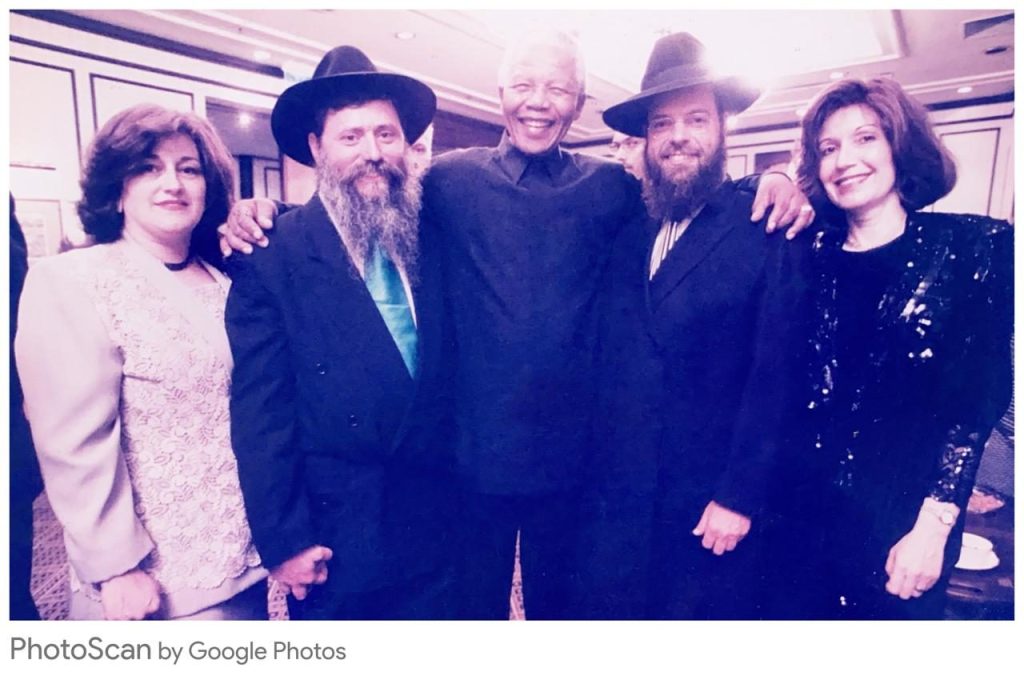
I met Mandela on a number of occasions. There was a dinner in Cape Town honoring Chief Rabbi Harris, whom Mandela held in the highest regard. Once, on a Sunday afternoon, I spotted Mandela walking near my house – he lived not far away. I quickly brought my children outside. He stopped for each one. “What’s your name? Which school do you go to?” “Torah Academy.” “What’s your name?” “Israel.” “Oh – I’m going to Israel soon with the Chief Rabbi.” He walked an entire block holding my small children’s hands.
I cannot think of a president of any country who would do that. He was a special personality. He saved South Africa. And the Rebbe had seen it coming.
Crime, Hijackings, and the Rebbe’s Bracha
After democracy came a new wave of emigration – driven not by political fear but by the country’s soaring crime rate. Many of my congregants became victims. I myself was hijacked – ironically, while driving to the shiva house of a man who had been murdered. My wife Rochel’s experience was far more dramatic. A would-be hijacker pulled the trigger at point-blank range. Nothing happened. He pulled it again. Nothing happened. Twice. A miracle.
People asked: How can any person, sitting on the other side of the world, tell a community not to leave a danger zone like this? My answer was always the same: to make such a statement, to take such responsibility upon yourself, you either have to be a fool or a prophet. One thing is certain: the Lubavitcher Rebbe was no fool.
The Rebbe himself, it is said, commented in his later years that while he had not been as successful as he would have liked in stemming emigration from South Africa altogether, he was gratified that he had succeeded sufficiently for the community to survive – with stability, with vibrancy, and with the Geula still ahead.
A Community That Stayed — and Thrived
South African Jewry today numbers perhaps sixty thousand – about half the peak of one hundred twenty thousand in the 1960s. The quantity is down. The quality, however, is extraordinary.
South Africa is, by any honest measure, the most traditionally observant Jewish community in the Diaspora. Not all frum – but deeply, authentically Jewish. Forty percent of South African Jews buy only kosher meat. Forty-one percent attend shul weekly – including non-religious Jews. Over ninety percent fast on Yom Kippur. Over ninety percent attend the Pesach Seder. Over ninety percent send their children to Jewish day schools. These numbers do not exist anywhere else in the Jewish world. The Rebbe knew this – and told the community’s skeptical establishment as much.
When we purchased the Torah Academy’s property in 1979, the five major Jewish establishment organizations came to our door demanding we stop. South African Jewry was “in decline,” they said. There weren’t enough children or resources to support another stream of education. When we proceeded anyway, they wrote directly to the Rebbe – co-signed by the chairmen of the Board of Deputies and the South African Zionist Federation – asking him to, and I quote, “curb the reckless empire building of his errant emissaries.”
The Rebbe’s response, several pages long, turned the entire argument around:
“As leaders of the community, it is your responsibility to ensure that South African Jewry should not be a dwindling community. Don’t accept the status quo.” He praised the community, highlighted its unique traditional character, and pointed out that strong diaspora communities play a vital role in supporting Eretz Yisrael.
Today the Torah Academy Chabad school system serves six hundred fifty children – the most we have ever had. We have the largest nursery school and kindergarten in the city. New shuls for young families are opening. There is genuine, organic growth. The establishment’s five organizations are mostly footnotes. The Rebbe’s vision endures.
The Rebbe, Moshiach, and the Message for Today
When the Rebbe told communities not to run, he was not simply offering political analysis or demographic projections. He was speaking from a place of prophetic vision – and he was speaking about Moshiach.
The promise to South African Jewry was not merely “it will be okay.” It was: “It will be good there until Moshiach – and after Moshiach, even better.” The destination the Rebbe had in mind was not a stable government or a favorable election result. It was the Geula Shleima. Every community, every shliach, every Jew who stays put and builds Jewish life in their corner of the world is bringing that destination closer.
This is the context in which the Rebbe saved Crown Heights. This is the context in which the Rebbe saved South African Jewry. We are not simply talking about real estate decisions or immigration patterns. We are talking about the Rebbe’s vision of a world standing on the threshold of Geula – a world in which every Jewish community, in every corner of the globe, plays a role in hastening the coming of Moshiach Tzidkeinu.
South Africa today is a remarkable demonstration of this vision. Our government took Israel to the International Court of Justice for alleged genocide – and yet the country itself is not antisemitic. I have walked from my home to shul and back on Friday nights, in the dark, for forty years. I have never had an incident. There is more antisemitism on the streets of New York than on the streets of Johannesburg.
The Rebbe proved prophetic in South Africa. I believe his message for New York today would be identical: Stay right where you are. Build. Grow. And bring Moshiach from exactly where you stand.
As for the current challenges – be it a hostile mayor, or a difficult political climate — there is an old legend that Shlomo HaMelech had a ring inscribed with three Hebrew words: Gam zeh yaavor – this too shall pass. He looked at it in hard times for encouragement. He looked at it in good times to stay humble. It is a message for all seasons.
The Rebbe, however, added something Shlomo Hamelech did not say: “And after Moshiach, it will be even better.” May we see that day, b’karov mamash.
Rabbi Yossy Goldman is the Life Rabbi Emeritus of Johannesburg’s Sydenham Shul and President of the South African Rabbinical Association. He and his wife Rochel were sent by the Rebbe to Johannesburg in 1976 as founding director of the first Chabad House on the African continent. The talk transcribed above (with light edits) was delivered at Chabad Lubavitch of Flatbush as part of a speaking tour this past winter
Beis Moshiach #1500 • pp. 24-29, 53
© 2026 Beis Moshiach Magazine. All rights reserved.
This article originally appeared in Beis Moshiach #1500. You are welcome to share it with friends and family by email or in print, provided that you do not change, add to or omit any part of it, you credit the author and Beis Moshiach, and you include a link to archive.bmoshiach.org (written out in full in printed copies).
To republish this article in a newspaper, magazine, book or website, please request permission in advance at [email protected].