When The Rebbe Finished The Rambam’s Work
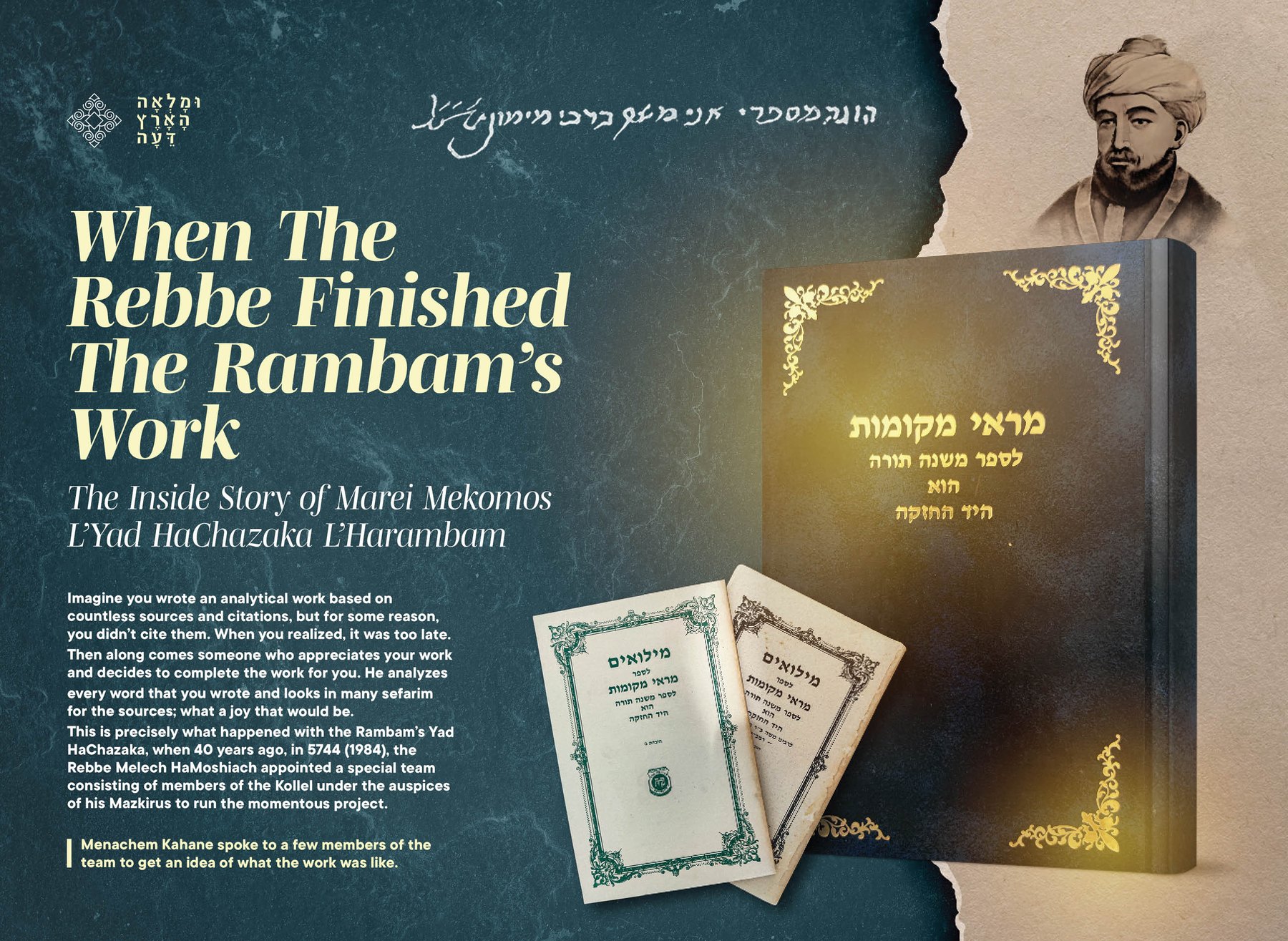
Imagine you wrote an analytical work based on countless sources and citations, but for some reason, you didn’t cite them. When you realized, it was too late. Then along comes someone who appreciates your work and decides to complete the work for you. He analyzes every word that you wrote and looks in many sefarim for the sources; what a joy that would be. This is precisely what happened with the Rambam’s Yad HaChazaka, when 40 years ago, in 5744 (1984), the Rebbe Melech HaMoshiach appointed a special team consisting of members of the Kollel under the auspices of his Mazkirus to run the momentous project. Menachem Kahane spoke to a few members of the team to get an idea of what the work was like.
Imagine you wrote an analytical work based on countless sources and citations. For some reason, and it’s not clear to you either, you didn’t cite the sources. When you realized this, it was already too late; lack of time, various involvements, and overwhelming commitments left the work undone.
Then along comes someone who appreciates your work and he decides to complete the work for you. He analyzes every word that you wrote and looks in many sefarim for the sources of the ideas; what a joy that would be.
This is precisely what happened with Rambam’s Yad HaChazaka, a work which is the foundation and basis of the world of halacha for 900 years. The Rambam toiled to write his halachic work that consists of 14 volumes, 83 topics and 1000 chapters, but he did not write sources for his psakim; he didn’t cite on what basis he make his psak. He himself wondered about this as he recounted, “The pious dayan came to me with a section of the work in his hand which has the laws of a murderer from the book of Nezikin and he showed me one halacha. He said to me, ‘Read it.’
“I read it. I said to him, ‘What doubt is there regarding this?’
“He said to me, ‘Where is this stated?’
“I said to him, ‘In its place, either in “Eilu hein ha’golin” or in Sanhedrin in the laws of the murderer.’
“He said to me, ‘I reviewed it all and didn’t find it.’
“I said to him, ‘Maybe in Yerushalmi?’
“He said to me, ‘I sought and did not find it, not in Yerushalmi and not in Tosefta.’
“I was taken aback for a moment and said to him, ‘I remember that in a certain place in Gittin this was explained.’ I took out a Gittin and looked and didn’t find it. I was amazed and stunned and I said, ‘Where was this said? Leave it for now until I find it.’
“He left and I remembered. I sent a messenger and called him back and showed him the explicit words in the Gemara Yevamos mentioned in passing.
“He was amazed and left.
“I am constantly anguished when a questioner comes and asks: Where does it say this? If this happened to me and I am the author, what will happen to other people?”
Later, the Rambam announced that he decided to cite the unusual sources of halachos. Despite his intention, he did not manage to do this.
His son, Rabbi Avrohom, too, tried to fulfill this request of his father and starting writing, Sefer HaBiur l’Ikrei HaChibur with sources. Apparently, he too was unable to complete the work as he testifies in one of his responsa about having no free time which is why he is unable to complete a number of works that he intended completing, “And I still did not find free time to complete them.”
Since then, over the years, many of the nosei keilim (classic commentaries) to the Mishneh Torah worked on finding the Rambam’s sources, starting but not finishing the work.
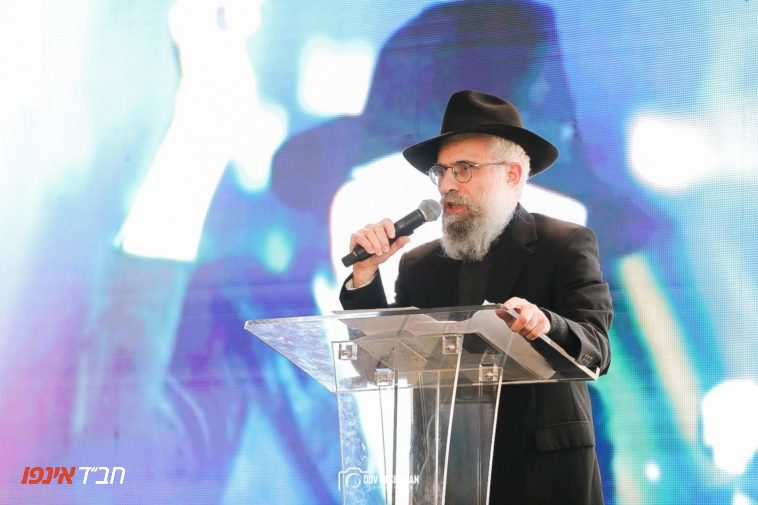
900 years passed until the Rebbe MH”M, Sar HaTorah, decided the time had come to publish the Rambam’s halachic sources in orderly fashion.
It was at the farbrengen the night of 15 Av 5744 when he said to publish a kuntrus of sources for the piskei dinim in the Rambam’s Yad HaChazaka. The Rebbe explained that the Rambam himself wanted this. He said that even though there are sefarim which have sources for the Rambam’s psakim, these sources are scattered over many sefarim which is why they should be collected and published in one place to be accessible to the learner.
“The idea itself came up many years earlier,” said Rabbi Mordechai Menashe Laufer, shliach of the Rebbe and director of a Chabad House in Rova 11 in Ashdod, who was a talmid on Kevutza at that time. “The Rebbe himself cited sources for psakim of the Rambam as well as sefarim that dealt with this. In addition, with the start of the takana of learning Rambam daily, there were special section in various journals in which Anash and tmimim wrote up sources for the Rambam.
“At a certain point, the Rebbe asked the editorial boards of the journals themselves to collect the sources in one place and to add the existing sources from previous commentators as well as continue to compile new sources in the journals.”
Eventually, the job was given to the members of the Rebbe’s kollel.
Starting the Work Immediately
As mentioned, in that farbrengen on the eve of 15 Av 5784, the Rebbe made the request in public.
As R’ Laufer tells it, “The Rebbe said to start collecting sources from the beginning of the sefer and to find sefarim and authors that already dealt with doing similar work, collecting all the sources, and publishing them in one place.
“The Rebbe also pointed out that those who owned rare sefarim that dealt with clarifying sources in the Rambam should send them to the editorial board.”
Rabbi Shaul Moshe Elituv, member of the Kevutza of 5744, remembers the feeling of that time: “The Rebbe said how beneficial this work would be: 1) By looking into the sources in depth, this would increase comprehension and understanding, give and take etc, without having to devote time to looking for sources, since everything is in the sefer; 2) When halacha is learned with the sources and reasons, one can reach halachic decisions from the Rambam’s work.

“The Rebbe also asked that the work be started immediately and to try and finish it with all possible speed. The Rebbe said that if it would be necessary to make corrections and add notes they could easily do so later and issue a second, corrected edition.”
On Monday, 16 Av, the members of the kollel began to develop a work plan. The Rosh Kollel, Rabbi Yosef Avrohom Heller, was called to Rabbi Chodakov and he received instructions and was also asked who was involved in the work and what was the plan of action.
The yungeleit were divided into groups with some of them working on collecting sefarim that bring sources while other began the work of writing. Each of the yungeleit received some chapters of the Rambam’s sefer and had to finish the work by the end of the week. Rabbi Moshe Friedman a’h led the teams.
‘mivtza’ Marei Mekomos
Rabbi Yitzchok Pruss, one of those involved in editing the sefer, relates:
All the yungeleit in the kollel began working on collecting sources. We received guidance in how to do so and made quick progress thanks to the earlier commentators who already began working on this. We did a lot of work to find the source for every detail. I remember that we used Gemaras, Rashi, the Gaon (Gra) and various sources to try and find sources for every detail.
The Rebbe stayed on top of us, and every so often we had to send him what we already had. The Rebbe said not to waste a lot of time searching over every halacha but to collect the most readily accessible sources and in the future we would complete the compilation of sources for the entire Rambam.
The work was done according to a plan and we covered about fifty chapters a day, with the entire Yad HaChazaka containing 1000 chapters. We planned to finish the work within several weeks.
As mentioned, we had to present to the Rebbe what we had already managed to complete. Setting the words for print wasn’t as advanced as it is today. The publishing crew, led by Rabbi Asher Heller, who gets a lot of credit, worked very hard. With the conclusion of every chapter we had to go to the printer and they would set the text and then we had to go over the galleys and edit them and send them back. This took place a number of times until the work was complete and correct.”
The Rebbe did not let up. It was apparent that he considered it an important and urgent task and nobody knew why; of course, no one asked.
At a farbrengen on Shabbos, Chof Menachem Av, the Rebbe urged “collecting sources for the piskei dinim in the sefer of the Rambam,” and said, “this is like the ‘wellsprings’ which are the source of the water.”
The next day, 21 Av, when he returned from the Ohel, the Rebbe announced a sudden farbrengen in the course of which he urged again about publishing the sefer. We felt that this was an otherworldly matter. The Rebbe said to print what was already ready and then they would print a kuntrus “second edition” which would complete the work of providing sources “that require searching” as well as those that needed “a search within a search.”
The next day, there was a meeting of the members of the kollel and it was decided to speed things up. The Rebbe asked, immediately after the meeting, what had been decided and what they had already accomplished. So too, the next day and a few additional times throughout the week. When the Rebbe received a report on Sunday, 28 Av, he noted his dissatisfaction for the zerizus was not ‘mehadrin min ha’mehadrin.’
In light of that, the decision was made to complete the work by the next day, erev Rosh Chodesh Elul, in advance of the Rebbe’s trip to the Ohel.
We entered the dining room in 770 where bachurim were sitting and asked for their help. We wanted to propel the work forward so that we could finish it by the following morning or early afternoon, before the Rebbe went to the Ohel. We wanted to be able to tell the Rebbe that we had finished the job.
“We got a large group of yungeleit and bachurim and each one was given instructions. They were given the material from which to collect sources and each one was allocated four chapters. We worked hard and under great pressure.
R’ Laufer said, “In every corner of 770 and the kollel you could see groups of chevra working on it, both energetically and seriously.”
Rabbi Moshe Akselrod wrote in his diary, “Any minute now, the Rebbe is going to the Ohel. Yesterday, the members of the kollel announced an emergency campaign in connection with source citations in the Rambam and enlisted all the bachurim. Each one took four chapters out of the 400 remaining chapters. Throughout the night and day, until noon, everyone sat with sources and finished them all. They informed the Rebbe that the work was completed.”
The Nachas Provided to the Rebbe
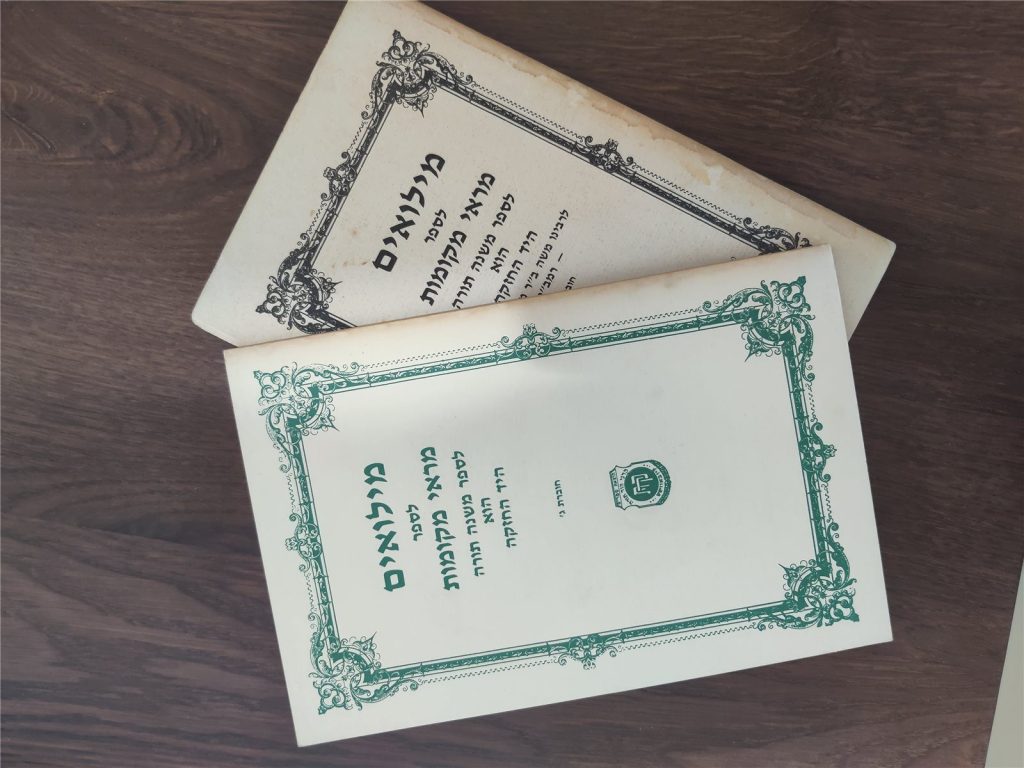
On Tuesday evening the material was submitted to the Rebbe. In the days that followed, the printers at Empire Press worked to typeset the sefer and prepare it for print. The sefer was ready by Shabbos, parshas Ki Savo, 18 Elul, and it contained 848 pages!
The Rebbe walked into the farbrengen on Shabbos while holding the new sefer. “Fortunate is the lot and great is the merit of all those who were involved in this work, about whom the verse says, ‘those who teach righteousness to the masses will be [as radiant] as the stars, forever and ever.’” The Rebbe said that from the outset he asked not to wait until the work was finished. The first sefer would be a sort of “first edition” and afterward there would be supplements or a second edition.
At the end of the sicha, he blessed those who did the work, “May all the members of the editorial team and the one who led it at their head, add energy and chayus in all that is associated with the second edition and completing this work in the most complete way possible and with alacrity.”
At the end of the sicha, the Rebbe poured mashke for the leading members of the editorial team: Rabbi Moshe Friedman, Rabbi Yosef Avrohom Heller and Rabbi Yitzchok Pruss.
“The sefer is a powerful and unique work,” said R’ Heller. “It essentially actualizes the heart’s desire of the Rambam who wanted to do it himself, as he notes in his letter.”
The Rebbe himself testified to that in explicit terms, “When students of the Rambam, students of his students etc. and in general all those who cite sources for the sefer of the Rambam, this fulfills the Rambam’s wish as he wanted to do this himself.”
Supplements and Additions
Then came the second stage, the stage of additions and corrections to the sefer that was published hastily. The Rebbe said that talmidim of the yeshiva who were suited to this work should also work on editing a ‘list of corrections’ for the sefer.
“Hundreds of talmidim enlisted to check over the sefer that had been published. They compared what was in the sefer to the actual sources and many mistakes were corrected,” said R’ Elituv. “The secretaries bought dozens of sets of the sefarim and the work was done day and night. Members of the kollel also worked on additional editing of the sefer and preparing the additions.”
By erev Rosh Hashana, as the Rebbe had asked, a list of corrections and the first round of additions were published in a very attractive format. This kuntrus consisted of 240 additional pages.
In this kuntrus, they filled in additional sources for the book of Nashim along with sources that were collected from new sefarim as well as sources that were sent by various people who became aware of the project.
The Rebbe walked into the farbrengen of 29 Elul holding the kuntrus in addition to the kuntrus of additions to the photographs of Tanya cover pages.
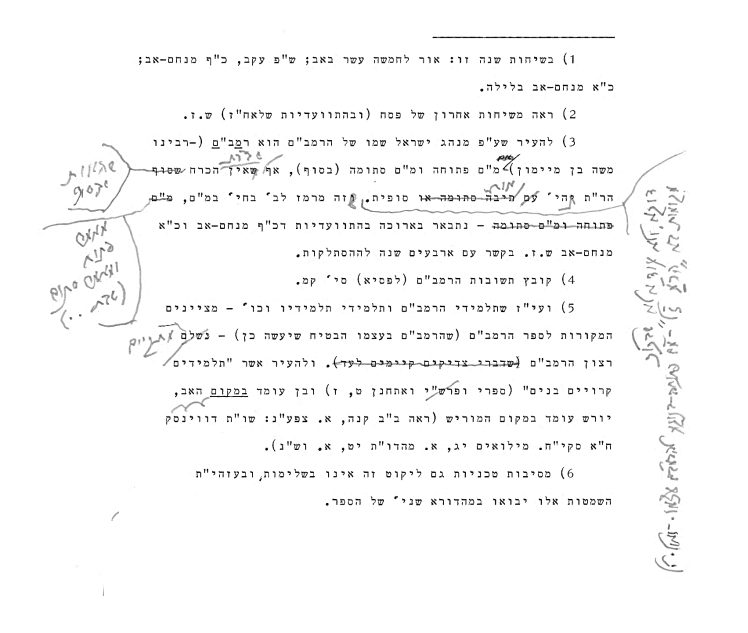
The Rebbe did not allow the project to end at this stage. On Shabbos parshas Noach 5745, he mentioned that the sefer should be published again with all the additions that came in. The Rebbe even suggested a target date: Yud-Tes Kislev.
The sefer was published by Yud-Tes Kislev in a new and corrected edition with additional sources, many additional sources.
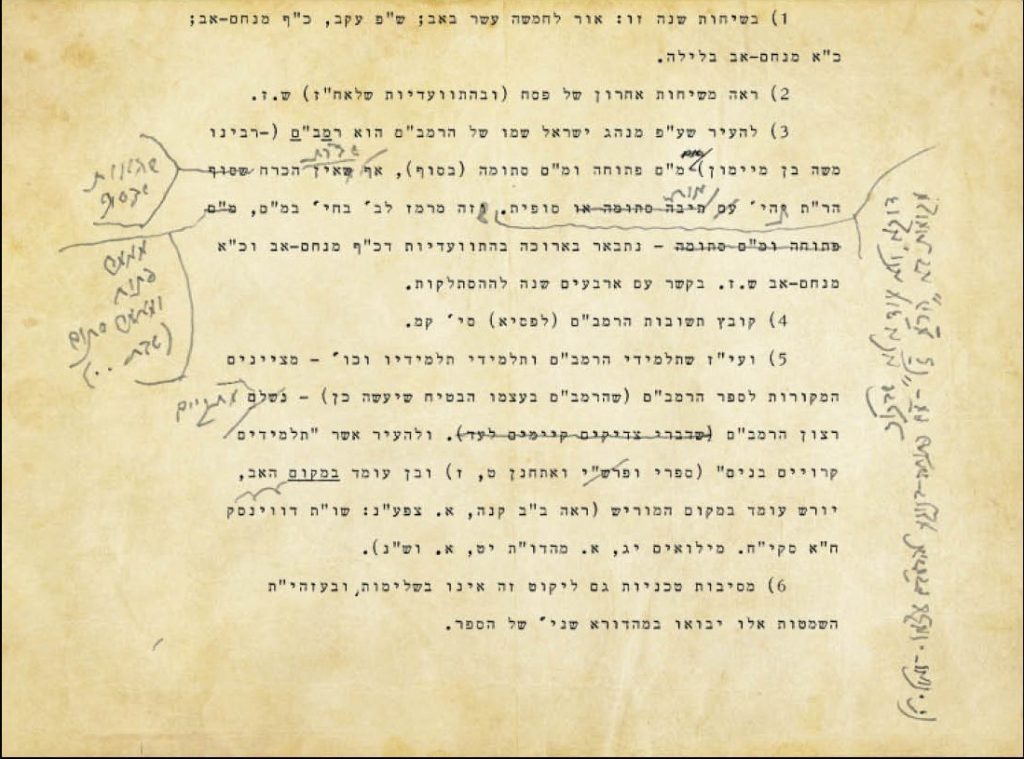
“We worked very hard so that by Yud-Tes Kislev there would be a new, updated sefer, much better than the original.”
Add More Sources
As soon as the sefer was published, the Rebbe said to send it rabbanim and gedolei Torah all over the world, along with the clarification that the sefer was incomplete, and asking whoever was able to send sources or comments to be put into the next edition.
The Rebbe sent the sefer to gedolei ha’Torah with a “general-personal” letter with a postscript stating that “I am hereby honored to offer your Torah honor the sefer Marei Mekomos L’sefer Mishneh Torah Hu HaYad HaChazaka of the Rambam – that was published in the most recent days.”
By the Rebbe’s instruction, the editors included another letter, “We ask that whoever has sources for the Rambam that are not in the sefer or comments on what is cited in the sefer, to send them to the kollel of the Rebbe shlita as soon as possible so we can include them in the supplement which will be published, G-d willing, before Rosh Hashana.”
R’ Pruss remembers:
“We received many sources from rabbanim who responded to the Rebbe’s request.”
One of the gedolei ha’Torah who received the sefer was the Pnei Menachem of Ger who was the rosh yeshiva of yeshivas Sefas Emes at the time and the brother of the Admor. He hurriedly sent a response to the Rebbe:
“To hod kevod kedushas pe’er mikdoshim etc., Admor of Lubavitch. With thanks I received the sources of the Rambam and particularly for those who are prompt and hasten, who study the one-year cycle, and they need to know the sources of things. And I saw in letters of the kollel… asking of those who have what to add, to add; because this edition was done in a rush… In fact, I have noted for myself dozens of additional sources that perhaps can be said to be worth adding, though I thought that they probably know of them and didn’t include them for some reason.
“In any case, bli neder, I will sent them right after Yom Kippur, because I come only to point out, and what they think should be added or omitted they will do…
“I once again bless him in friendship and deep appreciation, Pinchas Menachem ben HaRav HaKadosh of Ger.”
The Rebbe received the letter and was very pleased. He noted on the letter in his handwriting for the secretaries to prepare a response dated “Erev Chag HaSukkos” with a list of titles etc., expressing thanks for “the good news that his Torah honor will send notes [he’aros] (and certainly also – illuminations [ha’aros]) and additional marei mekomos and this is a merit for the many etc…”
After Yom Tov, the Pnei Menachem sent six pages packed with notes, first with eight “that are not exactly identical to the words of the Rambam and require some analysis.” After that, he added another twenty-four clear sources.
When the Rebbe received the letter and the comments, he said to give it immediately to the editors to add it to the new edition.
Said R’ Pruss, “The Rebbe asked that the editors write a thank you letter to the Pnei Menachem and say that the Rebbe gave them his notes etc. Also to write comments and responses to at least some of what he wrote, in order to show honor to the Torah, and obviously that’s what we did.
“In general, the Rebbe indicated tremendous interest in this project, so much so that the Rebbe himself even gave sources for the sefer…”
In a conversation with this author [MK], the head librarian, Rabbi Sholom Dovber Levin, said, “When the sefer with sources was published, I was told to send it along with the kuntrus of supplemental notes to several libraries. When I received confirmation from the libraries that they received the sefer, I submitted their letters to the Rebbe who responded, ‘I saw and thanks. To return. It would be worthwhile to send the above (in my name) also to the renowned Manfred Menashe Lehmann.’ That Menachem Lehmann was a well known philanthropist and sefarim collector and of course I sent him a copy.”
The Rebbe also sent a sefer to the publisher of Yad HaChazaka, Rabbi Yosef Kapach, with the Rebbe writing in his handwriting, “I was happy when they told me that his Torah honor is publishing the sefer of the ‘Yad’ based on handwritten manuscripts etc.” At the end of the generally worded letter, the Rebbe signed off with a personal blessing for success in the above and similar projects, and “With respect and blessing for good news, etc.”
Later on, the Rebbe sent him the booklet of supplements and additions and the new edition of the sefer.
They say that those who worked on the sefer approached the gaon, Rabbi Chaim Kanievsky z’l, who was known for his extraordinary bekius in all areas of Torah. R’ Kanievsky was very impressed by the sefer and said they had “stolen” his work since he had begun working on a sefer Kiryas Melech with sources for the Yad HaChazaka. In his other sefarim on the Rambam he also included sources on the Rambam. He also proffered to the representatives of the editorial team two sources on the Rambam which he found after he published his Kiryas Melech.
At a later point, when other rabbanim sent additional sources to the Rebbe, the Rebbe asked the editors to respond to them with thank you letters.
Add Even More
At the Chof Teves 5745 farbrengen, after an explanation the Rebbe gave on the words of the Rambam, he said, “It is fitting and proper that for the Rambam’s birthday they publish additional marei mekomos as a supplement to the sefer they already published and by doing so, even more will be added in the understanding of the Rambam etc.”
Said R’ Pruss, “Indeed, on erev Shabbos HaGadol, a second booklet of supplemental notes was published. In the years to come, a number of additional booklets were published with additional sources.”
HaTomim #14 • pp. 32-41
© 2026 Beis Moshiach Magazine. All rights reserved.
This article originally appeared in Beis Moshiach #1428. You are welcome to share it with friends and family by email or in print, provided that you do not change, add to or omit any part of it, you credit the author and Beis Moshiach, and you include a link to archive.bmoshiach.org (written out in full in printed copies).
To republish this article in a newspaper, magazine, book or website, please request permission in advance at [email protected].