What It’s Like to Live in Kfar Chabad’s Esrogim Orchards
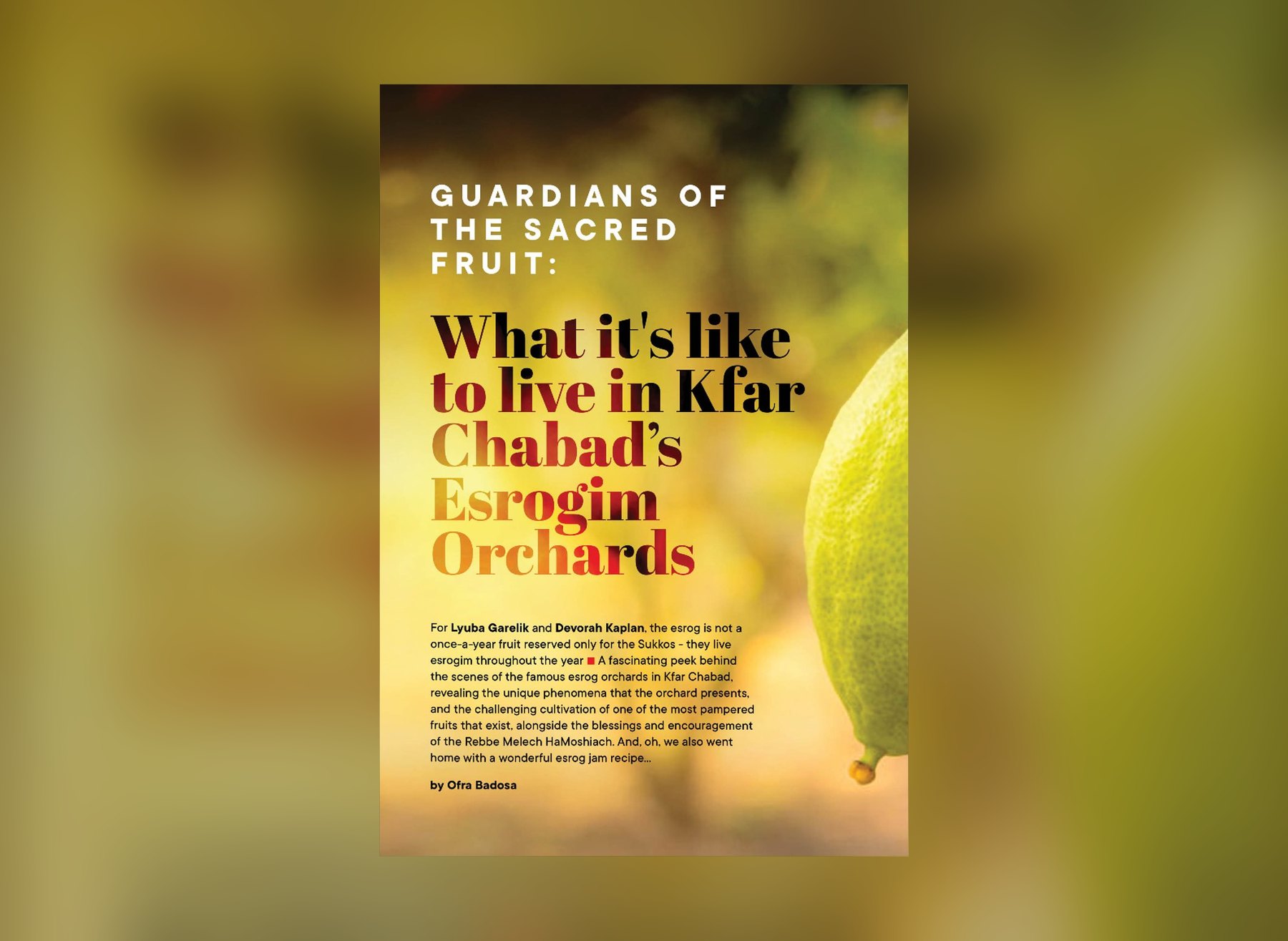
For Lyuba Garelik and Devorah Kaplan, the esrog is not a once-a-year fruit reserved only for Sukkos – they live esrogim throughout the year. A fascinating peek behind the scenes of the famous esrog orchards in Kfar Chabad, revealing the unique phenomena that the orchard presents, and the challenging cultivation of one of the most pampered fruits that exist, alongside the blessings and encouragement of the Rebbe Melech HaMoshiach. And, oh, we also went home with a wonderful esrog jam recipe…
Esrog cultivation is a unique and special field in agriculture. The esrog is the only fruit that is tested solely based on its appearance, beauty, and hiddur. The beauty is not determined by a person’s artistic taste. What is the correct size, what is a beautiful shape, what is a pleasant color, what is a “clean” esrog – everything is determined by halacha.
And why not grow only beautiful esrogim? Well, not only is it difficult to grow, but it’s also not simple to describe the process. So please, patience.
“We deal with esrogim that are bilti murkav (non-grafted),” begins Lyuba Garelik from ‘Garelik esrogim’ in Kfar Chabad:
All citrus trees need strengthening of their weak roots, and this is done by planting a strong wild tree, like a quince, cutting it after it has grown and grafting onto the remaining stock a branch of the citrus tree – orange, lemon, and so on, which develops into a strong well-rooted tree that produces the fruit of the graft.
The non-grafted esrog tree develops on its original, weak roots. This means that every seven to ten years, the tree weakens so much that it stops producing fruit, so we have to uproot it and plant a new sapling. And again, count three years of orlah (forbidden fruit), and then enjoy its fruits for only four, five, six years – and of course all stages are done under close supervision of mashgichim on behalf of the Badatz Yerushalayim who are also experts in agriculture.
That’s the big picture. Now let’s get into the details. In the non-grafted tree, along with leaves and fruits, large and sharp thorns also grow. Any touch of a thorn on the delicate fruit leaves a scar that disqualifies it from being one of the dalet minim.
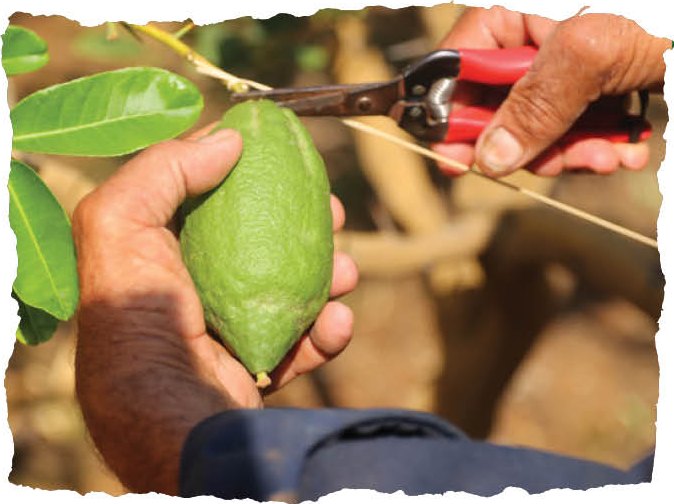
So what do we do? We work. From the moment the bud appears, we tie the branch on which it sits so that it is far from other branches, and leaves and thorns don’t touch it. What do we tie it to? We build wooden or metal frames around the trees to which we tie the branches. Often esrogim appear in pairs or in triplets, and then we need to thin them out for the same purpose, so that the one that remains will be a clean esrog. Not simple.
And let’s get into even smaller details: the pests. We don’t eat an esrog as it is, only if we make jam out of it, or candied esrogim, but the various pests: the flying, crawling, sticking ones – they don’t care that the fruit is bitter. They bite as much as they can, and even if their ability is as small as their tiny size, it’s enough to disqualify a beautiful esrog.
We fight them, of course. We spray and kill them with all kinds of toxic, expensive materials – allowed of course by the Ministry of Agriculture. And we’re careful not to overdo it, because the pesticides can also damage the beauty of the esrogim themselves; stain them with spots and weaken the stem or the pitom. Against other pests, we spread dense nets over the trees that also help to filter out too much sun and stop hail hits.
Esrog blossoming begins at the end of winter. Those who live near orchards enjoy this fragrance, but in winter there are also heavy rains and hail that cause severe damage to trees, blossoms, and the frames holding the tree branches. And if winter is delayed a bit more, the damage will also be to the fruits themselves that are starting to appear in the meantime. After each such event, we run to the orchard to check: How many nets were torn? How many frames were broken? How many trees were damaged? What needs to be rehabilitated? We see the crops we’ve grown and here they are going to waste. So much stress, so much aggravation.
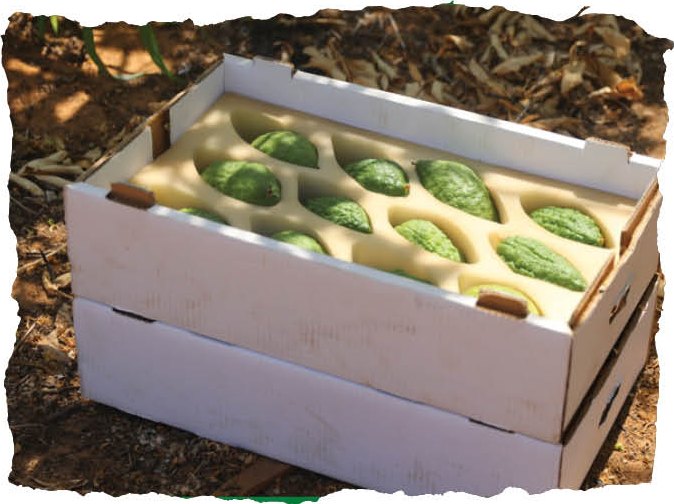
You don’t want me to continue describing to you the complications in harvesting, packaging, havchala – the process that yellows the green fruit, in the shemitta year, in shipments, with picky buyers, each of whom is certainly a ben yachid (only child) to Hashem, and he thinks that’s true with us too… How much patience is needed with everyone who just wants to be mehader and that’s okay, but not always is everything possible.
Once it happened that according to the area of the orchard, it seemed to the tax authority people that we were marketing more esrogim than the amount we reported. They came to check and when they saw the mountain of esrogim that were disqualified, which were thrown away and rotted (see picture), they were convinced that our reports were correct.
So why do we even deal with such a pampered branch? After all, the same sandy soil that is suitable for esrogim and is found on our farm and around Kfar Chabad, can easily grow tasty mandarins, select types of oranges – and in these types, fruit that is not so beautiful is not thrown into the rot pit, but marketed at a lower price or to industry.
The answer to this question is more special than the fruit itself.
Cultivation for the Sake of the Mitzva
We grow esrogim because the Rebbe instructed us to do so. When we started growing esrogim in Kfar Chabad there were many difficulties: large expenses for labor, guidance, water for irrigation, obtaining additional land. At some point we almost despaired and explicitly asked the Rebbe whether to continue. The Rebbe’s answer was unequivocal: to enlarge our orchard of non-grafted esrogim, for two reasons: 1) Because over time there will be difficulties in ensuring that the esrogim in Calabria are not grafted. 2) More and more Jews will want to fulfill the mitzvah of the dalet minim.
The Rebbe instructed the Vaad Kfar Chabad to help us, and you can find letters in the Igros Kodesh to the committee on this subject, and the Rebbe added that if they inform him what funding is missing, he will participate in the expenses.
Although we did not ask for the Rebbe’s participation in investments in our orchard, the very offer greatly strengthened us in difficult years. And there are such from time to time, for all the reasons described or some of them.
In the year 5751, the year of ‘I will show you wonders’, something wonderful happened to us. After years of asking the Rebbe to give us the esrogim he said a bracha on during the holiday after Sukkos, so that we could plant trees from their seeds to provide these esrogim for Anash and all Jews, the Rebbe agreed to deliver to us two esrogim over which he said a bracha, through Rabbi Groner.
The esrogim, along with a note from Rabbi Groner detailing their positive qualities, were handed over to our brother-in-law and partner Rabbi Moshe Naparstek a’h. Since then, all the trees in our orchard have been replaced and all our esrogim are descendants of the Calabria esrogim that the Rebbe said a bracha on that year.
Since this cultivation is entirely for the purpose of a mitzva, there are many unique phenomena around the orchard. For example, in the month of Nisan, people come from Bnei Brak, Yerushalayim, and more distant places to recite the blessing on the trees specifically here, on trees where all the halachos dependent on the land are meticulously observed; orlah, terumah and maasros.
In all seasons, people come and ask for esrogim as a segulah for healing, for easy childbirth, and more. Of course, they get what they want, as much as they want, and without payment. When this happens in the middle of winter, when even the esrogim that have fallen and are rolling under the trees look rotten and unfit for consumption, sometimes I can give them from the jam I prepared at the peak of the season, after Sukkos, and sometimes this jam also contains esrogim on which a bracha was recited during the holiday, and this surely adds blessing.
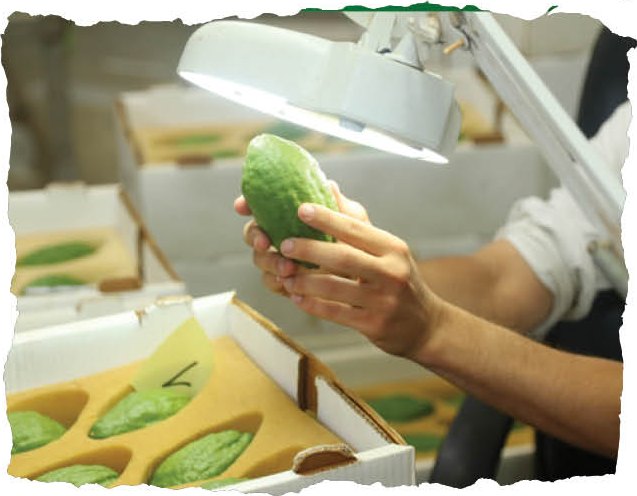
When I look at the whole story of our orchard from its beginning until today, I can say that the Rebbe chose our family for this mission, because here everything is done with the most exacting hiddur, without cutting any corners, despite difficult situations of funding, difficulties, disappointments and losses, always out of trust in Hashem, and the special optimism of my husband, Elazar, who always trusts that “next year will be more successful”, because “it is the nature of Good to do good”.
And the Rebbe put it like this: “I hear good things about Garelik’s esrog orchard and about this honest business, which befits Chabad.”
A Fruit Which Is Hadar
The work in the orchard is very diverse. There are easy things that even children can do, like arranging the ‘sleeves’ wrapping the esrogim. They are happy to do it, and we are happy to increase their allowance accordingly, but what they love the most is the special treat when Saba drives them on the tractor! They sit on the tractor’s wagon and cheer. Even the great-grandchildren and those who come from abroad, look forward to this event and remember it forever.
Tourists from all countries, students from various educational institutions, from kindergarten to college, senior military personnel, ministers and members of Knesset come to Kfar Chabad, to get to know its special character. Among the special things is, of course, the orchard. My husband gives them detailed and interesting explanations about the growing processes, about the many halachos dependent on the holiness of the land that must be observed. The listeners then understand why they have to pay so much for an esrog, because they are also covering the costs of the esrogim that grew at the same time with the same investments, which did not come to use.
By the way, there are also people who specifically want an expensive esrog. It happened that a boy from a Litvishe yeshiva came and asked for a beautiful esrog ‘the most expensive’ one, for his Rosh Yeshiva. When asked ‘But you’re a bachur, how can you afford such an esrog?’ he replied that it’s worth it for him because it will bring him a kallah.
Shliach for Land-related Mitzvos
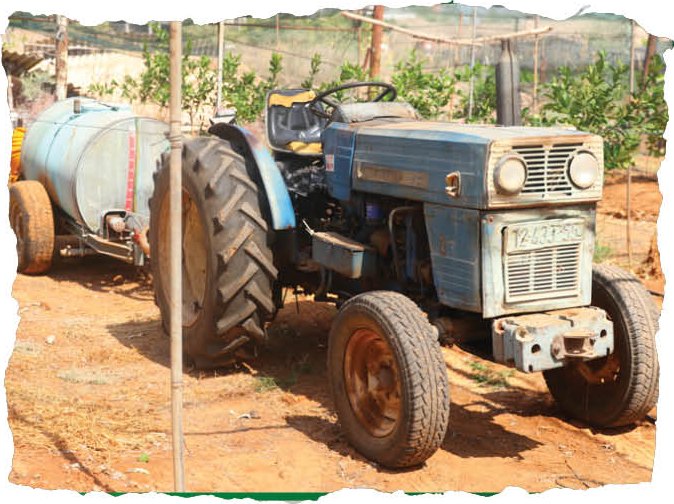
“From as far back as I can remember, our family ‘lived and breathed’ esrog growing,” says Devorah Kaplan, the Rebbe’s shlucha in the west of Rishon and daughter of R’ Nachum Luria, an esrog grower from Kfar Chabad. “My grandfather, R’ Eliyahu Leib Rivkin, received an esrog from the Rebbe with the goal of planting an orchard of esrogim from it, and my father joined my grandfather. When I was one year old, my grandfather passed away and my father continued and over the years, enlarging and expanding the orchard.
“My father is one of the bachurim that the Rebbe sent to Eretz HaKodesh in 5736. He arrived in Yerushalayim and after the wedding moved to Kfar Chabad. They always said that my father is a shaliach for mitzvos related to the land and that’s how we felt, that we’re not just working but working with a mitzva.”
Were you involved in the process of growing esrogim?
Since I was a little girl, I remember all of us involved in growing esrogim. It started already Pesach time, and in Tammuz they picked the esrogim. And for three months, until Tishrei, we were in a work marathon. The girls were very involved in the work. We are eight in the family and each one did what she could according to her age. We inserted the esrog into the sponge sleeve, arranged them in bags. When we grew up, we washed the esrogim and sorted them.
We understood everything related to the field. We advised and sold esrogim to people. For us, the long summer vacation was working from morning to night in the orchard. For us, it was beyond a family business; there was a mitzva aspect to it and it was felt in all stages of the work. And yet sometimes the work wasn’t easy, I remember us sitting with closed eyes, late at night, waiting for my father to finish with a customer.
At some point my father also started growing hadassim, so we specialized in that field too. We were the ones cutting and preparing the hadassim.
Describe the period of selling esrogim, from the perspective of a ‘grower.’
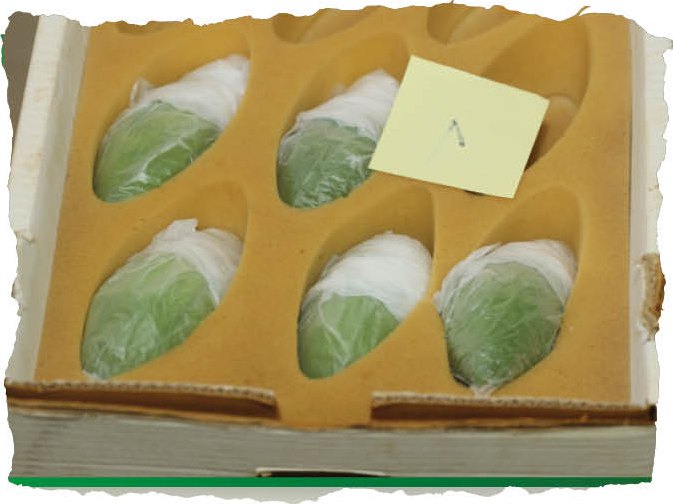
It was a very special time, full of chayus. We enjoyed seeing all types of people who came to us from all segments of the population: Jerusalemites, Bnei Brakites, Litvish, Chassidish. It was nice to see how each one had a different approach. There were those who arrived already in the month of Av to see the esrogim and they would continue to come until Tishrei; maybe they would find a more beautiful and mehudar esrog.
Towards Sukkos the work was almost 24 hours straight. People would arrive even at two in the morning. Every day someone else would stay at home to help my mother. When we returned, we always updated her and shared experiences about the day.
I remember we took a lot of pride in our esrogim. When there was a picture of the askanim bringing an esrog to the Prime Minister we could identify that it was an esrog from our orchard and so too, when we went out on mivtzaim. It’s really heartwarming.
In conclusion, Lyuba adds: “In the Torah, the name ‘esrog’ is not mentioned; it calls it a ‘pri eitz hadar’ (fruit of a beautiful tree). One of the interpretations of the words is ‘fruit that dwells on its tree from year to year.’ Indeed, esrogim are one of the few fruits that do not fall and continue to grow. This is of course not good for the tree, and we must pick the fruits that remain after Sukkos. Sometimes the esrogim reach the size of a melon! It’s very beautiful, and they then decorate our living room and spread a wonderful scent in it – and this too is part of the hadar.”
The Chassidishe Vibe #1430 • pp. 10-15
© 2026 Beis Moshiach Magazine. All rights reserved.
This article originally appeared in Beis Moshiach #1430. You are welcome to share it with friends and family by email or in print, provided that you do not change, add to or omit any part of it, you credit the author and Beis Moshiach, and you include a link to archive.bmoshiach.org (written out in full in printed copies).
To republish this article in a newspaper, magazine, book or website, please request permission in advance at [email protected].