When The Sefer Torah Took a Ferry…
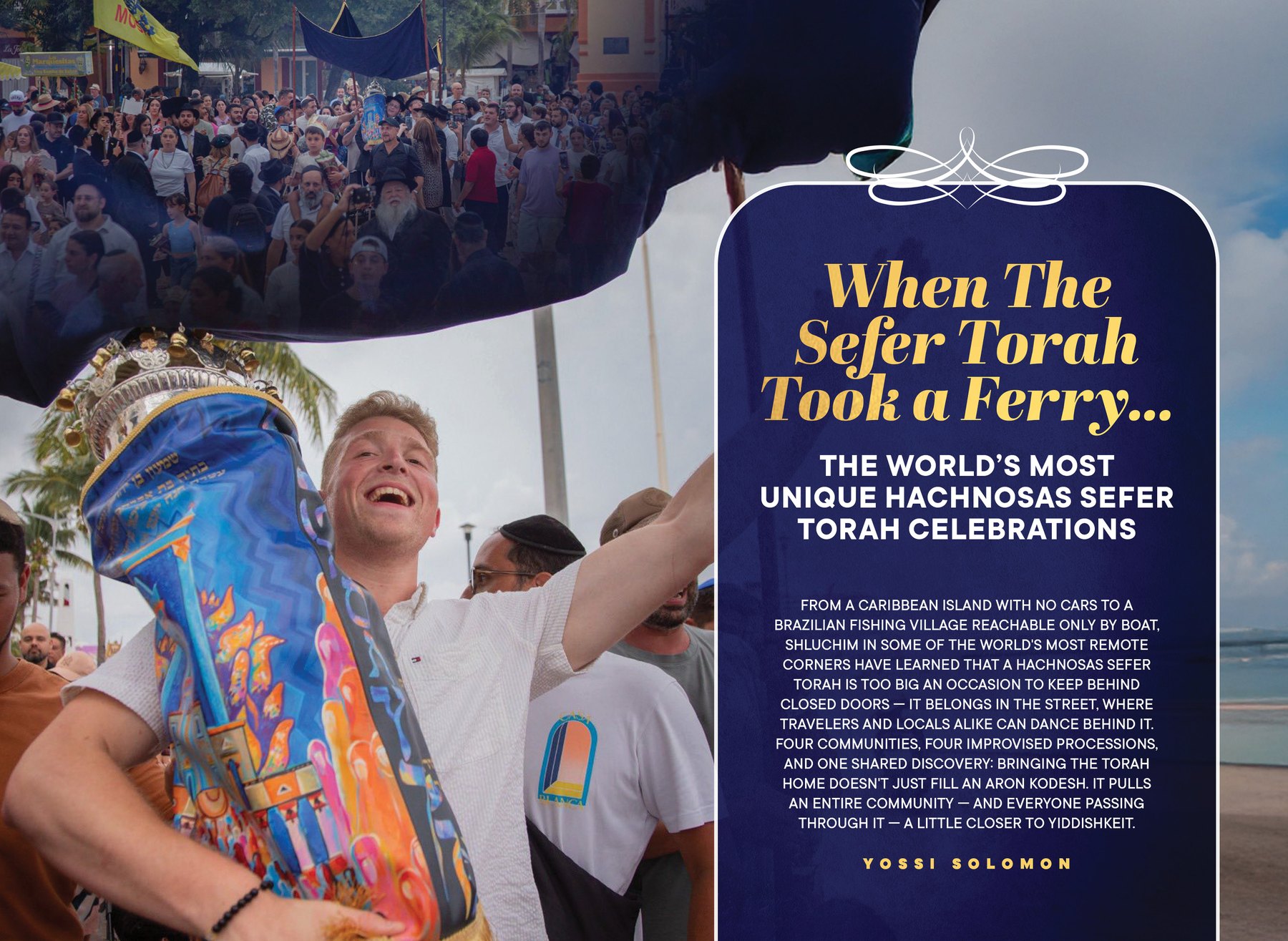
The World’s Most Unique Hachnosas Sefer Torah Celebrations
From a Caribbean island with no cars to a Brazilian fishing village reachable only by boat, shluchim in some of the world’s most remote corners have learned that a hachnosas Sefer Torah is too big an occasion to keep behind closed doors - it belongs in the street, where travelers and locals alike can dance behind it. Four communities, four improvised processions, and one shared discovery: bringing the Torah home doesn’t just fill an Aron Kodesh. It pulls an entire community - and everyone passing through it - a little closer to Yiddishkeit.
Every shliach of the Rebbe MH’M, wherever they may be across the globe, can tell of one of the most moving moments in a life of shlichus, the joyous ceremony of bringing a new Sefer Torah into the Aron Kodesh of a shul at a Chabad House. It is a rare and uplifting event, one that shluchim almost never experience in the ordinary course of their daily work, not that they lack for moving moments…
An event like this, a Hachnosas Sefer Torah, takes on a special quality because of its power to unite Jews from every background: locals and travelers, elderly and young, religious looking Jews alongside those whose lives seem far removed from a life of mitzvos. At such an occasion, suddenly everyone is holding the Sefer Torah, embracing it warmly, shedding tears of emotion, and dancing around it in honor of the Torah.
Ahead of Simchas Torah, the day on which the soul becomes infused with the holy Torah, and without distinction of age, status, or knowledge, everyone dances embracing the Sefer Torah, we spoke to several shluchim around the world, those who had a Hachnosas Sefer Torah into their own Chabad House, and asked them to share the special event they experienced, the community that came together around the great celebration, and the Jewish sparks that suddenly became flickering, dancing flames in the warmth of Torah.
We reached out especially to shluchim stationed in rather remote corners, far from large, central Jewish communities - from Cozumel in Mexico, to Morro de São Paulo in Brazil, and even to Nicaragua. The shluchim lift the curtain and reveal the less glamorous, yet still moving, behind-the-scenes details - the logistical challenges, the difficulties and their solutions, and the small moments that turn each event into one that illuminates the life of the entire community.
A Pesul Found in the Very Aliya of the One Who Would Later Donate It
Cozumel, Mexico is known as a tourist destination visited by masses of travelers from around the world, among them, naturally, many Jews - and not a few Israelis.
Yes, there is also a small Jewish community there, only about a hundred and fifty Jews. At the Chabad House, three minyanim take place each day, most of them tourists who have arrived on the island. “At a certain point it became clear to me that we needed to bring our own Sefer Torah here,” says Rabbi Dudi Caplin, the shliach in Cozumel. “The ones who donated the Sefer Torah were my wife’s parents - Rabbi Baruch Mordechai and Devora Sofer - who decided to bring in the Sefer Torah l’ilui nishmas their parents.”
Interestingly, every Chabad House has its own story about the need to obtain a Sefer Torah. For example, at the Chabad House in Morro de São Paulo, Brazil, one Shabbos a young man who had been educated in Chabad in the past - and had over time drifted somewhat from the derech - was called up to the Torah. The Sefer Torah was an old one, borrowed by the shliach’s father, Rabbi Yaakov Gerenshtat.
During his aliya, a pesul was discovered in one of the letters, and in accordance with halacha, the Sefer Torah was wrapped and sadly returned to the Aron. “This fellow couldn’t believe that a pesul in the Sefer Torah was discovered specifically during his aliya,” relates the shliach, Rabbi Mendy Gerenshtat “The young man felt pain and a sense of loss. ‘When I get to Israel, I’ll donate a new Sefer Torah to you,’ he promised us.”
A month and a half later, the tourist season in Morro ended, and the shluchim traveled to Israel. They spent Shabbos at the home of that same young man - with the meals held at the home of Rabbi Chanan Kochanovsky, the Rebbe’s shliach in the Neve Yam neighborhood of Rishon LeZion. After the davening, R’ Kochanovsky called the young man up and asked him to tell the whole congregation the story of what had happened to him in Morro. When he finished, R’ Kochanovsky asked everyone present: “Who wants to donate a Sefer Torah?” One of those present stood up and said he would donate one - and that is how a Sefer Torah was donated to Morro.
A similar but different story took place in Nicaragua. One Shabbos, a traveler arrived at the Chabad House who, outwardly, didn’t seem particularly connected to Torah and mitzvos. He had come to help complete a minyan. When the congregants reached the point of the Torah reading, Chumashim were pulled from the shelf and handed out to everyone present, and so they began reading that week’s parsha.
“Wait, where’s the Sefer Torah?” the traveler asked, astonished.
“We don’t have a Sefer Torah at the moment,” the shliach, Rabbi David Atar, answered sadly. The traveler was stunned. “We have to get you a Sefer Torah,” he said.
Rabbi Atar comments, “Because so many people make promises to the Chabad House that they don’t follow through on, I took his words with a grain of salt - a Sefer Torah, after all… But the traveler was completely serious.
“Motzoei Shabbos, he called his father, a wealthy man living in Miami. The next day his father contacted me and asked what the story was with the Sefer Torah. I explained that we needed one but had no one to donate it.
“‘Fine,’ he replied, ‘I’ll start working on it.’ I thought he meant he’d contribute the first thousand dollars or so, but the father took the matter completely seriously. ‘It can’t be that in some shuls dozens of Sifrei Torahs sit in the Aron, while the only shul in Nicaragua doesn’t have even one.’
“He began talking to his friends in Miami and hearts opened. In the end he managed to raise the money from several Jews, along with help we received from Jewish communities in Venezuela and Nicaragua.
“I won’t forget the day he called and said: ‘I’ve raised the donation for your Sefer Torah, but there’s a small problem.’ I thought to myself, ‘well, there’s no progress without delays and problems’…
“He said he didn’t see how he’d manage to get to Nicaragua in the coming month, and asked whether we could send someone to Miami to pick it up; he would buy him a round-trip plane ticket. ‘If that’s the problem, everything will be fine,’ I answered with relief, and sent one of the bachurim who works at the Chabad House.”
For Rabbi Aryeh Raskin, the Rebbe’s shliach in Cyprus, the need for a Sefer Torah grew after the Simchas Torah massacre, when the number of Jewish families living on the island rose to nearly five thousand, most of them Israeli families. The Sefer Torah was donated by the Yudkin family from Kfar Chabad, l’ilui nishmas their son, a soldier, may Hashem avenge his blood, who fell during the current war. His brother, Rabbi Levi Yudkin, serves in Cyprus as part of the team of shluchim, and it was for this reason that his parents decided to donate the Sefer Torah specifically to the Chabad House in Cyprus.
* * *
The Sefer Torah itself is one element - a central one, certainly, but one of many. No less important is the grand, festive event held in the Torah’s honor - the Hachnosas Sefer Torah. The Rebbe Rayatz elaborates in one of his letters on the festive significance of a Hachnosas Sefer Torah into the Heichal.
For shluchim, this matters all the more, since such an event is used to the fullest to connect more and more Jews to the life of the community, to the shul, and to a love of Torah. Since it takes place on a weekday, it’s an opportunity to reach out even to Jews who are distant (in both senses of the word) so that they come participate, body and soul.
If you chose to bring a Sefer Torah into a shul in Kfar Chabad, or in Crown Heights, or any other Jewish location, no problem. You can arrange to rent a truck decorated with all the trimmings, a sofer to come complete the final letters, an elegant seudas mitzva - it’s all within easy reach. Even the pekelach handed out to the children are easily arranged.
In Nicaragua or Cozumel, however, it’s an entirely different, more complicated story.
From Tractors on the Island to Fireworks in the Procession
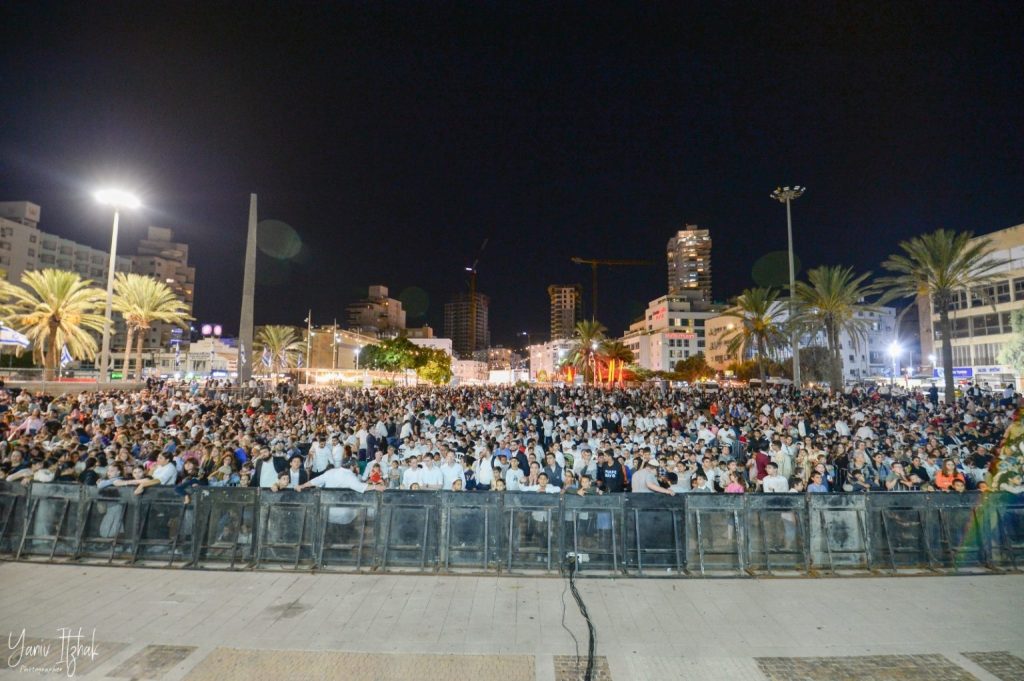
How do you organize such an event logistically?
Rabbi Dudi Caplin: “My father- and mother-in-law, who donated the Torah, brought the Sefer Torah with them from Eretz Yisrael. One of our staff members, Yisroel Hillel, who is a sofer, completed the writing of the final letters and closely followed the entire siyum process to make sure everything was done properly and according to halacha.
“As for the music, we hired a local DJ. We sent him the songs to be played and he played them. For the seudas mitzva, the kosher restaurants that operate regularly alongside the Chabad House took care of things, and they were the ones who supplied the kosher food.”
For Rabbi Gerenshtat in Morro, things were a bit more complicated. Transportation to the town is by sea, mainly via a ferry from Salvador (a 60-kilometer/37 mile crossing) or small catamaran boats or by regular flights between Salvador’s airport and the local airstrip. Because of this, the main logistical challenge was simply getting the Sefer Torah there. “In the end, the donor’s son took on the complex task himself,” relates Rabbi Mendy Gerenshtat. “It took several flights, continued by ferry - until the Sefer Torah arrived on the island, boruch Hashem.
“Since there are no cars on our island (the only vehicles that move around the island are tractors, and they’re also used to transport people), we couldn’t lead the tahalucha with a decorated car the way it’s done everywhere else. So we hooked up a few speakers to wheelbarrows, brought in some local non-Jewish helpers to push them and that’s how we held a joyous Hachnosas Sefer Torah, in our own special way…”
Getting the Sefer Torah there was also complicated in Nicaragua. “Flying a sofer out here is a complicated and expensive logistical matter,” relates the shliach, Rabbi David Atar. “So instead, we brought the Sefer Torah here already finished, and only did the stitching together of the parchment sheets here. That’s a task any knowledgeable person can perform; it doesn’t require a sofer specifically.” Apparently, there are places where everything has to be carefully calculated.
R’ Atar also used the car of a local DJ, who drove through the city streets with his sound system, playing songs the shliach had provided in advance. “We walked behind him with the Sefer Torah, in joy and dancing, through the streets, with the approval of the local police.”
When the Music System Breaks and a Singer Emerges from the Crowd
Were there any particular difficulties you ran into while organizing the event?
“Preparing everything needed for such an unusual event is a special challenge. Not a hardship, but definitely a challenge,” R’ Atar smiles. “You can readily understand that if in Israel you can simply order catering, here we had to prepare the kosher food ourselves. Of course, appropriate preparations were made with the help of the kitchen and logistics team, and thanks to that, everything went off very successfully.”
The one hitch that did occur was, of all things, with the Chassidic music played at the event. “During the seudas mitzva, the DJ equipment suddenly stopped working right at the moment the joyous part was supposed to begin… By incredible hashgacha pratis, there happened to be someone present who had undergone giyur, with a fine voice, and together with my brother-in-law, Dubi Piamenta, the two of them broke into song and brought joy to the crowd.”
For R’ Caplin in Cozumel, there was only one “pleasant difficulty,” hosting everyone who had already arrived for the Shabbos before the Hachnosas Sefer Torah. Many family members and others came to celebrate with them and to pay homage, and arrangements had to be made to host them all. The event itself took place in a large hall that comfortably held everyone.
In Cyprus too, the shluchim encountered no particular problems aside from the fact that the police wouldn’t allow the procession to pass through the main streets, only the streets near the Chabad House. “Of course we had to obey and that’s what we did,” says the shliach, R’ Raskin.
The First “Bible Month” in Mexico’s History
Could you share an unforgettable moment or a surprising story that happened during the event or as a result of it?
R’ Dudi Caplin: “At first we thought we’d hold a small event, but then we decided to use it to spread the light of the Geula and the Seven Noahide Laws throughout the region, and that’s what happened.
“We thought we’d run into problems with permits and licenses but, boruch Hashem, not only was there no difficulty getting approval for the Sefer Torah procession, but the municipality itself joined in, funded part of the event, and took care of all the required permits. That’s how the event became an official municipal event that achieved great success. I learned from this that even an event that looks small and local can become one with international resonance and a kiddush Hashem if you just step outside the limits you set for yourself.
“What moved me personally was seeing so many non-Jews come to the special ‘wishes station’ we set up so they could write notes that I promised to bring to the Western Wall. It was an especially moving sight. At a time when many Jews around the world are afraid to walk openly with Jewish symbols, here we saw all the gentiles supporting us and expressing appreciation; it was heartwarming.
“During the event we also held a joint singing of ‘Shir LaMaalot’ l’ilui nishmas the fallen soldiers and for the release of the hostages. Crowds, including non-Jews, joined in the singing using sheets we handed out with the letters in Spanish transliteration while the words were said in Hebrew. It was both uplifting and moving.”
It turns out that specifically this public, in-the-street, unapologetic Jewish pride has the power to draw in many Jews, even ones who don’t always identify that way.
“Very few Jews live in Morro itself, maybe 13–14 in total,” says R’ Mendy Gerenshtat. “At the end of the Hachnosas Sefer Torah, a woman in her 40s approached me and told me she was Jewish. She said that she was originally from Argentina, left her parents’ home at 17–18, married a non-Jew, and moved to live in Morro. Since then, she said, she hadn’t seen anything Jewish. Thanks to the Hachnosas Sefer Torah, which all the local residents attended, she came too, experienced the event, and the Jewish spark in her was reignited. Since then she’s been coming more and more to the Chabad house.”
R’ Raskin from Cyprus also reports on Jewish pride created in the city streets: “In recent years quite a few new Jews have arrived here, many of them Israelis, but until this event they didn’t feel any sense of belonging to the community. It was specifically the Hachnosas Sefer Torah, dedicated l’ilui nishmas the fallen soldier, that made them come with their children and participate in person. For many of them, this was the first time in their lives they took part in a Jewish event like this, and it was very moving.”
R’ Caplin adds a story about a local Jew from the Syrian community who didn’t really connect with the event. “He came because he initially thought it would be a small event held within the walls of the shul. When he discovered we were marching down Gaon Yaakov Street and making noise, he got angry, claiming it was provocative toward the gentiles. I explained to him that on the contrary, it strengthens Jewish pride.
“At the same time, we handed out over a thousand flyers with candy explaining in Spanish exactly what we were doing, and we received one hundred percent support from the residents. When I finished speaking at the event and got off the stage, that same man was standing next to me. When the deputy mayor spoke and got off the stage, he saw her come over to me and say, very moved: ‘Rabbi, I want us to hold a march here every year in honor of the Torah.’ When he heard that, he was in shock. Only then did he understand that when a Jew respects himself, the gentile respects the Jew too…
“In addition - for the first time in Mexico’s history - the municipality declared the month of August as ‘Bible Month.’”
“The locals too understood the importance of the Hachnosas Sefer Torah and came to participate in the simcha,” adds R’ Gerenshtat. “Someone connected to the municipality stopped everything for us and brought special fireworks to enhance the tahalucha… We walked in the middle of the street while the locals stood on the sides and applauded. Relative to the standards here it was a great kiddush shem Lubavitch.”
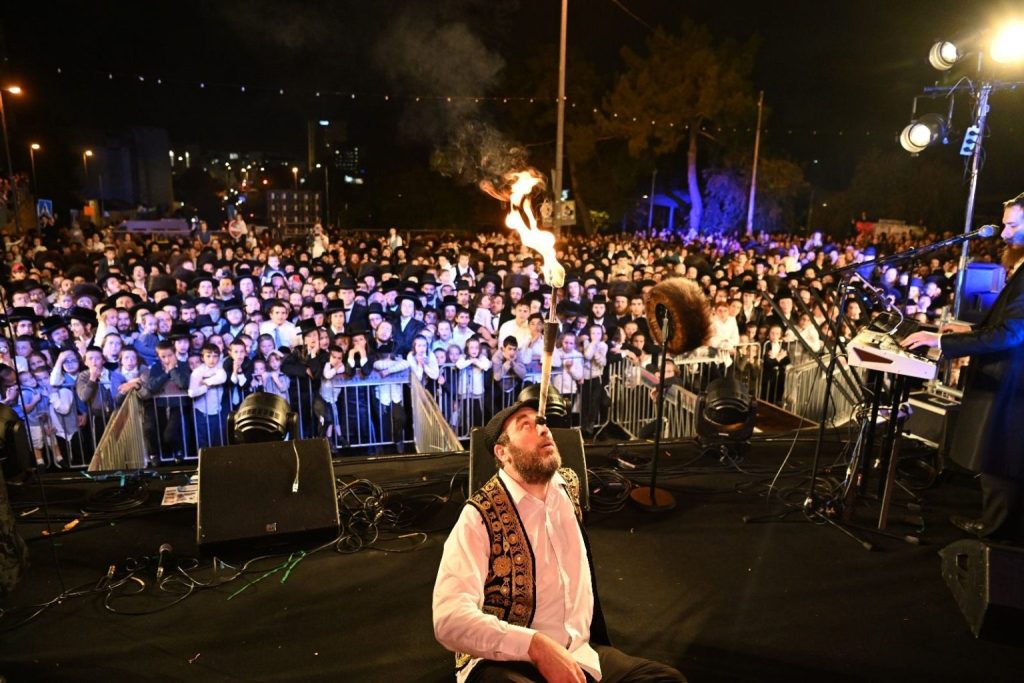
It turns out there was a kiddush Hashem in Cyprus too, as R’ Raskin recounts. “Many non-Jews who support Israel also came to express their solidarity with the Jewish people. The day before, a large anti-Israel protest took place here and the police were worried about the situation flaring up alongside our event, but boruch Hashem everything went calmly.”
Culture Shock in Cozumel
Can you tell us about donors or families who came especially for the event? And if so, how did they experience meeting the local public you deal with all year round?
R’ Caplin: “Friends of the Chabad house came here from all over the world out of solidarity and this moved us greatly. We told them in advance it was going to be a powerful event, and they were culturally shocked. One friend of the Chabad house who came especially said this was the most moving Jewish event she’d taken part in in her entire life. You couldn’t help but see the tears streaming from her eyes during the event.”
R’ Raskin: “The Yudkin family came from Kfar Chabad together with the Sefer Torah. You couldn’t help but see the pain on their faces over the loss of their son but they were very moved to meet the Jewish public, mostly Israeli, that came to strengthen and support them.”
An Island of Holiness in the Jungle
To what extent can you see the event’s impact on the local community or on travelers as far as their connection to Judaism?
R’ Mendy Gerenshtat: “Throughout most of the year many travelers come here, some of whom get called up to the Torah with us for the first time in their lives so the need for a beautiful Sefer Torah is definitely necessary.” He describes the impact of a first aliya l’Torah at the Morra Chabad house: “One Shabbos a Jew came who seemed far from Torah and mitzvos. He was the tenth man for Shacharis, and I asked him to complete our minyan. Later, I asked him if he had ever been called up to the Torah, and he said no. I then asked if he had ever put on tefillin, and again he said no. I told him he should be called up to the Torah now, and tomorrow we’d put on tefillin with him… He was embarrassed and explained that he would have liked to be called up, but he’d come to shul with his phone, and he felt uncomfortable… After some hesitation, he put the phone aside and was called up to the Torah. Afterward he stayed at the Chabad house for a while longer. A month later he came up to me and said he wanted to atone for the Shabbos on which he was called up to the Torah despite having been mechalel Shabbos…”
R’ Gerenshtat shares another interesting story: “There’s a famous Israeli who lives in Morro who is far from Judaism to the point that he once even spoke out against us… The day after the Hachnosas Sefer Torah, he came to the Chabad house feeling emotional, and said he’d felt an island of holiness within the island and that was very special for him, since the island is usually completely far from anything Jewish. He also asked to put on tefillin and since then he tries to put them on every day.
“There was also a family living on the other side of Morro, in the jungle, who had never made it to tefillos at the Chabad house or to other events. But when they heard about the Hachnosas Sefer Torah, they decided to come and participate. The event moved them deeply and ignited the spark of Judaism in them. As a result, they left the island and moved to a place which is more conducive to keeping mitzvos.”
R’ Raskin notes that the Sefer Torah brought into the Cyprus Chabad House has the power to connect and bring people closer together. “In the days after the event, we invited many people to come to the shul and take part in the Torah reading from the new Torah. Many people who don’t usually come to the shul came to see the Torah, and some were even called up to it, giving them a powerful Jewish experience.
“And in general, the Torah is a tree of life. ‘It is a tree of life to those who hold fast to it.’ We hold on to the Torah even in difficult days, and we know that the merit of the Torah will also benefit the souls of all the kedoshim who fell in the war.”
R’ Atar: “We had a traveler who came to us on Shabbos, and I invited him to be called up to the Torah. He was very surprised and asked: ‘Don’t you only get called up to the Torah at your bar mitzva?’… I explained to him that you can be called up your whole life… And indeed, he merited being called up to the Torah here for the first time since his bar mitzva.
“Besides that, every Shabbos morning we invite travelers to the Chabad house for jachnun (a traditional, slow-baked Yemeni Jewish pastry made of thin, rolled layers of dough brushed with butter or oil and cooked overnight for Shabbos) and that draws many Israelis, reminding them of home cooking. After the meal we ask them to help complete our minyan for Shacharis, and thanks to that, many Jews have been called up to the Torah with us for the first time in their lives!…
“In general, these days, Am Yisrael is thirsty for the holy Torah. You can clearly see how much power an event like this has to connect all parts of the nation. In Nicaragua there are travelers you wouldn’t have expected to be Torah-and mitzvos-observant, but suddenly you see them wearing wool tzitzis, something that once would have been seen as a ‘religious burden.’ Today people can’t wait to hear words of Torah.”
Beis Moshiach #1524 • י״ד תשרי תשפ״ז • pp. 48-56
© 2026 Beis Moshiach Magazine. All rights reserved.
This article originally appeared in Beis Moshiach #1524. You are welcome to share it with friends and family by email or in print, provided that you do not change, add to or omit any part of it, you credit the author and Beis Moshiach, and you include a link to archive.bmoshiach.org (written out in full in printed copies).
To republish this article in a newspaper, magazine, book or website, please request permission in advance at [email protected].