The Moshiach Patch Controversy
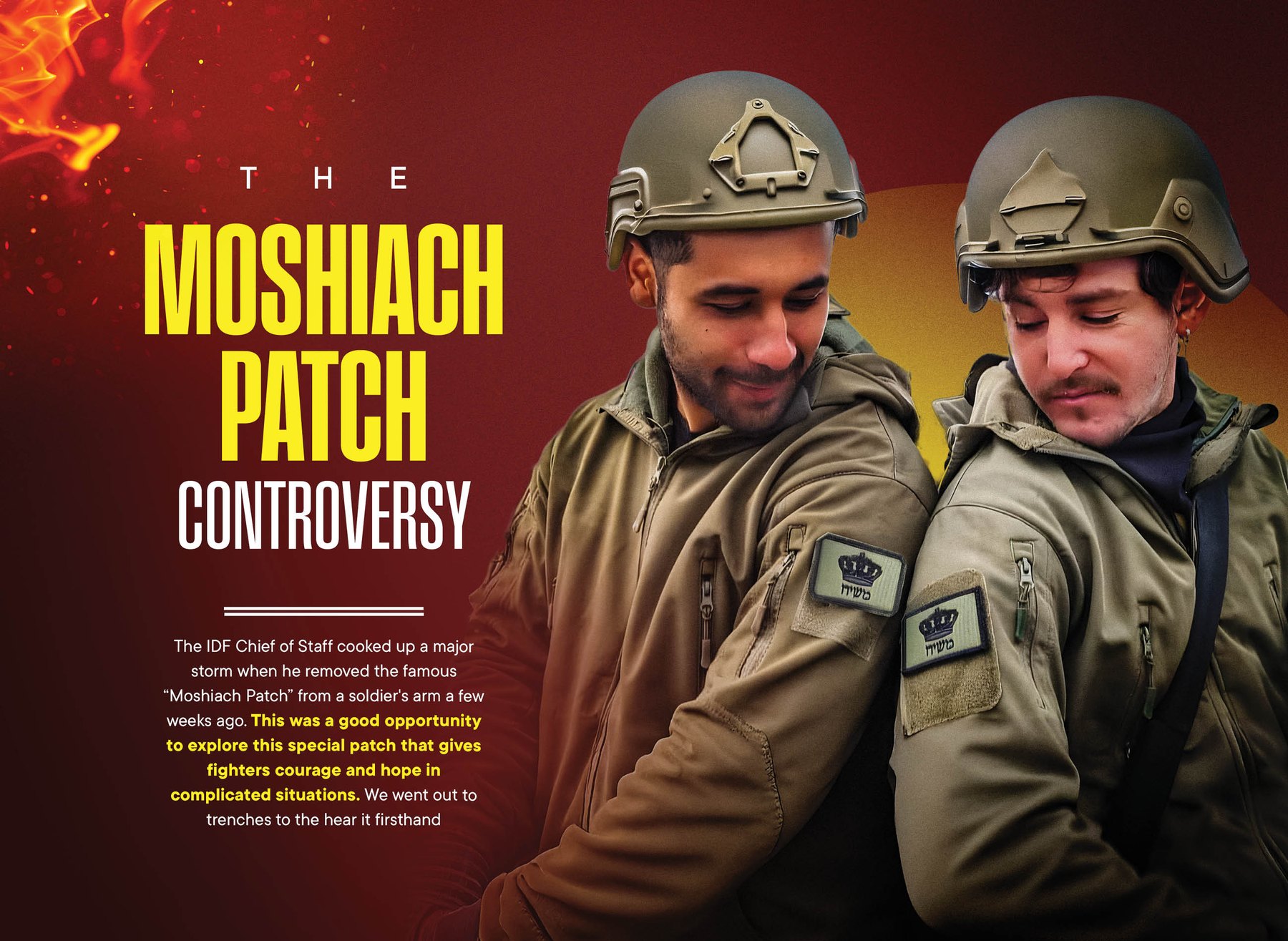
The IDF Chief of Staff cooked up a major storm when he removed the famous “Moshiach Patch” from a soldier’s arm a few weeks ago. This was a good opportunity to explore this special patch that gives fighters courage and hope in complicated situations. We went out to trenches to the hear it firsthand
In the alleyways of Gaza, between destroyed buildings and the smoke rising in the dense air, the soldiers determinedly take on the enemy. On their shoulders there are insignia indicating the soldier’s role in a unit. Some also have a Moshiach sleeve patch.
Way up north, in the deep wadis of Lebanon, among the thick cedar trees and the fog wafting from the mountains, the same Moshiach patch is worn with pride among the soldiers.
“There are moments in the fighting,” says Sergeant First Class Dovid Amitai, a Golani soldier operating in the Jabalia refugee camp, “that you feel depleted. The heat is oppressive, dust enters your moth, nose and eyes, thirst dries your throat, and there is unbearable tension. Then you see the patch on your friend’s uniform and are reminded of what the Lubavitcher Rebbe said about the imminent Geula and you are suddenly filled with new strength, as though the Rebbe himself is here with you, within the hell.”
* * *
The origin of the Moshiach patch goes back to the nineties when the Rebbe began emphasizing the imminent arrival of Moshiach. At the time, the yellow Moshiach flag was chosen to convey the message. The yellow color, symbolizing joy and optimism, with the royal crown and the word “Moshiach,” became identified with Chabad Chassidim around the world. Chabad is the yellow Moshiach, and the yellow Moshiach is Chabad. You can’t separate them.
However, nobody could have anticipated how during the dark days of the current war, this symbol would become a mass phenomenon that would catch on with thousands of Israeli soldiers. In an interview with the person who invented the Moshiach flag, the shliach, R’ Yaakov (Kobi) Ben Ari, he tells about the latest phenomenon which has caught on with IDF soldiers.
His personal story, which began on a secular kibbutz where he was born and raised, provides him with certain advantages now that he serves as the Rebbe’s shliach.
“This is precisely what gives me ability to understand every soldier. I am intimately familiar with both worlds.”
Right after Simchas Torah 5784, when masses of reservists headed for army bases, some of them after being called up and others who volunteered, R’ Ben Ari felt it was time to bring them the Besuras HaGeula. At first, he went to army bases and staging centers in order to put tefillin on with soldiers and to give out stickers that said, “B’ezras Hashem We Will Win,” the Chabad response to Bank Leumi’s slogan, “We Will Win.”
“But I knew that this wasn’t enough. I felt that the soldiers needed a stronger message that would accompany them into the danger zone.”
He went to a small business in Tel Aviv that manufactures military patches.
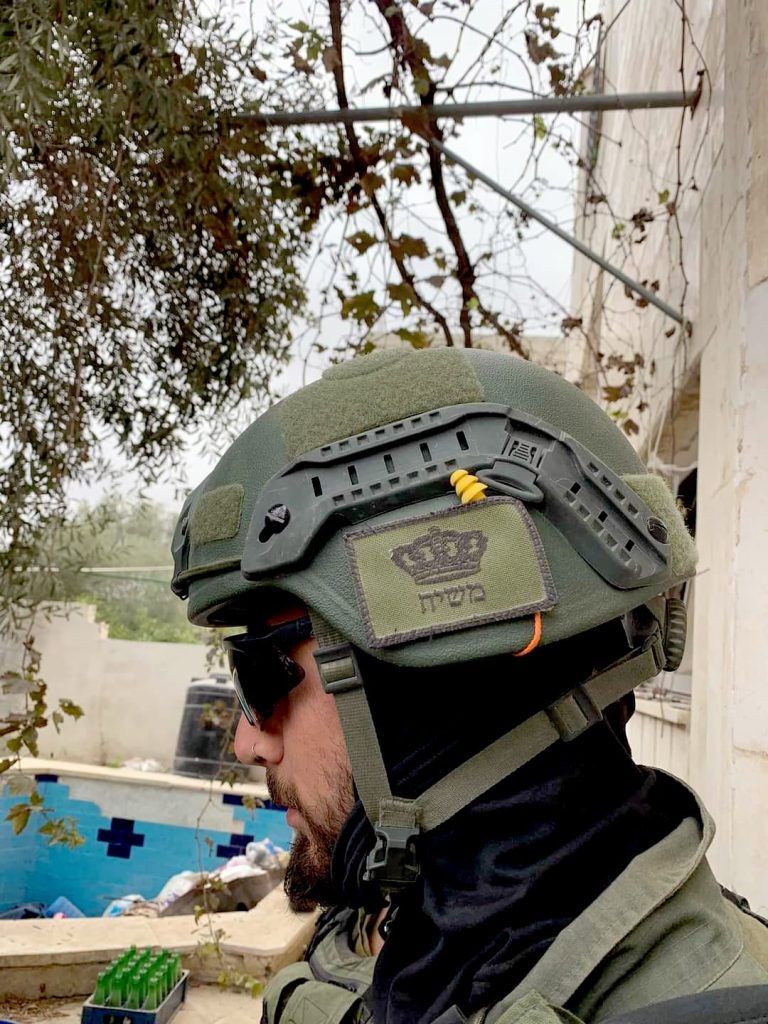
“On the shelves I could see all the insignia of the various units and I suddenly realized that the Moshiach flag could become part of the uniform.”
The manufacturer immediately agreed and the first order of 100 pieces was made.
“I had to pay 1000 shekels for the first hundred patches. I wondered how I would get the money when my phone rang. It was someone calling from the US who said he saw the Moshiach flag in a dream and he wanted to make a donation.”
What was the response?
“I took the patches to the entry point for soldiers near Gaza. Within half an hour I had given out all hundred patches. Soldiers, religious and irreligious, grabbed them up. I saw something unexpected in their eyes; they didn’t take it as you take another sticker. They took it with hope and emuna. One of them, an officer in the reserves from Tel Aviv, said, ‘I’m distant from all these things but when you enter Gaza you realize that there’s something here much greater than us.’
“The person from the US who is very into the flags, donated nearly $10,000. I saw Hashem guiding me. The Rebbe once gave me a bracha to succeed ‘in a way of nisei nissim.’ In the years that followed, I saw this.”
Things moved quickly. Through a family connection, R’ Ben Ari contacted a manufacturer in Germany who works with Chinese factories.
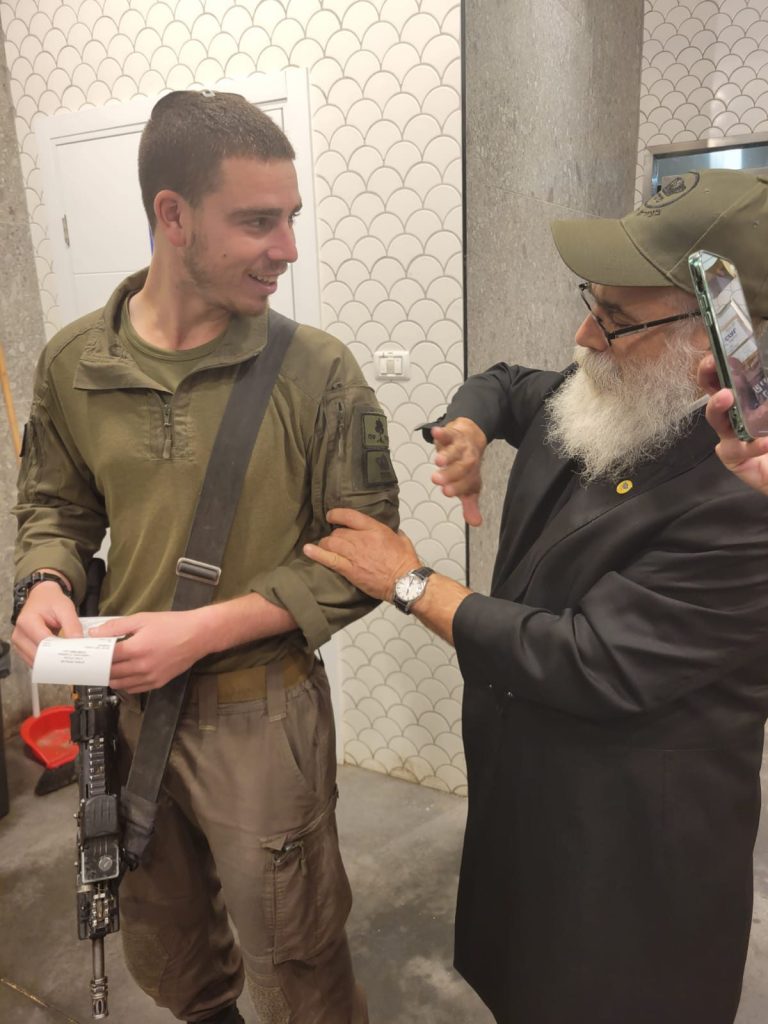
“The prices were much better. We could consider ordering tens of thousands of pieces. The first shipment from China, of 25,000 patches, was grabbed up by soldiers in just two weeks.
“We were on mivtzaim deep in Lebanon,” says Captain Roi, a Company Commander in Golani. “We lay in ambush for eight hours under tremendous tension and suddenly one of my soldiers, a guy from a kibbutz in the north, whispered to me, ‘Commander, every time I look at this patch, I’m reminded of what my grandfather would say about the Geula, that in the end everything will be good.’”
Nearly 100,000 soldiers already have the patch on their uniform, but what is really moving is the deep meaning they find in it.
“It’s not just a symbol,” explains Captain Elad Amrami, a Company Commander in the paratroopers. “When you go into battle and see the patch on your soldiers, you realize that they are fighting with something bigger, with emuna, with hope, with the knowledge that they are part of something historic.”
Even within the tunnels in Gaza, in the darkest of places, the patch had special significance.
“We entered a deep tunnel,” said Sergeant First Class Omer Natan from Golani. “It was pitch black with only the light of our flashlights. Suddenly, light fell on the patch of my uniform. It seemed like a sign from heaven, just as the Rebbe of Chabad said, that the light would illuminate even the darkest of places.”
The patch phenomenon is not only in the army.
“I’ve gotten inquiries from all over the world,” says R’ Ben Ari. “Jewish communities abroad ask for patches. Many want to be a part of this. I got a letter from someone in Brooklyn who wrote, ‘When I see the soldiers with the Rebbe’s Geula patch, I know that the prophecies are coming true before our eyes.’”
There are various reasons that the patch is worn. For religious soldiers, it’s an expression of faith that the current war is part of the Geula process and cleansing the world of our enemies. For others, it represents hope for a better future, peace and security. Some find in it a connection to their Jewish identity, even if they are not religious.
Senior Staff of Idf Are Not Pleased
An officer in a Golani brigade shared on social media, “I saw how this symbol unites soldiers of different backgrounds. Suddenly, there is something in common, something that unites us beyond the differences.”
However, among the senior staff in the IDF, the phenomenon is worrisome. Senior officers expressed opposition to using the patch. The reasons vary and reflect deep concern over the continuation of preserving the character of the army as a national army. IDF Chief of Staff Herzi Halevi ripped a Moshiach patch off a soldier’s arm during a trip to the northern border, saying he could keep it in the sleeve pocket, next to his heart.
Although nobody disagrees that the patch is inspirational for the soldiers, the IDF’s upper echelon’s opposition is because, firstly, it takes away from uniformity:
“The army is a people’s army which unites soldiers of all demographics and beliefs. If you allow a symbol of religious belief, you can create a feeling of alienation among soldiers who don’t identify with the message,” explained one military commentator on one of its broadcast stations. According to him, despite the unifying intentions of the Moshiach patch, there’s a fear that it can create division and tension among various groups in the army.
Secondly, in the military hierarchy there is a great fear of allowing religious elements into the battle. Senior command staff warn that combining religious beliefs with military operations can lead, according to them, to making decisions that are driven by considerations that are not professional.
“When you are fighting, you need to be driven by professional concerns,” explained Brigadier General Yair, an officer in the human resources department. “Bringing religious considerations into the equation can be dangerous.”
In addition, there is criticism of the legitimacy given to religious symbols on uniforms. Senior commanders maintain that it’s a problematic precedent that can open the door to additional demands on the part of other groups to display their symbols.
“What will happen when other groups will want to display their symbols?” asked a senior officer. “How can we say ‘no’ to others when we allowed this up until now?”
Opposition Only Trengthens the Phenomenon
The reality in the field is that the symbol has become an inseparable part of life for the combat units. Many lower level commanders are reporting about the positive impact that the Moshiach insignia has on the soldiers’ morale and the feeling of unity in the units.
“I see how it affects my soldiers,” says one Company Commander in Golani. “It gives them strength, it connects them to one another. It’s hard to ignore.”
The senior echelons are in a pickle. On the one hand, there are real fears of the ramifications on the national character of the army. On the other hand, there’s the awareness of the positive contribution that the patch has on the soldiers at this difficult time. As of now, the approach seems to be ‘watchful tolerance,’ not to officially forbid it but to try and limit and temper the phenomenon.
R’ Kobi Ben Ari sees the opposition as an opportunity:
“The opposition to the Moshiach patch only strengthens the phenomenon. It’s just like the Rebbe said over the years that the greatest light is revealed through the concealment.
“After the Chief of Staff removed the Moshiach patch from a soldier’s sleeve, the requests for them multiplied. Representatives of a number of troops contacted me and asked for all the soldiers there, not to mention many additional individual requests.”
It’s interesting to see the enemy’s reaction to the patches. If you follow Arab social media, you see that Hamas produced propaganda clips that warn of the “strengthening of messianic belief among the Zionists.” It seems they consider this a threat. They realize that the moment the Jewish people connects with its roots, to its essence, Hamas loses all legitimacy in their war.
The phenomenon also created surprising waves in the worldwide media. A reporter from CNN, who covered the fighting in Gaza, wrote, “There is something mysterious in this symbol which appears on the uniforms of Israeli soldiers. It provides them with a kind of inner strength which is hard to explain.”
A BBC reporter who visited the Lebanon border added, “The soldiers talk about it as a source of hope within the chaos.”
In the meantime, the impact on the soldiers and their families continues to deepen.
“My son returned home for Shabbos after a month in Gaza,” said a mother of a paratrooper. “He did not take off his uniform with the patch, even at home. When I asked him why, he said, ‘Ima, it constantly reminds me that we aren’t simply fighting.’”
As for chareidi soldiers:
“At first, some weren’t interested,” says Rabbi Shmuel Cohen, a military chaplain in the Nachal Chareidi brigade, “but after seeing how it affected the irreligious soldiers and how it strengthened their emuna, they realized that this is exactly what the Rebbe meant – to spread the light of the Geula everywhere.”
R’ Ben Ari’s plans for the future are ambitious:
“We are planning to produce a series of Moshiach stickers for mobile phones. Today, everyone is on their phone all the time. Every time someone looks at his phone, I want him to see the word ‘Moshiach’ and remember that we are in a special era and then he will do a good deed to hasten the Geula.”
He also plans on expanding the project to Jewish communities around the world.
“We already have orders from New York, Paris, and London. It’s precisely what the Rebbe wants, that the Besuras HaGeula reach everywhere in the world.
“Every soldier who has a Moshiach patch is basically a shliach of the Rebbe. Even if he is unaware of this, he is spreading the Besuras HaGeula. When I see 100,000 soldiers with this patch, I know that this is exactly what the Rebbe saw. It’s impossible not to see how the people are ready for the Geula and the hisgalus of Moshiach is closer than ever!”
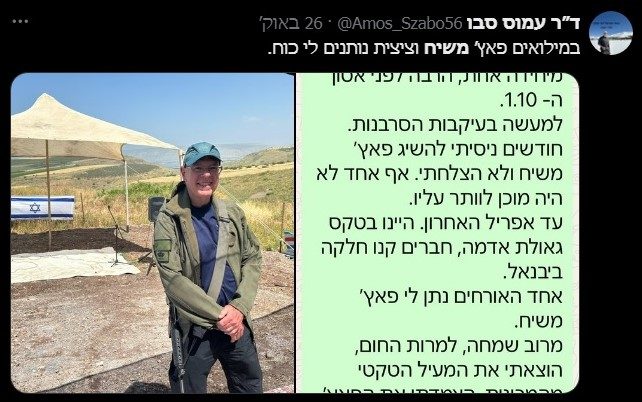
Dr. Amos Szabo: In the Reserves, the Moshiach patch and tzitzis give me strength.
I am a volunteer in the reserves in more than one unit, long before the tragedy of Oct 7. Actually, because of the refusals [due to the debate regarding justice reform – Ed]. For months I tried getting a Moshiach patch without success. Nobody was willing to give it up. Until last April. We were at a land redemption ceremony; friends bought a lot in Yavniel. One of the guests gave me a Moshiach patch. I was so happy that despite the heat, I took out my tactical jacket from the car, attached the patch, and wore it.
THE IRANIAN FREAK-OUT OVER THE TANYAS
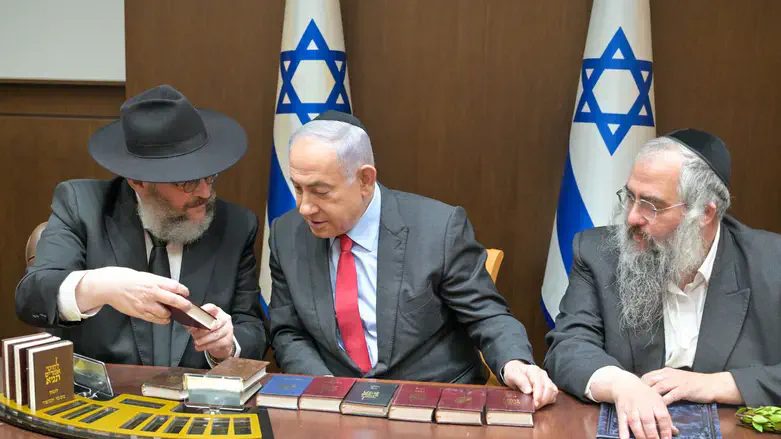
Before Sukkos, Israeli media reported that the meeting between PM Netanyahu and Chabad rabbis, turned into a major topic of heated discussion on Iranian and Shiite social media. The focus of the fuss was over Netanyahu being given sifrei Tanya that had been printed in Lebanon over forty years ago.
In a video widely spread on social media identified with Iran, Rabbi Yosef Yitzchok Aharonov is seen giving Netanyahu the Tanyas that were printed in a number of Lebanese cities. The sefarim were placed on the table in a certain order which led to some far-out speculation among some Iranian commentators, some of whom claimed it was a “religious ceremony” meant to launch “mystical forces” against the Shiites.
In Israeli media they clarified that these were sifrei Tanya that were printed by instruction of the Rebbe.
Beis Moshiach #1434 • pp. 22-27, 31
© 2026 Beis Moshiach Magazine. All rights reserved.
This article originally appeared in Beis Moshiach #1434. You are welcome to share it with friends and family by email or in print, provided that you do not change, add to or omit any part of it, you credit the author and Beis Moshiach, and you include a link to archive.bmoshiach.org (written out in full in printed copies).
To republish this article in a newspaper, magazine, book or website, please request permission in advance at [email protected].