Here We Build People – Part II
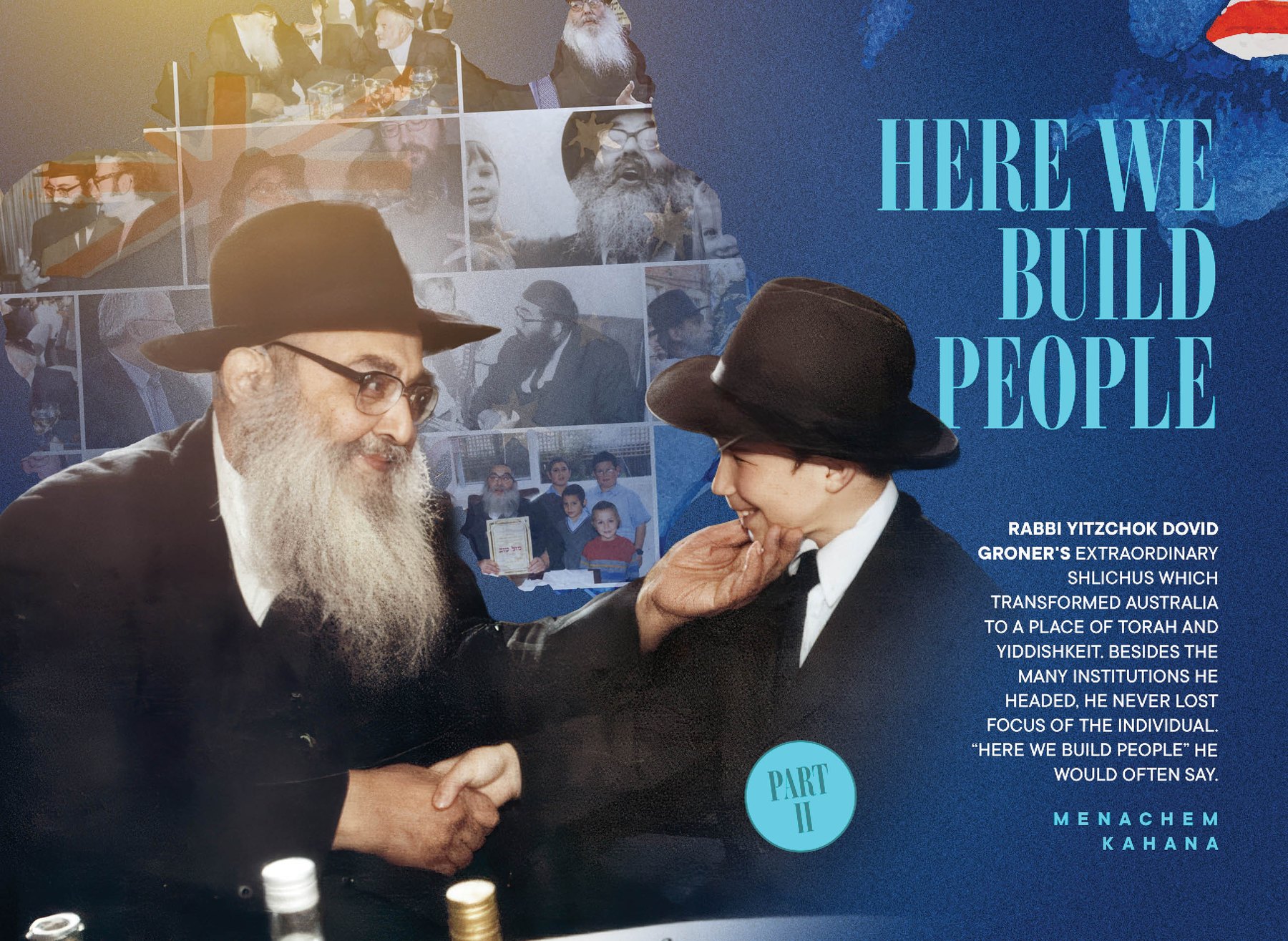
Rabbi Yitzchok Dovid Groner’s extraordinary shlichus which transformed Australia to a place of Torah and Yiddishkeit. Besides the many institutions he headed, he never lost focus of the individual. “Here we build people” he would often say.
Rabbi Yitzchok Dovid Groner brought about a true revolution in Australia. His experience in establishing institutions throughout the United States as a young man was later put to use in Australia, where he established mosdos, brought new shluchim, and expanded the limited activity that existed before his arrival into a mighty empire. Alongside managing mosdos with enormous budgets, he found time to care for every mekurav, providing personal attention in a way only he knew how to provide.
There were obstacles and delays, but he was never deterred. Under the guidance of the Rebbe, he continued throughout decades of his shlichus to expand the circle of mekuravim until he built a large Chabad community. His blessed talents, rare chein, and the affection that he showed toward each member of the community helped him advance the Jewish community in Melbourne to realms of dizzying success in Jewish-education.
Alongside this, he established and developed schools where boys study from nursery through kollel, and girls from nursery through seminary. The diversity of students was unique – children from all parts of the Jewish community: traditional, those who don’t observe Torah and mitzvos, religious, ultra-Orthodox, and of course children from Chabad families.
Rabbi Groner would repeatedly say that his shlichus was to develop ‘mentchlichkeit’ – to raise upright children who would be good people and be mekadesh sheim shomayim. “People ask me to write a sefer,” he once said in wonderment. “A book? Who needs that?! The most important book is to be a partner in raising thousands of children whose purpose is to add light, goodness, and holiness to the world.”
The caring and dedication he showed toward every student brought hundreds of families to draw closer to their Yiddishkeit thanks to the time they spent in the school, many of them later becoming full members of the Chabad community.
It is no exaggeration to say that an entire generation of Jewish children drew closer to Judaism thanks to Rabbi Groner’s dedication to chinuch. But as always – he never attributed anything to himself, only to the meshaleiach. “With my own strength I could not have established all this,” he would often say.
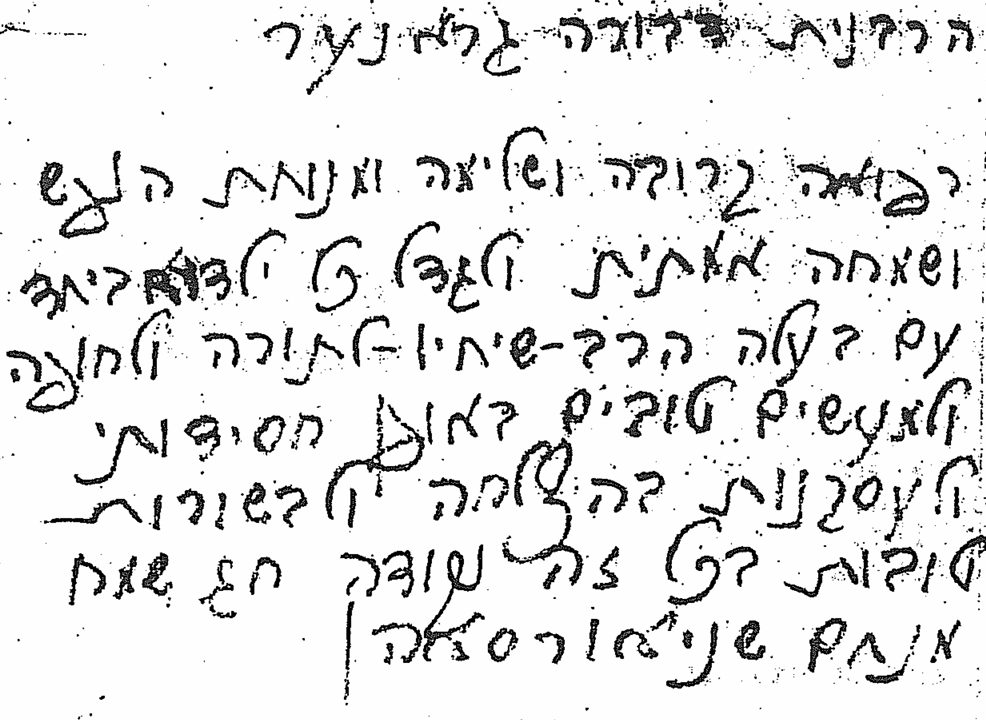
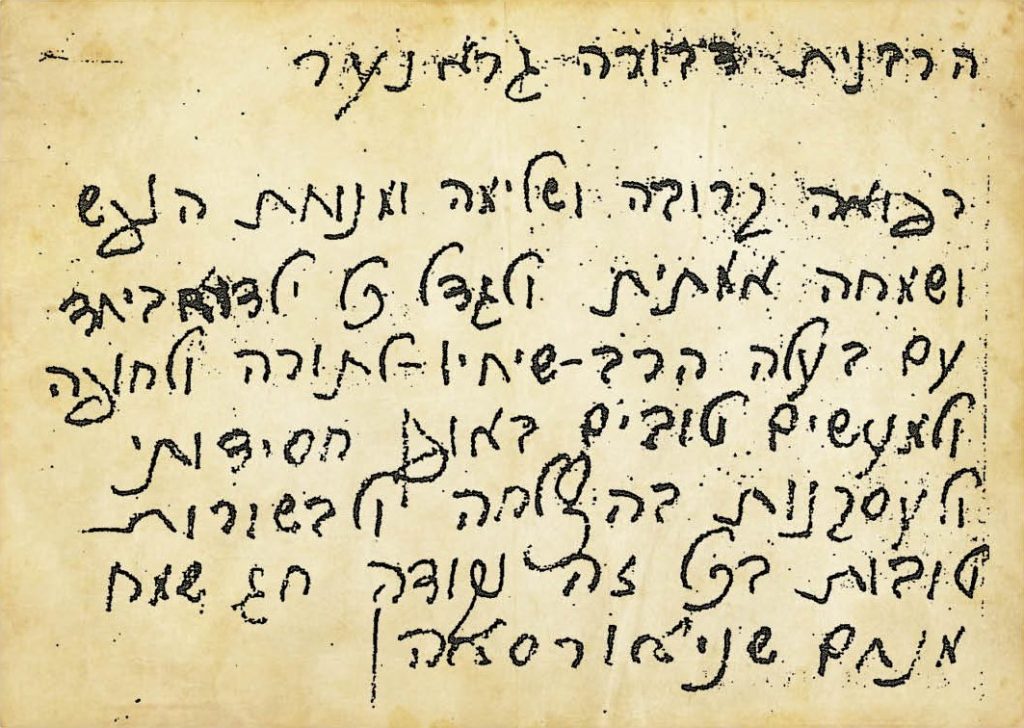
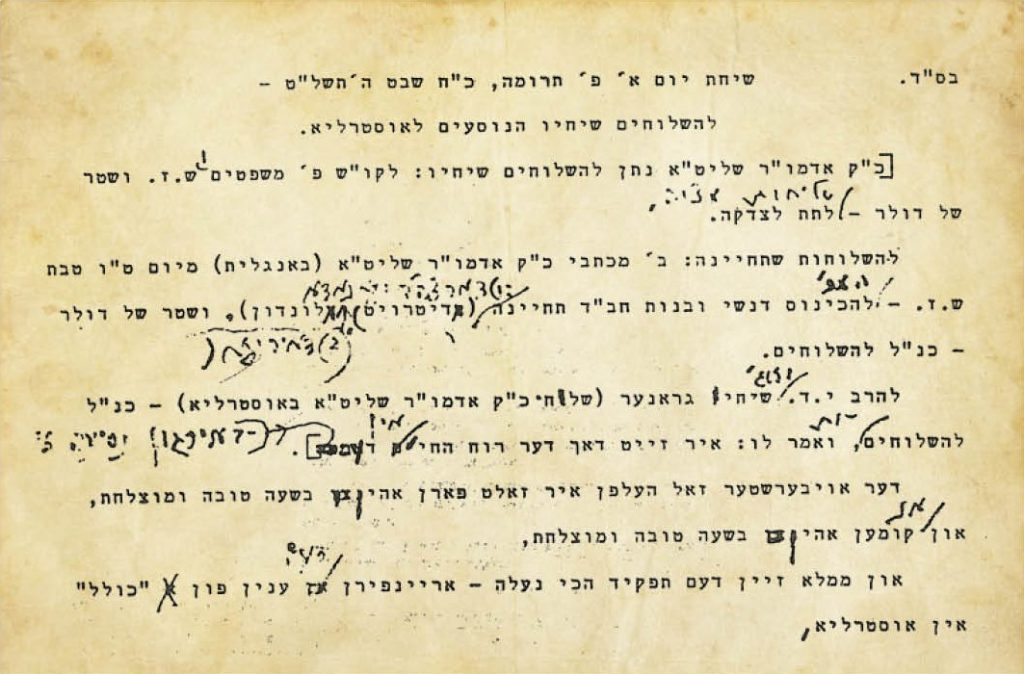
When he established a new high school, ‘Beth Rivkah’, a celebratory event was held with the participation of Australia’s Prime Minister and an audience numbering over 1,500 people. During the event, Rabbi Groner reported to the Rebbe through his brother, the Rebbe’s secretary, Rabbi Leibel Groner: “The success was so great – but this is not our success; rather it is certainly the Rebbe’s bracha.”
Following this, the Rebbe instructed his brother, to call their parents and tell them the good news, saying: “Why shouldn’t they have nachas?”
Testimonials from Community Leaders
“Rabbi Groner’s work is particularly evident through the institutions he nurtured,” said Michael Danby, member of the Australian Parliament. “When he arrived in Melbourne, he saw a community growing due to post-war immigration – and he provided strong support for Jewish education so the community could sustain itself within a secular society like Australia.”
According to Danby, Rabbi Groner’s greatest achievement was expressed in the Yeshivah Lubavitch center in Melbourne and the two institutions he headed: ‘Yeshivah Lubavitch’ and ‘Beth Rivkah College for Girls’ – “two institutions considered not only among the finest in Australia, but among the best in the entire Jewish world.”
“His impressive achievements and charismatic personality at all levels of community activity played a central role in making Australian Jewry one of the most magnificent communities in the diaspora,” added the late Isi Leibler, who served for about 20 years as head of the Executive Council of Australian Jewry (and later deputy chairman of the World Jewish Congress). “The exceptional growth of Chabad educational institutions had a notably positive influence on the development of Torah education in Jewish schools in general, and on the entire Jewish community.”
The Decisive Moment at the Bank Meeting
The great heart of Rabbi Groner melted all who came near him. A story told by his grandson, Rabbi Sholom Zirkind, sheds unique light on his educational approach and provides a glimpse into the Chassidic breitkeit with which he was endowed.
“One year, the Chabad institutions in Melbourne were on the verge of bankruptcy. The bank threatened to foreclose on the central building due to an unpaid mortgage. Out of a sense of responsibility, community representatives and senior businessmen requested to meet with the bank manager at the time, Mr. Murray, hoping he would understand the critical importance of the educational institution to the local Jewish community.
“But Murray came to the meeting accompanied by a rather dubious figure, a man named ‘John Edwards’, nicknamed in the bank offices ‘John the Butcher’… He was responsible for handling clients who had difficulty repaying debts – and the approach he took was sharp and harsh. He was a declared atheist who didn’t hide his disgust with religion. As far as he was concerned, a yeshiva was a failed business that deserved to be closed. Worse yet: an institution that provides religious education to children only harms society, according to his view.
“At a certain point, in the middle of the meeting, an oppressive silence prevailed. The tension was clearly felt in the air. Then, with rare courage and in an almost fatherly tone, my grandfather Rabbi Groner stood up, tall in stature and broad of heart, and approached Edwards directly. He gently placed his hands on his shoulders, looked into his eyes, and said to him firmly: ‘Hello John, I’m Isaac. Nice to meet you. I think you didn’t understand correctly – we’re not just running an educational institution. We’re building people. Do you know what a ‘mentch’ is? A ‘mentch’ is a person who has respect for others; a person who cares for others, a good citizen. Australia today needs more ‘mentchen’. We produce them.’
“The words were said in a way that could not be misunderstood and with deep honesty. They didn’t rely on intellectual persuasion, but touched directly at the heart. John understood that he couldn’t refuse such power, and when the delegation left the meeting, they had a compromise agreement that saved the institution from collapse.
“And the result? The Chabad institutions in Australia not only survived – but continued to flourish. A network of Chabad schools operates today throughout the continent with hundreds of students, shluchim, and rabbanim who continue to build a generation of mentchen, exactly as my grandfather Rabbi Groner dreamed and achieved.”
Rabbi Menachem Mendel Amar, who had a warm relationship with Rabbi Groner for many years, adds this:
“I received so much from Rabbi Groner. I learned from his leadership, his strength, his bren (fervor), and the inner truth that burned within him. He had an incredible power of influence – it could penetrate even bunkers.
“I’ll never forget an anecdote that so characterizes him: One morning, a woman entered his office and asked how he was doing. He answered with a question: ‘And how are you feeling?’ Then suddenly, without any introduction, he simply said: ‘I need ten thousand dollars for the yeshiva.’ Just like that – no formalities, no beating around the bush. And it worked…
“Anyone who knew Rabbi Groner understood – he didn’t fundraise in the usual sense. Because fundraising means: ‘I have an institution, and I’m asking you to help me.’ With him, it worked in a completely different way: ‘This isn’t my institution – it’s yours. Your yeshiva is missing ten thousand dollars. What are you doing to fill the gap?…’ That was his approach. An inner truth that burned in the simplest and most authentic things. Really – who could stand up to that?
“This, in essence, is how the Rebbe educates us: First, you must connect to the cause so deeply that it becomes a part of you. Then, you can transmit to the other person that the idea cannot be any different for him either – because he, too, is part of it.”
A Great Scholar
Rabbi Groner was first and foremost an outstanding talmid chacham, with extensive knowledge in both Nigleh and Chassidus. He once recounted one of the first experiences he had in the days of the Rebbe Rayatz, when he sat learning in the zal on the first floor of 770:
“Once the Rebbe came down from his father-in-law’s apartment and entered the zal where about fifteen students were sitting and learning at that time. The Rebbe said: ‘My father-in-law’s wish is that you, you, and you – and so he pointed to all of them – should be talmidei chachamim, big lomdim.’ These words made an enormous impression on us to be diligent in learning,” Rabbi Groner later recounted, having been present at the time.
Thousands of residents, community members, and guests who passed through Rabbi Groner’s modest home in Melbourne immediately noticed his great love for learning. Even a short conversation with him revealed extensive knowledge. The bookshelves in his home were loaded with sefarim well-worn from use. He knew exactly where every sefer was placed. On every Torah topic he had insight and the ability to delve ever deeper.
“What impressed me especially was the unusual combination we saw in him between active and heartfelt involvement in the shlichus, alongside diligence in Torah study,” later recounted the late Rabbi Aharon Eliezer Zeitlin, one of the tmimim sent to strengthen the yeshiva in Melbourne. “Rabbi Groner was a gaon, with an extraordinary memory, an enormous lamdan with extensive knowledge in all parts of Torah. He gave regular shiurim, and meanwhile devoted himself heart and soul to the practical and physical aspects of the shlichus. To see this balance in him – this was a living demonstration of what the Rebbe demands of us: that even when dealing with technical matters, not to move from the source – always to live with Torah and give classes.”
“Every Thursday night, almost without exception,” added Rabbi Zeitlin, “we – the six shluchim to the yeshiva – would visit his home. He would sit with us for hours, overflowing with Chassidic stories, being an extraordinary baal shemuah (accurate transmitter of oral traditions), as if there was no tomorrow… It gave us spiritual chayus that sustained us throughout the entire week. The atmosphere in his warm and radiant home was for us a continuous spiritual delight.”
“My father was a busy man, both as a shaliach and as the community rav,” said his son, Rabbi Chaim Tzvi, who testifies: “Despite his packed daily schedule, he was meticulous about learning every day, and he allowed no excuse – not even shlichus related matters – to get in the way.”
Over the course of his shlichus, Rabbi Groner traveled to dozens of countries, with the Rebbe encouraging him to share words of Torah wherever he went and to study with the local rabbis. On one occasion, the Rebbe even instructed him to publish some of those Torah talks. The list of people he engaged in Torah discussions with includes Rebbes, roshei yeshivas, and renowned halachic authorities.
It is told that during a visit to Eretz Yisrael in his youth, he entered into a Torah discussion with the Gaon of Tchebin. After he left, the Tchebiner Rav remarked with excitement: “Even in this orphaned generation, there are still those who know how to learn…”
In a report he wrote to the Rebbe in Sivan 5735, after his visit to Eretz Yisrael, Rabbi Groner wrote: “I also visited Rabbi Zevin, and he asked that I mention him to the Rebbe. I entered into discussions with Rabbi Yechezkel Abramsky, [one of the roshei yeshiva of Slabodka Yeshiva], and we spoke several times; I also visited him in his home and purchased his sefarim on Pesachim, Shabbos, Eruvin, Niddah, and Mikvaos.”
A Loving Rabbi and Father to His Community
“When he entered a room, it was impossible not to feel his presence. Tall in body and spirit, he naturally inspired respect – and all this with rare Chassidic simplicity. He always emphasized that ‘only a fool would say this is within the power of an ordinary human being, and not through the great power of the Rebbe,’” said his grandson Sholom Zirkind.
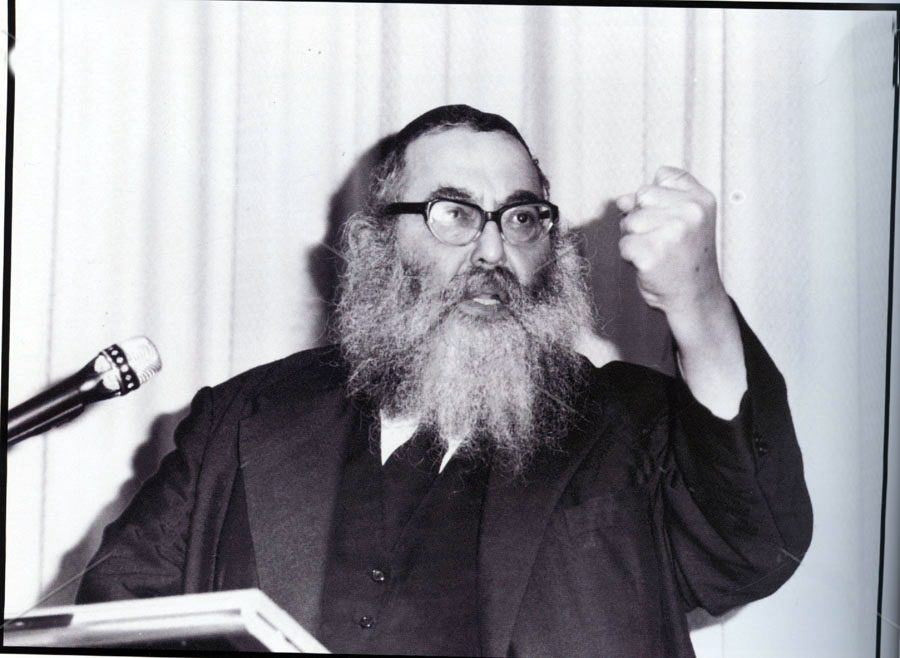
Once Rabbi Yosef Katzman asked him: “Tell us about your many travels… After all, your influence is spread across the entire world!” And Rabbi Groner replied simply: “Me? I have no control over anything. A person doesn’t need to seek ‘control.’ He should be honest, faithful, and help others. People recognize if you’re genuine or pretending. Lubavitch succeeds because the Rebbe taught us that greatness is in giving to others. I’ve met shluchim who don’t ‘break down walls,’ they’re simple people. But they have truth. And truth penetrates!”
As mentioned, one of the many ‘hats’ that he wore was his role as the community rav. A member of his congregation recalled his leadership: “When he dealt with your problems, he made you feel like you were the most important person in his life at that moment. After his passing, many people said how he treated them, saying, ‘I felt so special to him.’”
Another community member shared that Rabbi Groner would counsel hundreds of people who came to him with complex halachic questions: “Although he never compromised on halachic principles,” he said, “he embodied the best of the Chabad tradition – combining kiruv and compassion. Despite his impressive personality and vast wisdom, he was a humble man, far from materialism. Even the coldest of hearts were stirred with love and respect for him.”
His grandson added: “Another outstanding trait he had was his remarkable hospitality. His Shabbos table was always open to those who were not considered ‘regular guests’ – the lonely, the needy, the isolated, widows, and even those who were not capable of holding a normal conversation. He would seat them at his table, draw them close, and give them a place of honor and heartfelt love. At every such meal, he enjoyed sharing stories and memories of the Rebbe and the Rebbe Rayatz – even when there wasn’t always someone who fully understood or connected with them. That was the essence of his Ahavas Yisrael – his love for every Jew: genuine, simple, and sincere.”
His brother, Reb Leibel, later relayed this aspect of his brother’s character: “My brother had a good heart; he was very sensitive to others’ needs. People said that when they poured out a problem to him, he didn’t just look at it from the outside; he felt it as if he were a family member experiencing the hardship. He felt others’ pain even more than his own. Everyone loved him because he loved everyone… He was a good father and a good brother to his close friends – and also to his own family.”
His Final Years
In his later years, Rabbi Yitzchok Dovid Groner became ill and suffered severe pain. Despite the great suffering, he continued to maintain joy and bitachon in Hashem.
Only on his 80th birthday did Rabbi Groner allow himself to pause for a moment of reflection on the transformation Australian Jewry had undergone. “This gives me a certain satisfaction,” he said honestly, “but in the same breath – it also gives me a sense of obligation, that we haven’t done enough. We must continue forward.
“The Rebbe never rests on his laurels,” he continued. “He always pushes – more and more. The greatest satisfaction is when I can help others – after all, the entire community passes through us. If I can help them spiritually, educationally, materially, in connection to the Rebbe – that’s my satisfaction.”
His Passing
On Sunday, Gimmel Tammuz 5768, Rabbi Groner asked all his children to come to him at the hospital. Some of his children living overseas immediately boarded flights to be with him, and those living in Melbourne gathered around him.
On the morning of Monday, the 4th of Tammuz, he put on tefillin with the help of some of his children, and at the end of the davening he tasted something and a few minutes later returned his soul to his Creator at the age of 83, leaving behind thousands mourning the one who brought them closer to the path of Yiddishkeit and Chassidus during more than fifty years of shlichus.
Rabbis, dignitaries, community leaders, and even many politicians testified that he was the ‘faithful shepherd’ of all of Australian Jewry that developed and expanded after World War II. “Australian Jewry lost one of its most noble figures,” said Isi Leibler. “History will testify without any doubt that Rabbi Yitzchok Groner was the most distinguished Jewish leader in Australia in the past century.”
According to his request, Rabbi Groner was buried in Eretz Yisarel. He left behind eight children, dozens of grandchildren and great-grandchildren engaged in the shlichus of the Rebbe MH’M, to prepare the world l’kabbolas pnei Moshiach.
The Concern of the Rebbe Rayatz
In one of the interviews he gave to the general press, Rabbi Yitzchok Dovid Groner emotionally recalled the moments engraved in his soul from his youth – the Purim Farbrengen of 5700 (1940), just days after the arrival of the Rebbe Rayatz in New York, following his rescue from the jaws of the Nazis in burning Europe.
“Hundreds came to hear the Rebbe, from all segments of the population – everyone longed to know what was truly happening in Europe,” he recounted. “I remember the Rebbe opening by saying: ‘Gut Yom Tov’ and at that moment, the Rebbe added in a broken voice: ‘Ich ken nisht zogen Gut Yom Tov ven meine brider brenen’ [I cannot say, ‘Gut Yom Tov,’ while my brothers are burning]…
“Despite the great joy surrounding the Rebbe’s rescue,” Rabbi Groner explained, “the Rebbe’s heart was shattered, carrying the pain of the Jews left behind in Europe. Those words… the concern for suffering Jewish brothers – broke me and were deeply engraved in my heart,” he concluded.
He Lived Moshiach With All His Heart and Soul
As a true chassid, Rabbi Groner lived Moshiach with his entire being. In his many speeches, he elaborated on how “the Lubavitcher Rebbe shlita is preparing the entire world for the coming of Moshiach Tzikeinu, through an unparalleled, constant and all-encompassing effort,” and that the Rebbe is the goel Yisrael.
Rabbi Groner noted that in Chapter 32 of Tanya, the Alter Rebbe gave us the key to Geula – Ahavas Yisrael. He added that emunas tzaddikim is an inseparable part of the Jewish people.
He recounted how once the Baal Shem Tov told his students after Maariv on motzoei Shabbos, to take a pitak – a Russian coin – out of their pockets. Everyone simply reached into their pockets and pulled out the coin.
“Chassidim explained that this was a miracle,” Rabbi Groner declared, “but the miracle wasn’t that they pulled out the coin – it was that they believed simply and purely in the tzaddik’s words, who told them to pull out a coin from their Shabbos clothes, and they just did it.”
From this, he connected to the subject of the Geula: “Emuna is a part of the Geula. And therefore, when the Rebbe says that he will take us out of galus – that’s exactly what will happen!”
At the well-known women’s gathering for “Kabbolas Pnei Moshiach,” held on 28 Teves 5752 (1992), Rabbi Groner spoke with his typical pathos and stirred the hearts of the women:
“In the Birkas HaChodesh, we say: ‘He will redeem us soon and gather our exiles from the four corners of the earth – all of Israel united.’ When does this Geula happen? When all of Israel are united – as we are sitting tonight, in unity. This is the light of unity between Chassidim and the Jewish people in general – unconditional love – that will bring about the ‘Hu yigal osanu b’karov.’”
He continued, relating to the theme of the gathering:
“‘Kabbolas Panim’ comes from the word ‘pnimiyus’ – inner essence. We are receiving the inner essence of Moshiach; we must truly accept Moshiach in a way that affects us not only tonight but also after we leave here—as ‘kol Yisrael chaveirim.’ Let Chabad around the world see that we are as one person with one heart, under the leadership of the leader of Israel – then we will merit ‘He will redeem us.’
“The light of Moshiach is already here, as it says: ‘Arise, shine, for your light has come’ – and the Medrash explains this is the light of Moshiach. Moshiach is the individual who delivers the final blow to the Angel of Death. Everything we are doing tonight is delivering a blow to the Satan – and this is what will bring the light.”
“How Much Are Your Speeches Worth…?”
In one of the early years of the Rebbe’s leadership, during the Acharon Shel Pesach Farbrengen, the Rebbe distributed a piece of matza to those who had gone out on Tahalucha and reviewed inyanei Chassidus in shuls.
At that time, Rabbi Yitzchok Dovid Groner was serving as a rav in one of the shuls and would repeat Chassidus there. Accordingly, he approached the Rebbe to receive a piece of matza as well. But the Rebbe said that he receives payment for his speeches…
Rabbi Groner replied with a smile that sometimes his speeches “zaynen mer vert vi di gelt vos men git mir (are worth more than the money they give me).”
Upon hearing this, the Rebbe laughed and said: “Dos darf men fregen by di baalei batim” (That’s something you should ask the laypeople!).
The Rebbe did not give him matza at that moment.
Later, the Rebbe’s shliach, Rabbi Shmuel Dovid Raichik, approached him and thanked him for managing to bring a smile to the Rebbe’s face.
Despite what the Rebbe had said at the farbrengen, when Rabbi Groner entered for a yechidus two days after Pesach, in honor of his birthday, the Rebbe opened a drawer and gave him a piece of matza, saying:
“You wanted to receive matza from me – this is from the remnants of my Seder plate.”
Beis Moshiach #1473 • pp. 22-31
© 2026 Beis Moshiach Magazine. All rights reserved.
This article originally appeared in Beis Moshiach #1473. You are welcome to share it with friends and family by email or in print, provided that you do not change, add to or omit any part of it, you credit the author and Beis Moshiach, and you include a link to archive.bmoshiach.org (written out in full in printed copies).
To republish this article in a newspaper, magazine, book or website, please request permission in advance at [email protected].