Building Bridges In Buffalo
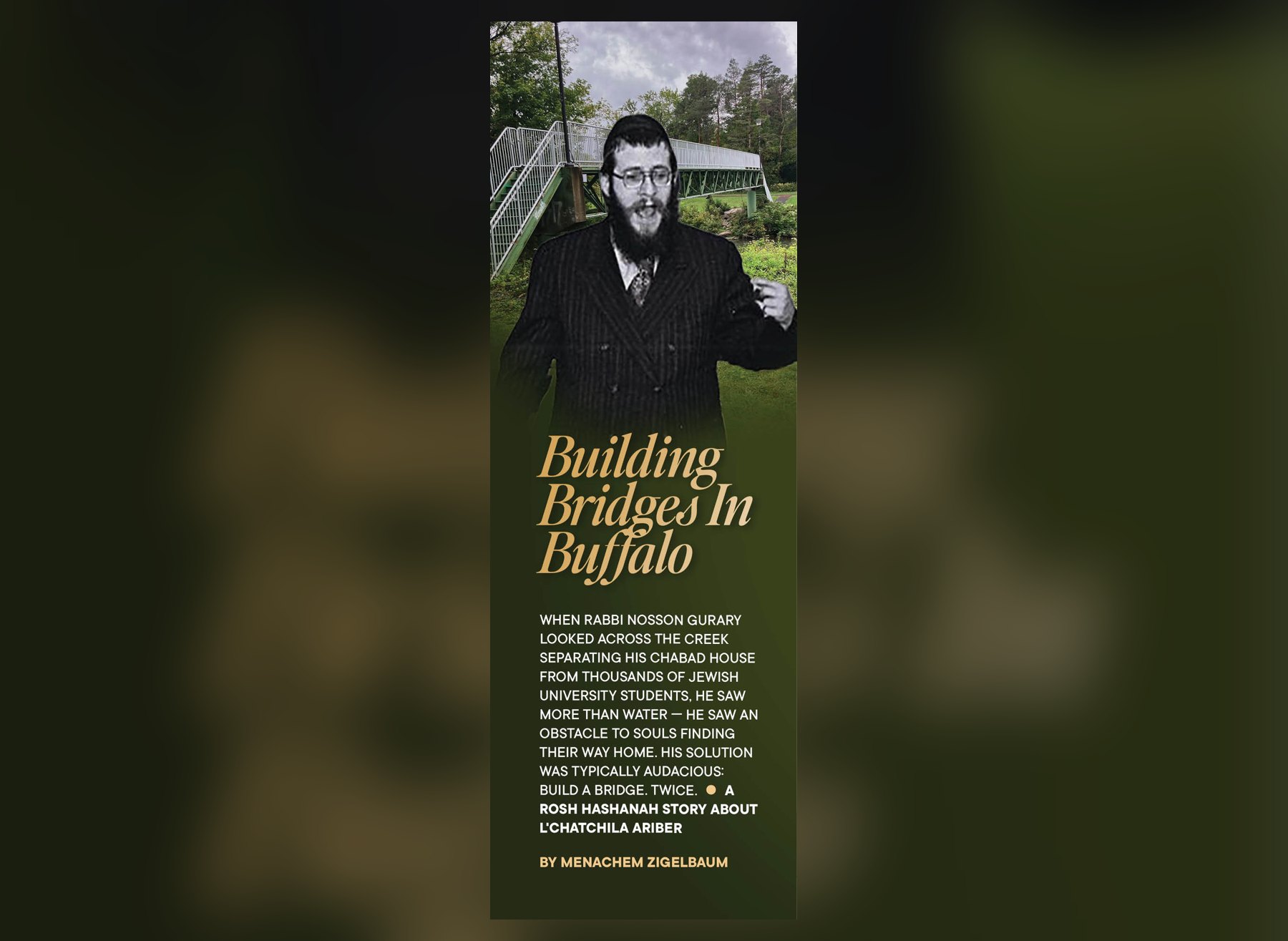
When Rabbi Nosson Gurary looked across the creek separating his Chabad House from thousands of Jewish university students, he saw more than water – he saw an obstacle to souls finding their way home. His solution was typically audacious: build a bridge. Twice. A Rosh Hashanah story about l’chatchila ariber.
I
The University at Buffalo (State University of New York at Buffalo) is one of the most well-known in the state of New York. Around 32,000 students study across the thirteen schools that comprise the university, making it the largest public university in the state.
Thousands of Jewish students attend the university, many of whom have little to no knowledge of their Jewish identity.
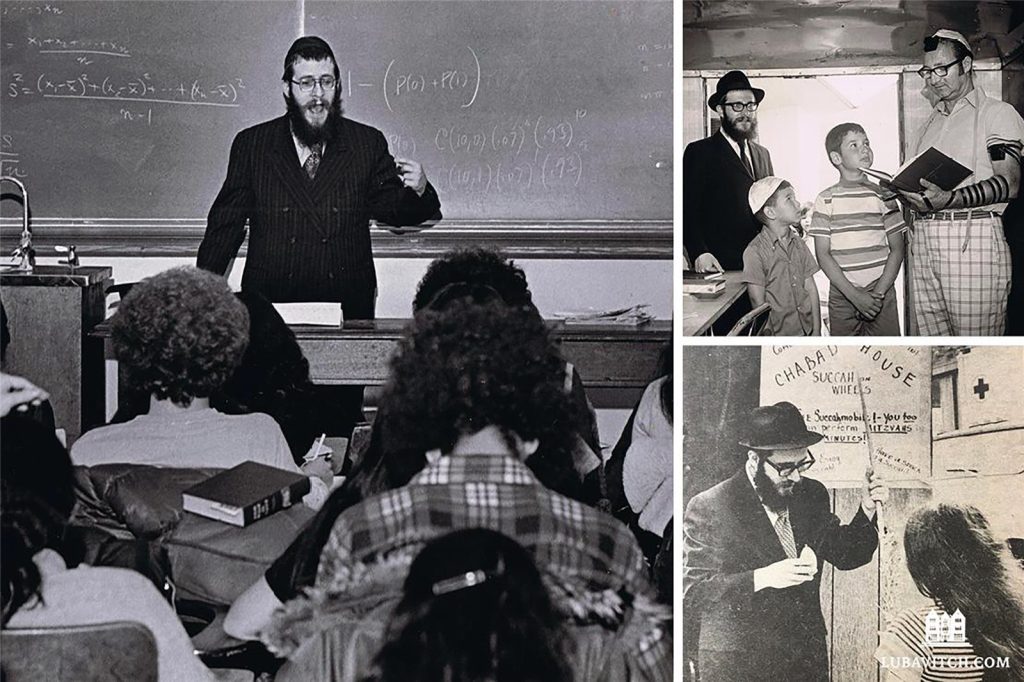
Those who went to help them reconnect with their heritage and their G-d were the shliach couple Rabbi and Mrs. Nosson and Miriam Gurary. Their Yiddish was better than their English, yet they dared to jump into the water and, in the mid-1970s, opened a Chabad House on campus – one of the first in the world within a university setting.
R’ Gurary served as the Rebbe’s shliach to upstate New York, and he was the one who founded the Chabad Student Center at the university (he currently serves as mashpia of the Chabad community of Monsey).
The Jewish students were generally far removed from anything Jewish; many denied their Judaism entirely. Some were hippies, proudly waving the banner of rebellion against structure. R’ Gurary, with his colorful and lively personality, knew how to speak to young people in their language – boldly, without currying favor, and when needed, with a certain holy audacity.
If he suspected a certain student was Jewish – based on his “Jewish face” – he would approach him directly: “You must be Jewish!” or ask, “Be honest, what’s your Jewish name?” This was how he tried to awaken the spark of Jewish identity hidden within.
Often, he would grab a Jewish student by the hand and, without unnecessary formalities, bring him straight into the Chabad House… R’ Gurary also used bold marketing techniques that spoke to the students’ hearts, who, in turn, respected his straightforward – and sometimes even cheeky – approach.
“I had to grab their attention,” he later recounted. He understood that beneath the youthful rebellion and fiery defiance was a soul searching for something real – and that’s exactly what he aimed to offer.
II
The following story took place in 5737.
The University at Buffalo expanded after purchasing a vast property surrounded by a beautiful lake on the northern outskirts of the city. Recognizing the need to reach the hearts and souls of the thousands of Jewish students, R’ Gurary decided to establish the Chabad House adjacent to the new campus area.
It wasn’t exactly adjacent – a side creek separated the university from the Chabad House. Thus, it was “a long way that was actually short.” “We were so close, yet so far,” said R’ Gurary. To attend Shabbos or Yom Tov meals held in an authentically Jewish atmosphere, many students had to make a long detour to reach the path leading to the Chabad House.
R’ Gurary felt that this inconvenience caused many students to hesitate about coming to Chabad, and that was precisely what he wanted to avoid. He racked his brain for a solution.
III
As Rosh Hashana approached, R’ Gurary came up with a characteristically original – even daring – idea. He decided to build a small, improvised pedestrian bridge directly in front of the Chabad House. This would make it easy for students to attend Rosh Hashana prayers, hear the shofar, experience Jewish traditions, and join in the Yom Tov meals.
With much creativity, he gathered a number of flotation devices, tied them together with ropes, attached an anchor, and thus created a small, charming bridge right in front of the Chabad House…
Indeed, the two days of the holiday passed peacefully and joyfully. Hundreds of students enjoyed the magical Jewish-Chassidic atmosphere. But outside, a storm was brewing…
Since the bridge was placed over a side stream, it barely disturbed anyone – until a seasoned fisherman came across the obstructing bridge. Outraged, he immediately filed a formal complaint with the university administration and another with the city’s Department of Urban Planning.
To complete the drama, police cars, fire trucks, and city vehicles arrived at the scene. It was quickly discovered that the “culprit” was none other than the university rabbi who had taken it upon himself to build a bridge…
Soon, the shliach found himself at the center of a heated city dispute. “Chabad Went One Bridge Too Far,” screamed the headlines in local newspapers. Politicians and commentators criticized Chabad for constructing a bridge without approval.
Motzoei Rosh Hashana, city inspectors knocked on R’ Gurary’s office door and ordered him to dismantle the obstructing bridge immediately. They also fined him a considerable amount for disrupting public order.
R’ Gurary wasn’t particularly troubled by the fine – but he was greatly troubled by the thought that from now on, it would again be difficult for students to reach the Chabad House.
He dedicated the coming year to legalizing the bridge. With determination and persistence, he finally received the necessary approvals. He immediately moved on to the next step: hiring a contractor to ensure that the bridge would be in place for the upcoming Rosh Hashana – this time solid, large, and legal.
An engineer brought in for the project designed a tall, stable pedestrian bridge that would connect the new university campus with the Chabad House – high enough not to interfere with boats or fishing in the area.
Just before Rosh Hashana, the bridge was installed – ready and waiting to serve the students.
Hundreds of Jewish students came to the Chabad House for the Yomim Noraim, and afterward, easily returned to campus.
IV
A few days later, a bill for the bridge construction arrived at the Chabad House. For a moment, R’ Gurary’s head spun – it was for several hundred thousand dollars!
But someone like R’ Gurary wouldn’t be fazed by such a situation. He immediately announced that the university administration should cover the cost, since the bridge served the students no less than it did the Chabad House.
When the bill was presented to university leadership, they were shocked. They hadn’t ordered a bridge – why should they pay for it? The invoice was passed from department to department, each avoiding responsibility. Even the university president declared emphatically that under no circumstances would he pay such a large sum.
He was not known to be particularly fond of Jews, to say the least, which hardened his stance even more. He openly disdained the Jewish community and strongly opposed the rabbi’s outreach efforts among Jewish students.
The argument over the bridge’s funding dragged on, until at one point the university president threatened: “It’s either me or the bridge!” If they forced him to pay, he would resign.
He made good on his threat – and eventually, the university president died suddenly and unexpectedly.
Askanim in Crown Heights who heard about the affair decided to step in and help. Some had prior connections with the Speaker of the New York State Assembly, a friend of Chabad, who began using his influence among state authorities to have the state cover the bridge’s cost – which indeed is what happened in the end.
To this day, nearly fifty years later, the strong and beautiful bridge still connects the Chabad House with the University at Buffalo campus. The university administration didn’t stop there – they even installed an official sign directing students to the Chabad Center.
“It was a miracle,” concluded Rabbi Nosson Gurary as he told his story.
Special thanks to Rabbi Moshe Gurary, currently the Chabad shliach at the university, who sent a recent photo of the bridge, still standing proudly.
Beis Moshiach #1477 • pp. 38-40
© 2026 Beis Moshiach Magazine. All rights reserved.
This article originally appeared in Beis Moshiach #1477. You are welcome to share it with friends and family by email or in print, provided that you do not change, add to or omit any part of it, you credit the author and Beis Moshiach, and you include a link to archive.bmoshiach.org (written out in full in printed copies).
To republish this article in a newspaper, magazine, book or website, please request permission in advance at [email protected].