My Rambam “Yechidus” With the Rebbe
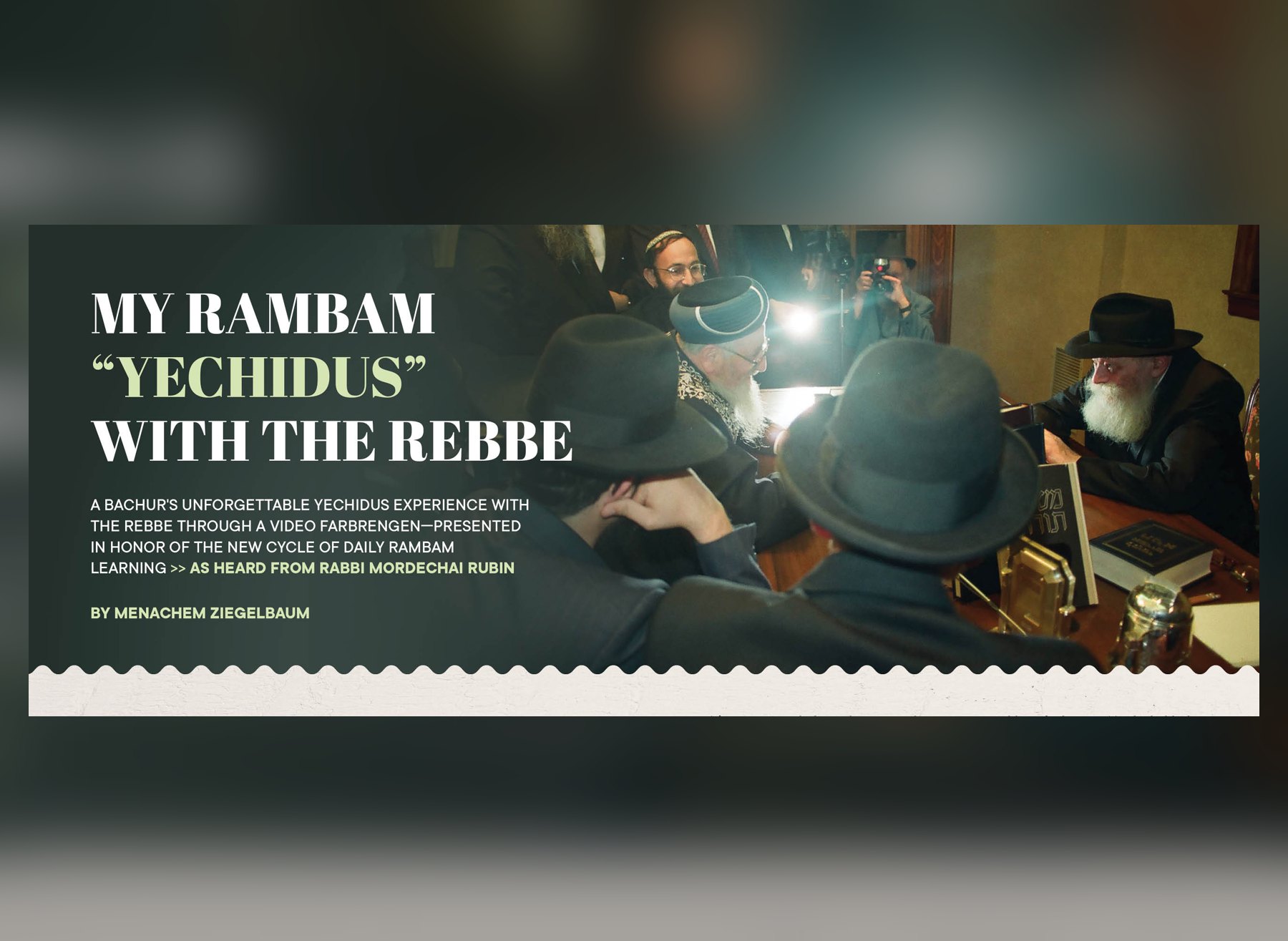
A bachur’s unforgettable yechidus experience with the Rebbe through a video farbrengen – presented in honor of the new cycle of daily Rambam learning. As heard from Rabbi Mordechai Rubin.
I
Rabbi Mordechai Rubin merited to be one of thousands of the Rebbe’s shluchim in the world. He lives in Colonie, New York, where together with his wife Chana, he prepares the city’s Jews to welcome Moshiach.
Rabbi Rubin was born in 5753 (1993), and therefore has no personal memories of seeing the Rebbe with his own eyes. Despite this, he is a Chassid and shliach with every fiber of his being, with enthusiasm no less than the earliest Chassidim – those who merited to attend the Rebbe’s farbrengens during the luminous days of the seventh generation. The Chassidishe chinuch he received from his father, the shliach Rabbi Yisroel Rubin, one of the veteran shluchim who went to Albany, the capital of New York, to spread Yiddishkeit, prepared him well for the future.
Through inner hiskashrus and attachment, he feels that the Rebbe accompanies him and is present in his life, accompanying him in all ways. There were even instances where he felt how the Rebbe turned to him and conveyed specific instructions relating to his way of life.
“Nevertheless,” he recently shared, “a true yechidus is something I never thought I would merit until the coming of Moshiach – but it happened, it actually happened…”
II
The Year 5769
The young Mordechai Rubin was studying in shiur beis at the Chabad yeshiva in Chicago. That year he learned meseches Kesubos with his classmates under the maggid shiur Rabbi Yossel Cohen.
Simultaneously, he began maintaining a course of learning one perek of Rambam per day, according to the Rebbe’s takana. This was the first time in his life that he started this track, persisted in it with determination and success for three years – and almost reached the end of the learning cycle, about to complete it, and he was very excited.
That day when our story occurred – 13 Iyar – was an ordinary day at yeshiva. Mordechai was immersed in the fine print of the Gemara, and at a certain point noticed a difference in approaches between the Bavli and Yerushalmi on the topic before him. He felt a slight tingle at his fingertips and realized there was potential here for his own Torah chiddush… He hurried to record it as a question in the yeshiva’s internal “kovetz he’aros” that was to be published that week.
The rest of that day was especially busy:
After a long day of study, Mordechai and his friends went to the Fasman Yeshiva High School, known by its nickname ‘Skokie Yeshiva,’ where they studied Chassidus with bachurim who were not Chabad chassidim. For two years they studied on Thursday nights with the bachurim – thanks to which, two of the bachurim eventually became Chabad and established Chassidishe homes.
Since that day was the yahrtzeit of the Rebbe’s brother, Rabbi Yisroel Aryeh Leib, the yeshiva administration decided to screen a video of the Rebbe for the tmimim. It was leil shishi (Thursday night) – a common concept among bachurim, when one can stay up even after the official time.
When the bachurim returned from another successful learning session at Skokie Yeshiva, they sat down to watch the video of the Rebbe. The hanhala allowed students who requested it to stay awake throughout that entire farbrengen which lasted many long hours – a rare thing for the young bachurim of shiur beis.
The farbrengen chosen was from Chof Menachem Av, 5742 (1982). The reason for the choice was rooted, presumably, in that the farbrengen held in honor of the yahrtzeit of the Rebbe’s father – Rabbi Levi Yitzchok – the closest to his brother’s yahrtzeit, and also because the topics dealt with inyanei ‘hilula’ .
Mordechai had a special feeling for watching broadcast farbrengens; he had first done so with short farbrengen videos from “Living Torah,” and as he matured, he added longer sichos as well – but this was the first time he watched a complete and lengthy farbrengen, and without translation subtitles at that.
Something drew him to stand alert before the video screen, completely tense, exactly as if he were standing at that very moment at the Rebbe’s farbrengen in 770. Something in what the Rebbe said drew his heart, to the point that he felt as if he couldn’t wait for the next words…
One of the sichos was dedicated to a siyum the Rebbe made and its continuation – a magnificent ‘hadran’ on two sedarim in Shas: Moed and Nashim. The uniqueness of the pilpul the Rebbe delivered in the ‘hadran’ was in the focus – comparing the differences in approach between the two Talmuds, Bavli and Yerushalmi, and the style characterizing each of them.
“It was so geshmak,” he said, “and suddenly, all at once, the insight struck me that the Rebbe’s explanation also resolved the question I had written down for myself that morning!”
Young Mordechai, all of 16, was so surprised by the hashgacha pratis. He could literally feel that the Rebbe was like a teacher patiently and faithfully explaining to him the depths of the sugya, exactly as if he were a private tutor…
During the niggun the Chassidim sang between sichos, he hurried to write down for himself a summary of what the Rebbe said which he had just heard, connecting it to the question that had arisen in his mind that morning and its resolution.
As the farbrengen progressed, he felt a sweet sensation, like a pleasant warmth enveloping him from all sides. “I was completely into it,” he recounted. “This was the Rebbe’s farbrengen – and mine! Although at this stage there was still a respectable number of talmidim in the zal, I felt as if I were here alone with the Rebbe.”
The corner of the zal in Chicago seemed to disappear, and he felt himself standing at a farbrengen in 770, surrounded by thousands of Chassidim, before the Rebbe – receiving Torah as it was given at Sinai.
III
The Rambam
But in the next sicha, the Rebbe began by quoting from the Rambam: “Shteit in Rambam, sefer halachos halachos, Hilchos Avel perek yud gimmel…”
At this point, Mordechai felt that he knew the conceptual basis about which the Rebbe was going to speak – for the perek the Rebbe began to discuss was the perek of that day’s daily lesson for those learning the one-chapter-per-day track… Oh, what a wonderful and amazing feeling – after the Rebbe answered his question in Gemara from the morning, now he was about to explain to him the daily Rambam… An incredibly sweet feeling.
Mordechai wondered which passage exactly the Rebbe would discuss, and he listened closely to the quote the Rebbe began to say: “And he should examine his deeds and return in teshuva.”
Wait. What? This sentence wasn’t familiar to him…
He grabbed his head for a brief second, then pulled toward him a volume of the Rambam being studied that day, opened to the appropriate perek, and suddenly remembered that because of the busy schedule he had that day, he had forgotten to learn that day’s Rambam… Usually he had persisted in learning the perek before sunset, for three consecutive years, and now, almost near the end, he had forgotten to learn a perek…
And the Rebbe continued, but the words struck him again and again: “And he should examine his deeds and return in teshuva.”
The wheels of his mind began to move in new directions. He indeed heard the Rebbe in the background, but the prophetic voice within spoke to his heart as if on its own:
‘You can do many good things; learn well in yeshiva, write beautiful he’aros, even teach others Chassidus – but how can you forget my takana of learning Rambam?!’
This voice shattered at once the pleasant feeling that had filled him throughout the entire day – with the morning’s Gemara study, with the learning of Chassidus with the Litvishe bachurim, and now throughout the entire farbrengen in which the Rebbe answered his question and explained the idea to him so clearly. The feeling had been so uplifting and elevated, and suddenly he landed on the ground of reality…
But the Rebbe – like a personal and caring mashpia – came to teach him that no matter how elevated a person feels, even in the holiest things, one can never miss a day of the personal takana the Rebbe established for learning Rambam…
Mordechai Rubin heard the internal voice, got the hint, and felt that the words came to his neshama ‘from above,’ like that heavenly voice that goes forth from Har Chorev…
He waited for the completion of the sicha and then began to learn that day’s perek – the perek that had the Rebbe not reminded him, he would have missed…
“Believe me, I learned perek 13 of Hilchos Aveilus well,” he shared at a Chassidishe farbrengen. “To this day I can hear those words echoing in my ears; the Rebbe’s voice speaking as if to me personally. That was my true yechidus with the Rebbe.”
Beis Moshiach #1493 • pp. 30-33
© 2026 Beis Moshiach Magazine. All rights reserved.
This article originally appeared in Beis Moshiach #1493. You are welcome to share it with friends and family by email or in print, provided that you do not change, add to or omit any part of it, you credit the author and Beis Moshiach, and you include a link to archive.bmoshiach.org (written out in full in printed copies).
To republish this article in a newspaper, magazine, book or website, please request permission in advance at [email protected].