The Rebbe Has a Good Eye
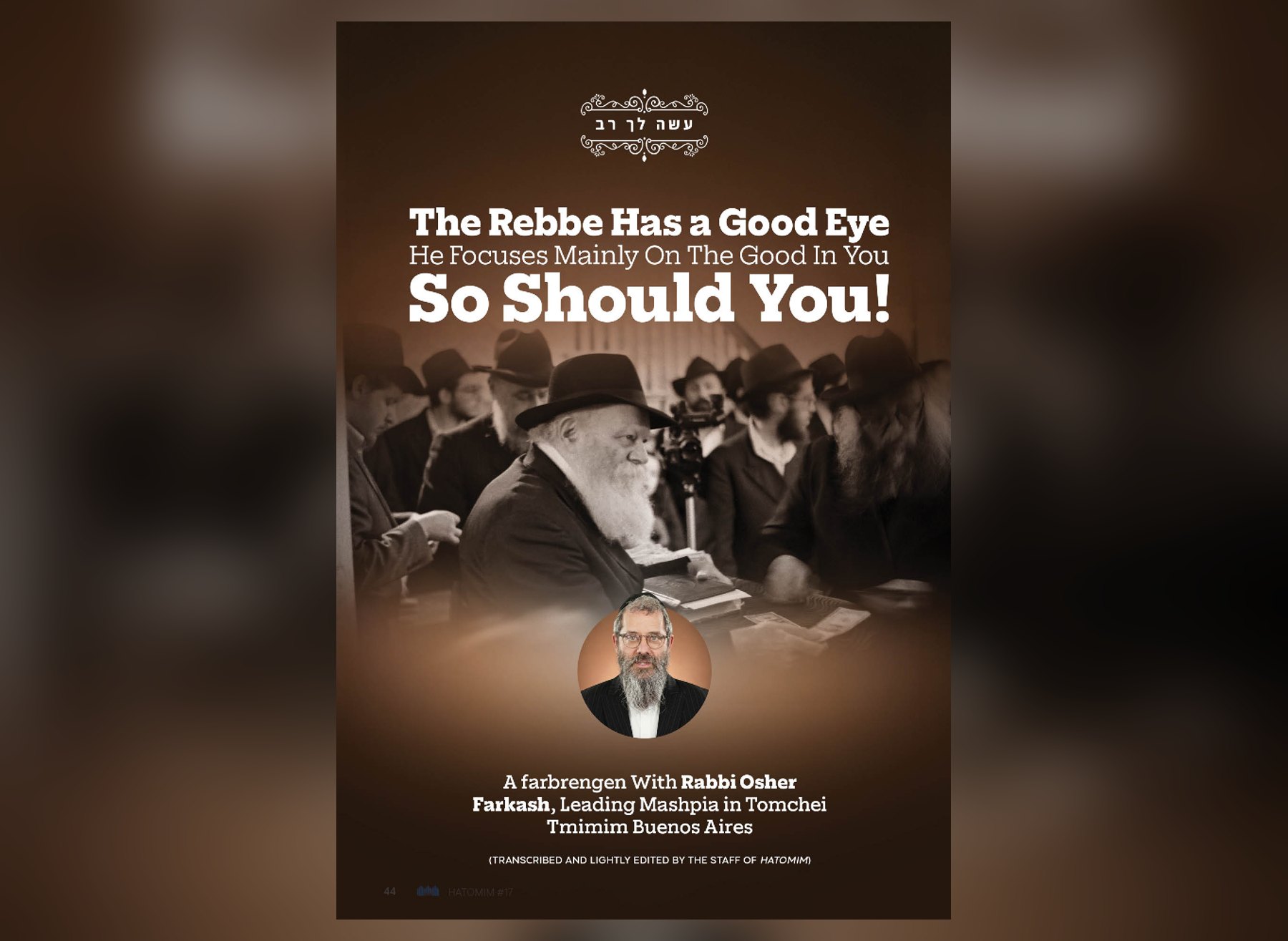
A farbrengen with Rabbi Osher Farkash, leading mashpia in Tomchei Tmimim Buenos Aires. (Transcribed and lightly edited by the staff of HaTomim.)
Every bachur in Tomchei Tmimim lives the life of a bachur for a very short period in his life – eight, ten years – but these years are special years in which his connection with the Rebbe is a special connection. The bachurim are “the apple of the Rebbe’s eye,” and the Rebbe’s love for the bachurim is particularly special.
Usually, an ordinary person thinks of himself as nothing special. However, when a person thinks of himself as an entity unto himself – then he thinks he’s the greatest in the world… For example: if you tell him “sit down, daven like a mentch, like a Chassid,” he reacts: “You’re talking to me? I’m nothing, gornisht…” But when his honor is offended? He becomes the most perfect person with the most virtues, and naturally “How dare you offend me? Don’t you know how great I am…”!?
The Rebbe knows the virtues of each and every bachur! The Rebbe wants the bachurim to be on the front line to bring the devar Hashem into the world. From the Rebbe’s perspective, everyone can and has the ability to bring the supreme intention into actual practice!
Every bachur needs to dedicate time to sit and think about the fact that he has special love from the Rebbe, the Rebbe relies on him! Think what it means to take a bachur who is still a child, “chicks whose eyes have not yet opened,” and tell him “you are the person I rely on, and my work in the world is accomplished through you…!”
Where does this come from? Because the Rebbe looks at every bachur as he truly is, in his inner essence. “Literally infinite!”
A bachur needs to work on his thinking, that he should look and gaze upon himself as the Rebbe looks at him – even “half, a third, or a quarter” of the way the Rebbe looks at him. The entire reality of a ‘tamim’ needs to come from the way the Rebbe looks at ‘tmimim,’ through the Rebbe’s glasses – and this will affect us and change us.
The perspective through which a bachur is accustomed to looking at himself – “chatasi, avisi, pashati – I have sinned, I have transgressed, I have rebelled,” I did such and such, etc. – all of this are arguments of the yetzer hara that wants to get out of doing avoda. But the Rebbe – Moshe Rabbeinu – has an ‘ayin tova.’ The Rebbe looks at everyone, and particularly at a bachur in Tomchei Tmimim, as the epitome of perfection – in Nigleh, in Chassidus, in mivtzaim – because through him the ultimate divine intent is fulfilled.
Moreover: The Rebbe’s perspective works on us so that this will truly be so! The Rebbe works within us and reveals these virtues in us so that we can fulfill the Rebbe’s will, the kavana elyona, the Rebbe’s desire.
When I was a bachur, I had a fear of passing by in the ‘dollars line’ before his holy presence… Imagine: you know that the Rebbe sees everyone as they truly are, and you can’t play games… The Rebbe sees what you think, do, study… so how can you pass by?
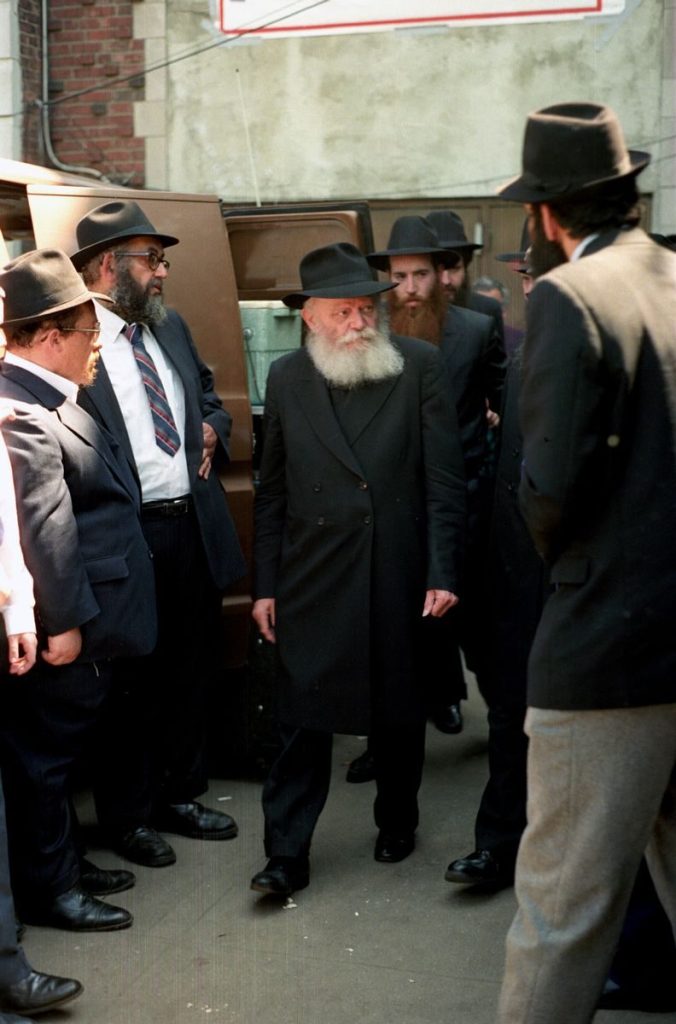
That’s how I felt until I learned the maamar where the Rebbe explains the difference between Moshe Rabbeinu and Bilaam the rasha: when Bilaam sees someone – immediately he finds the evil in them, and even if there is no obvious evil – he searches for the “depth of evil.” But Moshe Rabbeinu sees everyone with an “ayin tova” – he sees the good, reveals the good, and makes them good.
In the Pesach Haggadah we say “Va’yareiu osanu haMitzrim” (and the Egyptians did evil to us). The question arises: why do we say “Va’yareiu osanu?’ We should have said “Va’yareiu lanu!” The Rebbe Rashab explains this, that the Egyptians made us evil! Not that they did evil to us – but that they made the people evil…
When a bachur looks at the evil in himself, or at the “depth of evil” in himself and makes it into a ‘metzius’ – this is the perspective of “Egypt,” of “Bilaam the rasha.” But the Rebbe’s perspective is “ayin tova.” I remember when I learned in the yeshiva in Lod, our mashpia, R’ Zusha Posner would tell us “You’re a good bachur, you’re a good bachur, I can tell you forever that you’re good…” These are the words of a Chassid. And with the Rebbe, it’s more than that: The Rebbe looks at a bachur and makes him good – he doesn’t tell the bachur “you’re good,” but simply makes him good!
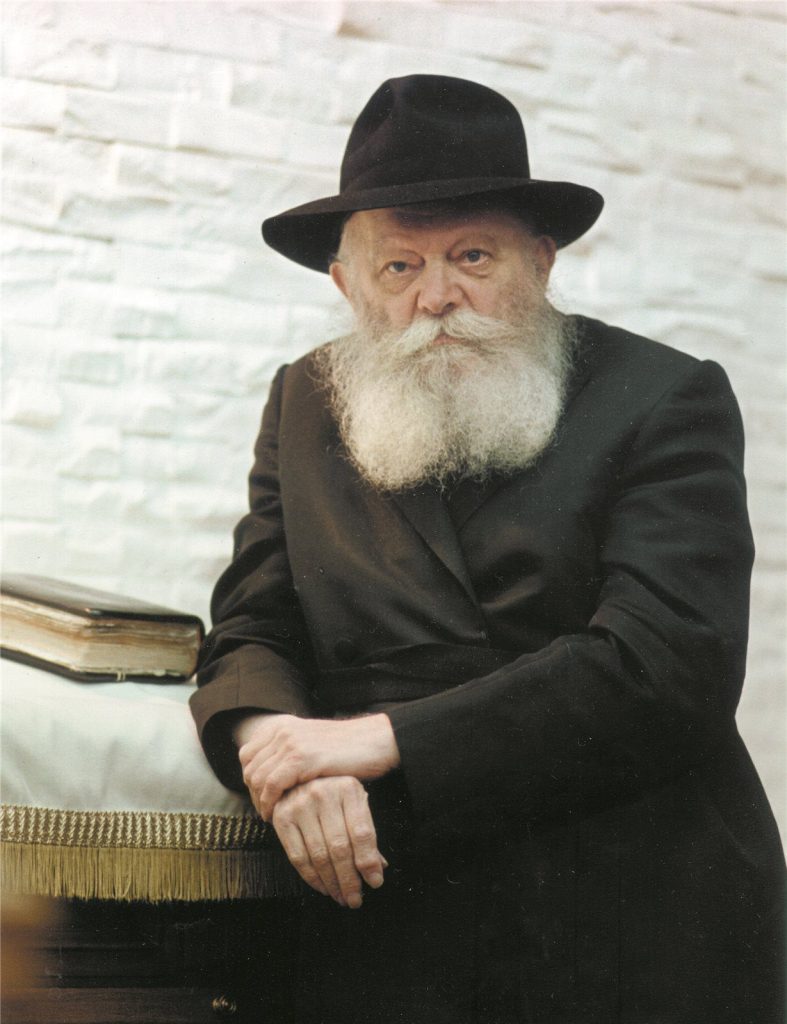
The Rebbe reveals “depth of goodness” – he brings out the good from the lowest place, treasures of goodness! When we look at ourselves the way the Rebbe looks at us – we can be as we truly should be, not as an ‘addition’ to what we appear to be, but the true reality as it’s supposed to be.
This doesn’t mean that the Rebbe doesn’t see the not-good that exists in us… “Nothing is hidden from You.” But that’s not the point, because that’s not what’s important to the Rebbe: The Rebbe sees and looks at the good that exists – and as mentioned, not only looks but reveals it – so that it will dominate the person.
And together with this, it’s required of me personally to stand for one moment before myself and look at myself with the Rebbe’s gaze: “How does the Rebbe see me?” When I look at myself as I’m accustomed to – I see a coarse and crude person, “a person is [a subjective] close [relative] to himself.” But the Rebbe sees the perfection of goodness in the bachur! And we on our part need to take the depth of the person and create from it a new person, a person with the Rebbe’s perspective…
Rabbi Grunblatt farbrenged with us once and said that the first time he had yechidus he wrote all sorts of not-good things about himself… In yechidus, the Rebbe said to him: “Der Rebbe der shver [the Rebbe, my father-in-law, the Rebbe Rayatz] says that lashon hara (evil speech) is forbidden to say not only about others but also about yourself…”
With these words the Rebbe not only gave him a horaah for life, but moreover: The Rebbe didn’t look at his evil at all!
In the edited maamarim of the Rebbe beginning with “V’Atah Tetzaveh,” “Zos Chukas HaTorah,” “B’Yom Ashtei Asar” – the Rebbe demands from us the highest levels of G-dliness, supreme perfection. Not as an attainment of perfection, but as a realization of the Divine will. The Rebbe surely knows who I am, how far I am! And nevertheless… The Rebbe demands all this from me! Because this is the nature of Moshe Rabbeinu – “ayin tova.”
Although there are bachurim from different Chassidic groups who appear more beautiful, their chitzoniyus looks good – but we are the Rebbe’s, because the Rebbe finds and reveals in us the “depth of goodness.”
This is the Rebbe’s tremendous love for us. The Rebbe relies and is confident that specifically the bachurim of today will bring the hisgalus of the Rebbe and the Geula, and this needs to be contemplated again and again until it penetrates and changes reality.
From this farbrengen a bachur needs to leave with a hachlata to change his perspective on himself. Then, the situation will be completely different. It doesn’t matter what I saw, how I look, and how I think I look – but how I truly should look. This perspective of the Rebbe needs to be adopted: you are not what you see or hear, all of that is chitzoniyus, such a perspective of not-good the Rebbe throws into the sea! The Rebbe sees who you truly are, and this he reveals and establishes in you; you are the Rebbe’s Chassid…
Of course, the intention is not that the negative facts ‘don’t interest’ the Rebbe and don’t pain him. On the contrary, one needs to know that the Rebbe knows this, etc., but the main thing is not to make a ‘big deal’ out of it, not to make an issue of it, to move forward, because the Rebbe sees the inner essence.
Reb Reuven Dunin had a special relationship with the Rebbe. He would enter to the Rebbe whenever he wanted. Once he entered two days after Simchas Torah and began to cry that he wants to do teshuva… The Rebbe said to him, “It was just Simchas Torah and you’re already crying?” Reb Reuven answered that he saw that the Rebbe also cried in the middle of the farbrengen… and the Rebbe told him that he cried because Moshiach hasn’t come…
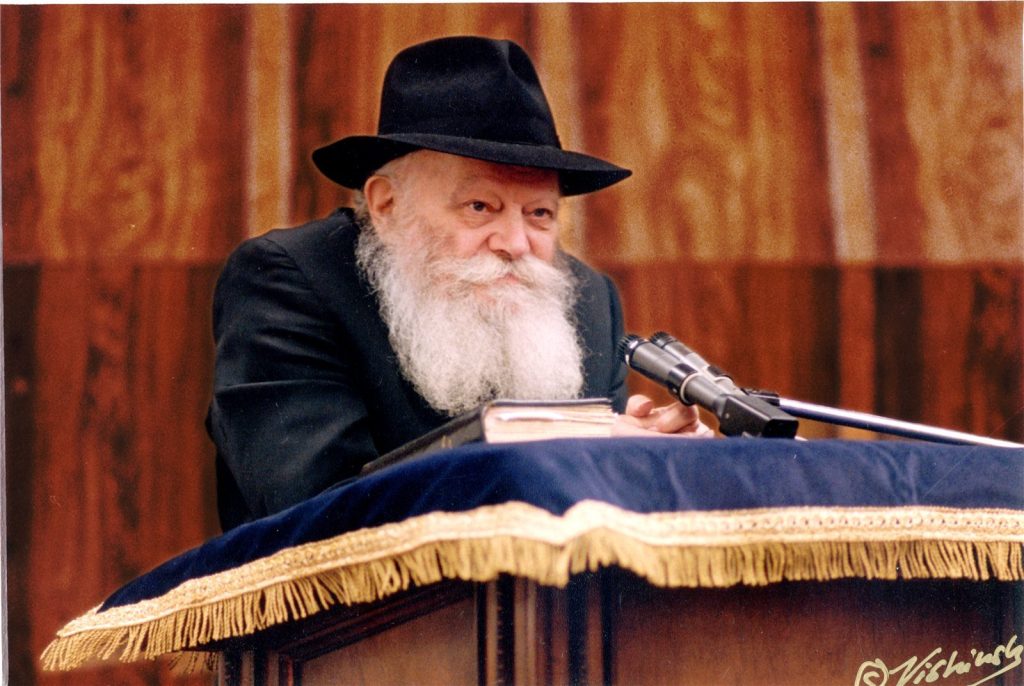
If we contemplate this story, it truly illustrates the subject we’re dealing with. The Rebbe said to Reb Reuven “You’re crying about yourself, but I’m crying that Moshiach hasn’t come…”
There is a well-known sicha of the Rebbe about “Yosef cried on Binyamin’s neck and Binyamin cried on his neck.” The Rebbe asks: why did each one cry for the other; cry for yourself! And explains, that to cry for yourself and for your not-good doesn’t help… but when the other has not-good – about that you should cry…
There are those who think there’s value in crying. When will I be a baal teshuva? When I cry… So what does he do? He takes the sefer Derech Chaim and tries to cry… and if that doesn’t work for him? Then he takes an onion and pushes it into his eyes, the main thing is that he should cry…
It’s clear that this doesn’t mean that if someone feels they need to cry they shouldn’t cry… rather the intention is not to make an issue of it.
Among the ‘mussar people’ there’s a concept of crying. They see someone crying – everyone says ‘he’s a holy person,’ and then you can commit sins anew… and then come the Aseres Yimei Teshuva about which it’s written that one who doesn’t cry during those days, “his soul is not whole,” so he does everything to cry…
The Rebbe says: to cry about yourself – that’s not an ‘inyan!’ If you feel a need to cry – no problem, but one shouldn’t sanctify the crying… Sometimes crying creates a good feeling. Great, I’ve cleansed myself, I’m so full of sins and there’s no room, so we cry because we want to unload, to feel good, and right after that we start with transgressions anew…
Once I heard a beautiful vort: Just as in holiness there exists the concept of “ratzo” (running forward) and “shov” (returning), a desire to connect to Elokus and on the other hand to return into the world to make “a dwelling place in the lower worlds” – this also exists in kelipa. On the one hand, a person runs to commit transgressions, “ratzo” to transgressions, and then there’s “shov,” they begin to do teshuva, but all the “shov” is preparation for a new “ratzo”…
True, the negative matters certainly affect the Rebbe, as brought in the maamar “Basi L’Gani” that transgressions made the Rebbe sick. And together with the pain, the Rebbe, as it were, tells you: “This isn’t you.” Moshe Rabbeinu who has an ayin tova looks “what’s beyond.” As if he says: how did you fall, it doesn’t suit you to deal with this evil… move forward and continue to do the supreme will.
A non-Chabad bachur told me that one Chassidic vort that he heard from Reb Chaim Sholom Deutsch brought him close to Chassidus and to the Rebbe. Reb Chaim Shalom quoted the words of the Alter Rebbe in Tanya in Iggeres HaTeshuva, that immediately when a person says “forgive us” – immediately Hashem forgives him. Yes, afterward you need to do the work of teshuva and fix all the matters that need fixing! But the initial point, the inner one, is “what passed is passed,” now begin anew.
In sifrei mussar the concept of teshuva is a very difficult thing. Many fasts and afflictions, vidui, this or that gehinom, but the Alter Rebbe says, immediately when you said “selach lanu,” the Holy One Blessed Be He forgives!
True – you need to resolve to do better from here forward, you need to do teshuva for the past. But that’s not the main thing! What you did is an external thing, like a shell that wraps the fruit. Your essence is good. There’s a “ruach shtus” that attaches itself to a person but that’s not what he is!
So why don’t we look at ourselves this way? It’s because the yetzer hara comes to a person and tells him: “You’re in the lowest depths! Remember ‘what you did last night!’ Suddenly you want Elokus? You’re a liar! You know exactly where you belong!”
But in Hakdamas HaMelaket the Alter Rebbe says “b’yodai u’makirai ka’amina” – I know each one and I say that the perspective needs to be exactly the opposite: you are essentially good! Remember who you are in your inner essence! Indeed there are external things that wrap around you and attach to you, like an ‘appendage’ that needs to be removed. But remember who you are!
Reb Zalman Morozow farbrenged once and said that in the haftora of Machar Chodesh it’s written that Dovid HaMelech didn’t come to the meal. Shaul HaMelech said perhaps “it so happens that he’s not pure,” maybe David fell into sin and he’s afraid to come…
So too, tmimim wouldn’t just pass by the Rebbe. Only on special occasions, special times, birthdays and such. The reason everyone talked about this was simply because the bachurim didn’t want to bring their crude faces before the Rebbe; this came from shame.
After all that we’ve farbrenged here, we understand that this calculation is a calculation of the animal soul. Because you’re constantly busy with yourself, with the not-good things that are attached to you. But when you know that the Rebbe looks at you as you’re essentially good and the highest thing there is – this changes the connection.
The task of a ‘tamim’ is to reveal his essence and his core. The point is that the moment you say “selach lanu,” or in other words – the very fact that you make a firm and courageous decision to change – this is the opening to change, and what’s important is what you’ll do from here forward.
* * *
In the maamar of “V’Atah Tetzaveh” the Rebbe brings two interpretations in “Raya Mehemna:” one interpretation that he’s a faithful shepherd of Israel (and doesn’t explain it), a second interpretation is that he nourishes and sustains the faith – and the Rebbe deals with this throughout the maamar.
It’s known that Dovid HaMelech was a “faithful shepherd” and Hashem chose him and took him from the sheep pens. His faithfulness was expressed in that he would feed the young sheep with soft grass, the youth he would feed with hard grass, and the elderly he fed with medium grass. He didn’t just throw them the grass and say figure it out, but thought about each and every one in detail, what were each one’s keilim to receive. And therefore Hashem said about him that he’s a “faithful shepherd.”
The Rebbe is a “faithful shepherd.” He cares for everyone individually and gives each one what they can receive. There are small ones, there are bachurim, and there are elderly. With the Rebbe there’s language and style for everyone: when the Rebbe speaks to ‘soldiers’ of Tzivos Hashem it’s one style, there are sichos where the Rebbe speaks to wealthy people in “Machne Israel,” there are sichos to women and girls, and there are sichos to bachurim which is a different style.
The Rebbe not only gives – but also demands from each one according to their inyan. Everyone needs to ask themselves which group they belong to – the small ones or the elderly or the bachurim. To bachurim the Rebbe gives the hard grass because you’re a bachur, you have strength! So break your teeth a bit…
There aren’t many sichos of the Rebbe to bachurim. In the early years there was a sicha at ‘Chanuka gelt,’ ‘birkas ha’banim’ on Erev Yom Kippur, and after that there was yechidus for tmimim. From time to time during farbrengens on dates like Purim and the last day of Pesach – the Rebbe would farbreng with the tmimim.
Reb Itche Meir Gurary related that he had yechidus and told the Rebbe that the bachurim are engaged in mivtzaim. The Rebbe told him “from bachurim I demand that they be well-versed in Nigleh, in Chassidus, and in avodas ha’tefilla.” Reb Itche Meir told the Rebbe that the bachurim say that in farbrengens the Rebbe speaks about ‘shlichus’ and conquering the world and that’s ‘the inyan’ because that’s what the Rebbe talks about!
The Rebbe answered him that “Torah speaks to the majority” – since most of the people sitting at the farbrengen are married men, balebatim, etc., that’s what he speaks about, but from bachurim a completely different avoda is demanded, what’s written in the kuntres ‘Eitz HaChaim’ etc.
When you look at the sichos where the Rebbe speaks to bachurim, you see that the Rebbe demands hard work: diligence and perseverance in studying Nigleh and studying Chassidus, avodas ha’tefilla, ‘iskafya’ and ‘ishapcha,’ ‘mivtzaim,’ ‘mesira u’nesina,’ ‘kabbalas ol.’ The Rebbe gives us the hard grass, we need to toil, “Not mastery do I give you; servitude I give you!”
Among Chassidim the style of speech is “one on one” and not in respectful language (as exists in other places where they speak in plural, ‘ihr’ – you plural). When the Rebbe speaks with a Chassid not in plural, not in language of honor and formalities – this shows the relationship, that he’s a Rebbe and you’re a Chassid.
Reb Zalman Moshe HaYitzchaki took the histalkus of the Rebbe Rashab very hard. When the Rebbe Rayatz accepted the leadership, he went to yechidus. When someone came out, Reb Zalman Moshe asked him what’s happening there? So he told him that the Rebbe Rayatz speaks in the language of ‘ihr’ [you plural…]
Reb Zalman Moshe said: “If he speaks in the language of ‘ihr’ – then that means there’s still a metzius, that’s not how you enter yechidus…” and immediately he got up and left. After a year he returned and entered for yechidus. As soon as he entered, the Rebbe Rayatz smiled a broad smile and said to him “How are you Reb Zalman Moshe? How’s the davening, how’s the learning…?”
There are people with whom the Rebbe speaks in a language of formalities, ‘soft language.’ But with bachurim the Rebbe speaks without coverings and external wrappings, not with language of ‘formalities.’ From bachurim the maximum is demanded, no compromises! And so we need to demand of ourselves the standard that the Rebbe demands of bachurim.
[A bachur is not only one who hasn’t yet married… there’s a bachur who hasn’t married and yet he’s a balebus, “lacking only the actual deed.” “anything about to be burned is considered burned…” and there’s a balebus who is a bachur, his essence is different and distinct.]…
Once the Rebbe wrote a letter to someone regarding avodas Hashem, that there are two types of answers: A ‘hard answer’ – what I demand of myself I demand of you. A ‘soft answer’ – “little by little I will drive them out,” and you decide which type of answer to receive…
Everyone needs to define themselves within a group – whether they’re in the group of elderly, of children, or of bachurim, and if you decide you’re in the group of bachurim – then know that you’ll eat hard grass…
Today there are bachurim who need to be spoken to in the language of balebatim, need to be spoken to in soft language, to give them a pat on the shoulder, to tell them you’re a sweetheart, and if you say a word of “rebuke from revealed love” they already think you hate them…
We need to be bachurim! To eat hard grass! “Let the work be heavy upon the people and let them not pay attention to words of falsehood…” To be the Rebbe’s bachurim means that the Rebbe can speak to you in hard language, not in the respectful language of ‘ihr.’ This is the meaning of the term Chassid. ‘Hard language’ means that the Rebbe can demand from me without explanations.
There are those who reach a certain age and they begin with excuses: “I have a family, I’m a shliach, I’m busy…” But the Rebbe demands: how much Chassidus did you study, how much time did you daven, did you contemplate Chassidus before davening! And if not, this is called davening like a misnaged…
Reb Efraim Piekarsky once farbrenged and said that everyone declines after marriage and the difference is between one who davened at length in his youth and one who didn’t: one who davened at length, then after marriage he’ll daven with a minyan, and one who in his youth davened with a minyan – after marriage he doesn’t daven…
This isn’t “Torah from Sinai,” but there’s a correct point in it. Once I heard from the Rebbe after Pesach in 5748, when the Rebbe spoke in extraordinary language. This is what the Rebbe said: “When you studied in Tomchei Tmimim you would contemplate an hour of Chassidus before davening, and today when you get up in the morning and look in the mirror to see whether the tie is in place – then look at yourself and say when was the last time you thought an hour of Chassidus before davening, at least half an hour…!”
Rabbi Grunblatt related that he entered yechidus and he asked the Rebbe how to arrange his times of study during the day, how much to dedicate to himself and how much to others, the Rebbe answered him that he’ll decide when the time comes…
And Rabbi Grunblatt explained what the intention was in this: everyone needs to know that from time to time one needs to forget about all the things around him and dedicate time to studying a maamar Chassidus thoroughly and daven with it.
The Rebbe demands from us without compromise. The Rebbe Rayatz said that a Chassid who on Shabbos morning gets up after six o’clock, is not a Chassid… Meaning – if he doesn’t study several hours of Chassidus at length then he’s not a Chassid…
On the other hand we know that the Rebbe loves all Jews and the Rebbe brings everyone close. But it depends on whom you’re speaking to… if speaking to a balebus – then there are many excuses. But if we want to be connected to the Rebbe – then the Rebbe’s demands from us are completely different.
We also aren’t ‘pnimiyim’ – to put it mildly – so at least let’s use this for the Rebbe, for spreading the wellsprings, not to remain with it alone for ourselves; at least to direct it to better places. Reb Mendel once told one of the Chassidim that he’s a ‘chitzon,’ but at least he should utilize this for spreading the wellsprings.
Once someone asked Reb Berel Mochkin about his brother Leibel Mochkin who organized the escape of Chassidim from Russia, whether he did this out of mesiras nefesh or out of wildness..? Reb Berel answered him that in that period everything was mesiras nefesh and even if you were a wild person you used it for mesiras nefesh…
HaTomim #18 • pp. 44-51, 63
© 2026 Beis Moshiach Magazine. All rights reserved.
This article originally appeared in Beis Moshiach #1491B. You are welcome to share it with friends and family by email or in print, provided that you do not change, add to or omit any part of it, you credit the author and Beis Moshiach, and you include a link to archive.bmoshiach.org (written out in full in printed copies).
To republish this article in a newspaper, magazine, book or website, please request permission in advance at [email protected].