Sukka Hopping in 770
Did you know that 770 has had many different sukkos over the years – big ones, small ones, plain ones, and even one just for standing in? Come take a picture-walk through 770’s Sukkos history!
Read the text of this article
ה’תש”א (1940)
Three Sukkos, One Amazing Sight
When American Jews first walked into 770 for Sukkos, they could hardly believe their eyes. There were three sukkos—one big one in the yard, one for the Rebbe Rayatz on the porch, and one for the Rashag and his family upstairs, on a porch of the third floor of 770. Jews in America were free to keep Yiddishkeit, but many were embarrassed to do so. The Rebbe Rayatz would say, “America iz nisht andersh—America is not different,” and Sukkos was just the time to display that Jewish pride!
The Rebbe Rayatz’s Porch Sukka
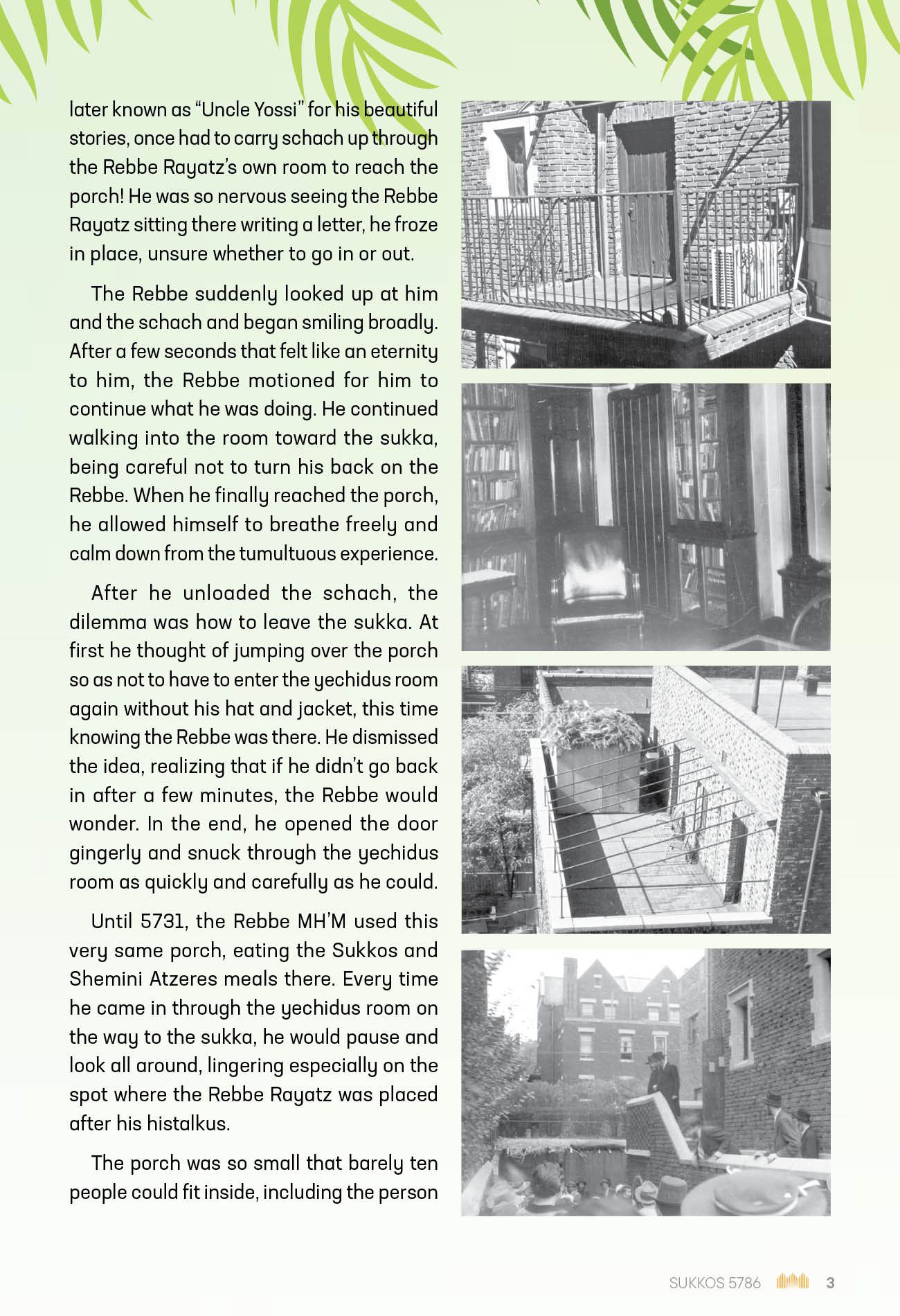
The Rebbe Rayatz’s sukka was tiny—just a porch connected to his room by a narrow black door. One Chassid, R’ Yosef Goldstein, later known as “Uncle Yossi” for his beautiful stories, once had to carry schach up through the Rebbe Rayatz’s own room to reach the porch! He was so nervous seeing the Rebbe Rayatz sitting there writing a letter, he froze in place, unsure whether to go in or out.
The Rebbe suddenly looked up at him and the schach and began smiling broadly. After a few seconds that felt like an eternity to him, the Rebbe motioned for him to continue what he was doing. He continued walking into the room toward the sukka, being careful not to turn his back on the Rebbe. When he finally reached the porch, he allowed himself to breathe freely and calm down from the tumultuous experience.
After he unloaded the schach, the dilemma was how to leave the sukka. At first he thought of jumping over the porch so as not to have to enter the yechidus room again without his hat and jacket, this time knowing the Rebbe was there. He dismissed the idea, realizing that if he didn’t go back in after a few minutes, the Rebbe would wonder. In the end, he opened the door gingerly and snuck through the yechidus room as quickly and carefully as he could.
Until 5731, the Rebbe MH’M used this very same porch, eating the Sukkos and Shemini Atzeres meals there. Every time he came in through the yechidus room on the way to the sukka, he would pause and look all around, lingering especially on the spot where the Rebbe Rayatz was placed after his histalkus.
The porch was so small that barely ten people could fit inside, including the person serving! Even so, the seating was kept exactly as it always had been: a place was set at the head of the table for the Rebbe Rayatz himself, his chair on the left with a plate and cutlery waiting, while the Rebbe MH’M sat at the edge of the table, to the Rebbe Rayatz’s left. The Rebbetzins ate their meals inside the building.
Before the Rebbe’s Nesius: The Communal Sukka
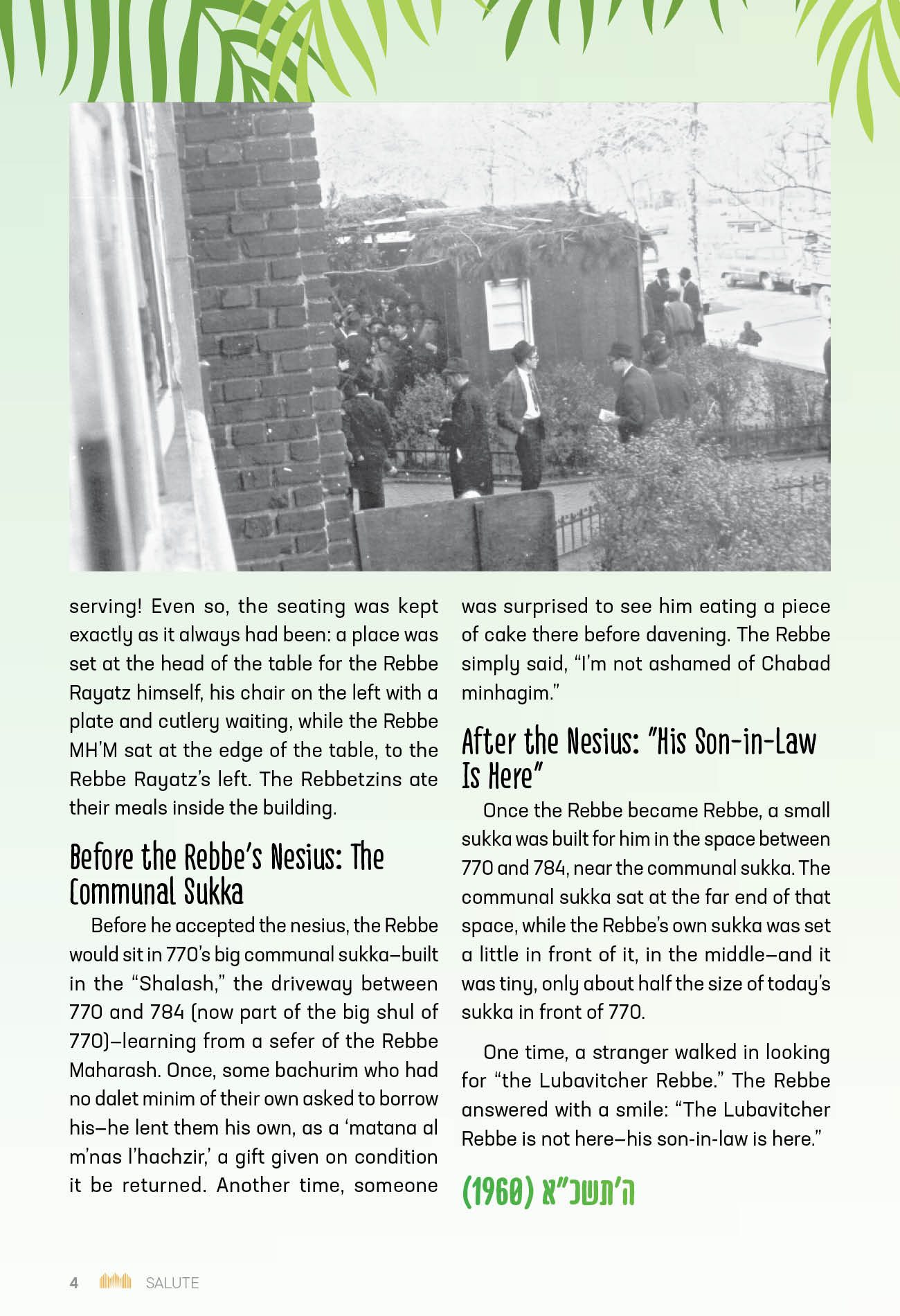
Before he accepted the nesius, the Rebbe would sit in 770’s big communal sukka—built in the “Shalash,” the driveway between 770 and 784 (now part of the big shul of 770)—learning from a sefer of the Rebbe Maharash. Once, some bachurim who had no dalet minim of their own asked to borrow his—he lent them his own, as a ‘matana al m’nas l’hachzir,’ a gift given on condition it be returned. Another time, someone was surprised to see him eating a piece of cake there before davening. The Rebbe simply said, “I’m not ashamed of Chabad minhagim.”
After the Nesius: “His Son-in-Law Is Here”
Once the Rebbe became Rebbe, a small sukka was built for him in the space between 770 and 784, near the communal sukka. The communal sukka sat at the far end of that space, while the Rebbe’s own sukka was set a little in front of it, in the middle—and it was tiny, only about half the size of today’s sukka in front of 770.
One time, a stranger walked in looking for “the Lubavitcher Rebbe.” The Rebbe answered with a smile: “The Lubavitcher Rebbe is not here—his son-in-law is here.”
ה’תשכ”א (1960)
The Sukka Moves to the Front
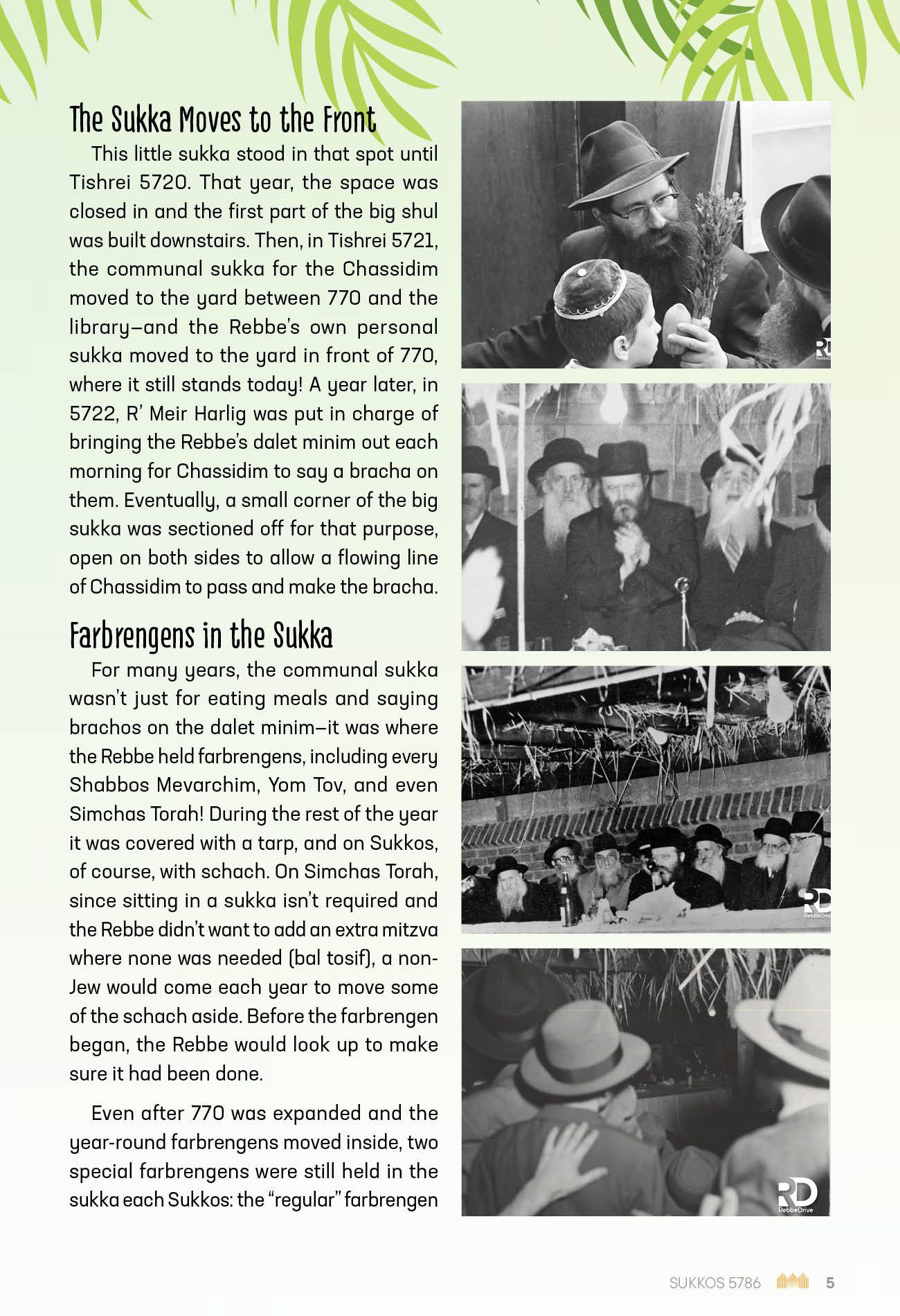
This little sukka stood in that spot until Tishrei 5720. That year, the space was closed in and the first part of the big shul was built downstairs. Then, in Tishrei 5721, the communal sukka for the Chassidim moved to the yard between 770 and the library—and the Rebbe’s own personal sukka moved to the yard in front of 770, where it still stands today! A year later, in 5722, R’ Meir Harlig was put in charge of bringing the Rebbe’s dalet minim out each morning for Chassidim to say a bracha on them. Eventually, a small corner of the big sukka was sectioned off for that purpose, open on both sides to allow a flowing line of Chassidim to pass and make the bracha.
Farbrengens in the Sukka
For many years, the communal sukka wasn’t just for eating meals and saying brachos on the dalet minim—it was where the Rebbe held farbrengens, including every Shabbos Mevarchim, Yom Tov, and even Simchas Torah! During the rest of the year it was covered with a tarp, and on Sukkos, of course, with schach. On Simchas Torah, since sitting in a sukka isn’t required and the Rebbe didn’t want to add an extra mitzva where none was needed (bal tosif), a non-Jew would come each year to move some of the schach aside. Before the farbrengen began, the Rebbe would look up to make sure it had been done.
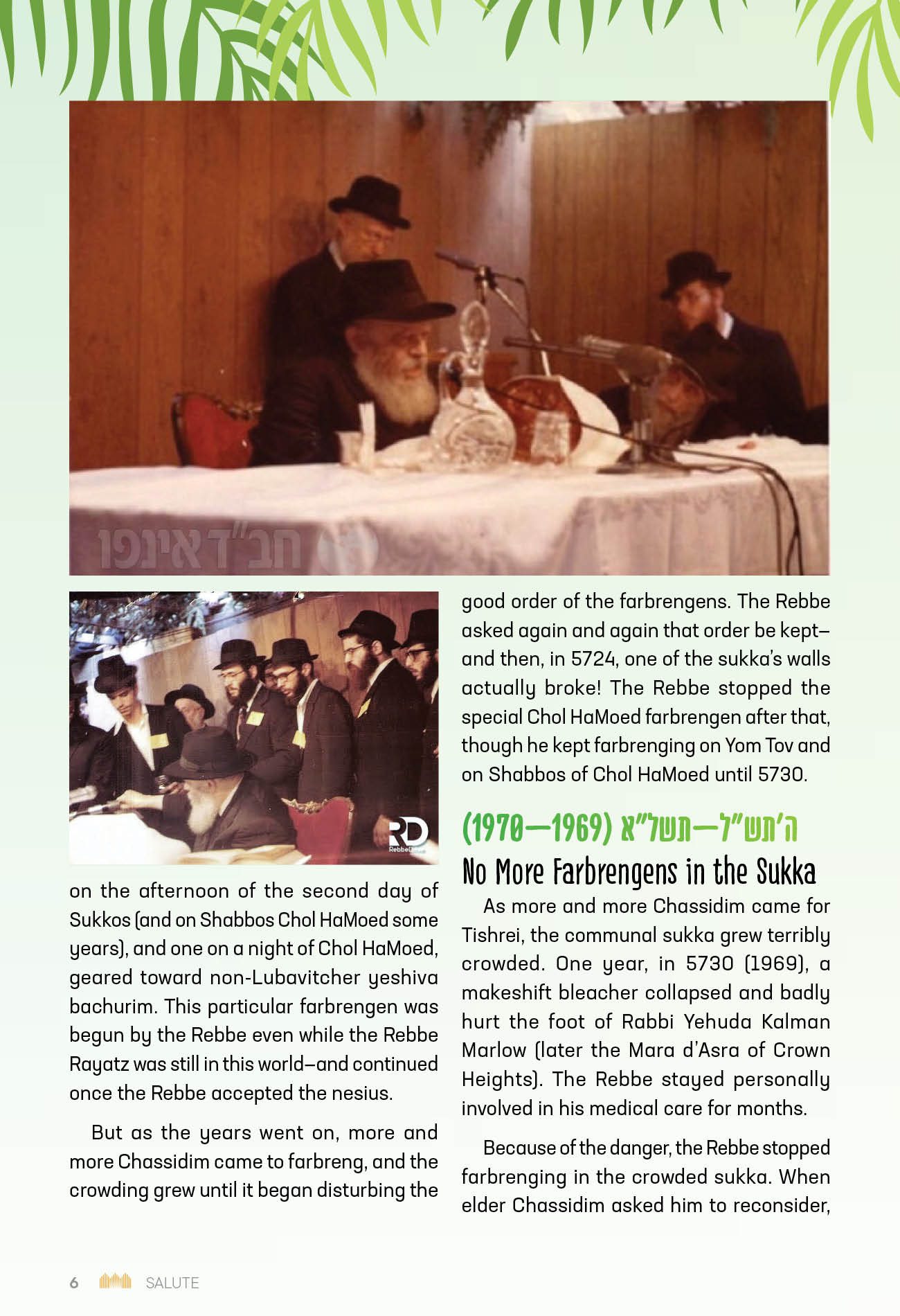
Even after 770 was expanded and the year-round farbrengens moved inside, two special farbrengens were still held in the sukka each Sukkos: the “regular” farbrengen on the afternoon of the second day of Sukkos (and on Shabbos Chol HaMoed some years), and one on a night of Chol HaMoed, geared toward non-Lubavitcher yeshiva bachurim. This particular farbrengen was begun by the Rebbe even while the Rebbe Rayatz was still in this world—and continued once the Rebbe accepted the nesius.
But as the years went on, more and more Chassidim came to farbreng, and the crowding grew until it began disturbing the good order of the farbrengens. The Rebbe asked again and again that order be kept—and then, in 5724, one of the sukka’s walls actually broke! The Rebbe stopped the special Chol HaMoed farbrengen after that, though he kept farbrenging on Yom Tov and on Shabbos of Chol HaMoed until 5730.
ה’תש”ל–תשל”א (1969–1970)
No More Farbrengens in the Sukka
As more and more Chassidim came for Tishrei, the communal sukka grew terribly crowded. One year, in 5730 (1969), a makeshift bleacher collapsed and badly hurt the foot of Rabbi Yehuda Kalman Marlow (later the Mara d’Asra of Crown Heights). The Rebbe stayed personally involved in his medical care for months.
Because of the danger, the Rebbe stopped farbrenging in the crowded sukka. When elder Chassidim asked him to reconsider, the Rebbe answered firmly: their Shulchan Aruch was his Shulchan Aruch too—and when it comes to safety, we’re careful even for a sfek sfeika, a doubt of a doubt.
ה’תשל”ז (1976)
Besides for One…
There was just one exception. In 5737, the Rebbe held a special farbrengen for the children of “Shelah”—the “Released Time” program. He washed and ate a seuda, and beforehand he even issued a note laying out the detailed order of the farbrengen!
ה’תשל”ו (1975)
A Royal Sukka
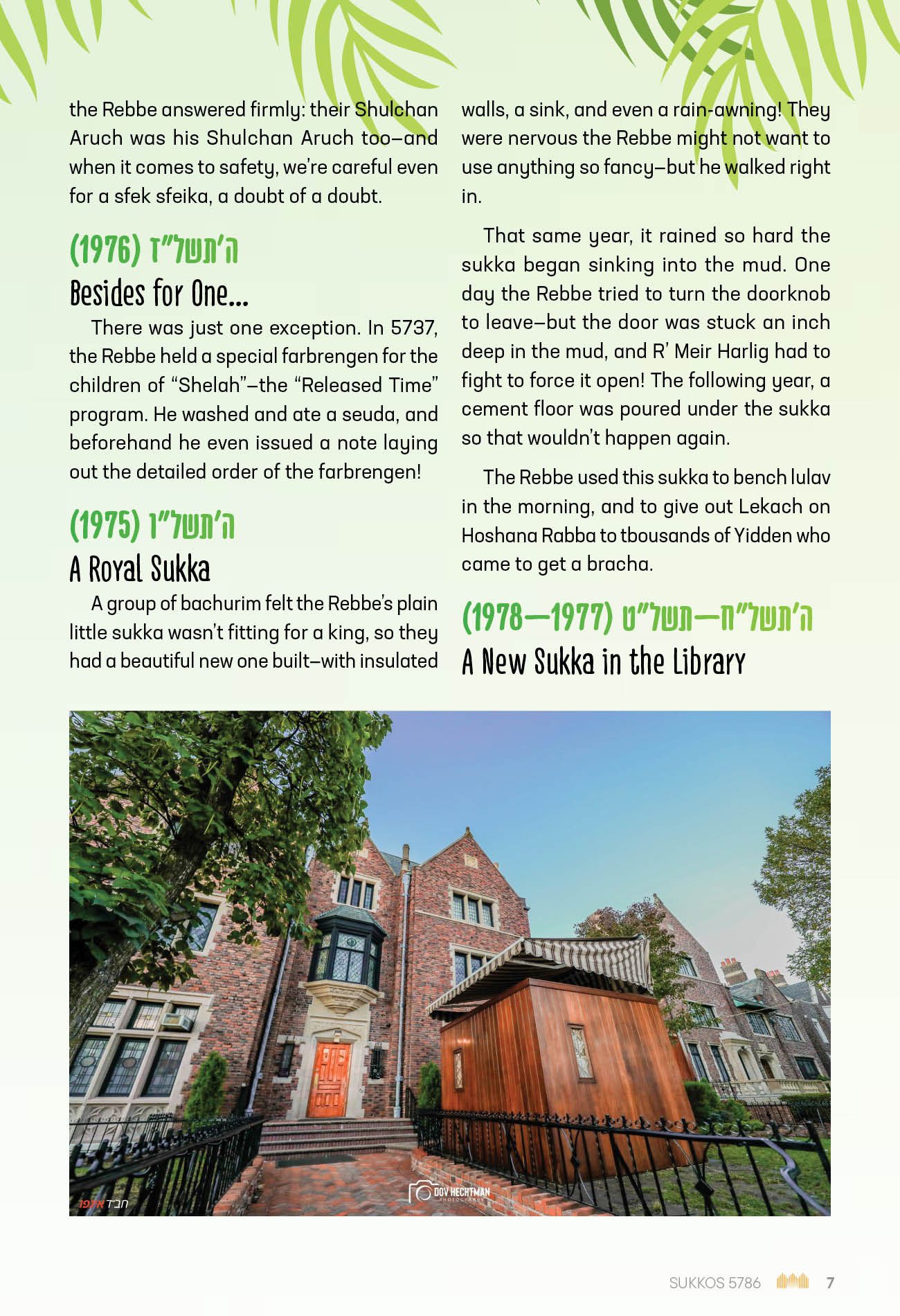
A group of bachurim felt the Rebbe’s plain little sukka wasn’t fitting for a king, so they had a beautiful new one built—with insulated walls, a sink, and even a rain-awning! They were nervous the Rebbe might not want to use anything so fancy—but he walked right in.
That same year, it rained so hard the sukka began sinking into the mud. One day the Rebbe tried to turn the doorknob to leave—but the door was stuck an inch deep in the mud, and R’ Meir Harlig had to fight to force it open! The following year, a cement floor was poured under the sukka so that wouldn’t happen again.
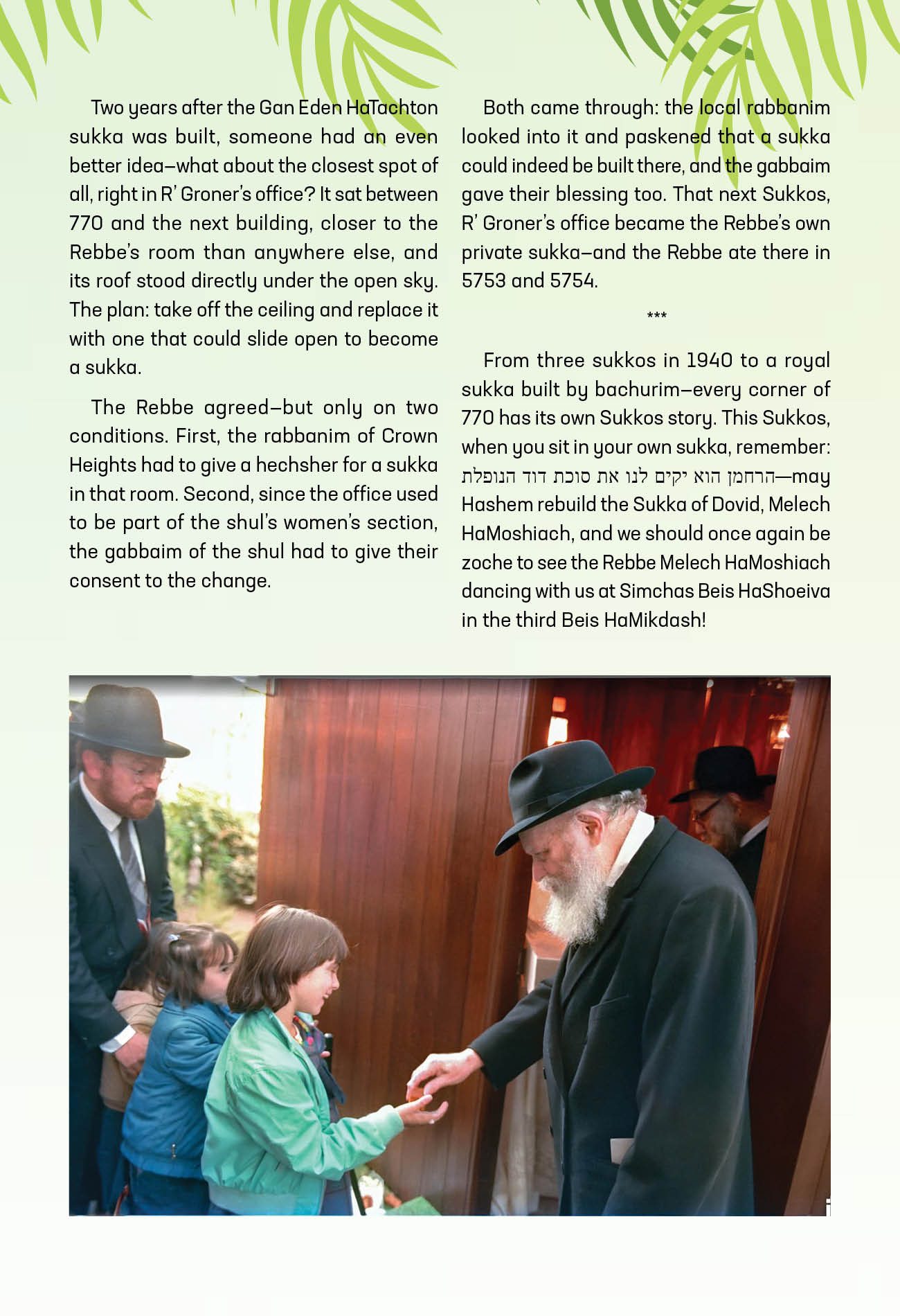
The Rebbe used this sukka to bench lulav in the morning, and to give out Lekach on Hoshana Rabba to tbousands of Yidden who came to get a bracha.
ה’תשל”ח–תשל”ט (1977–1978)
A New Sukka in the Library
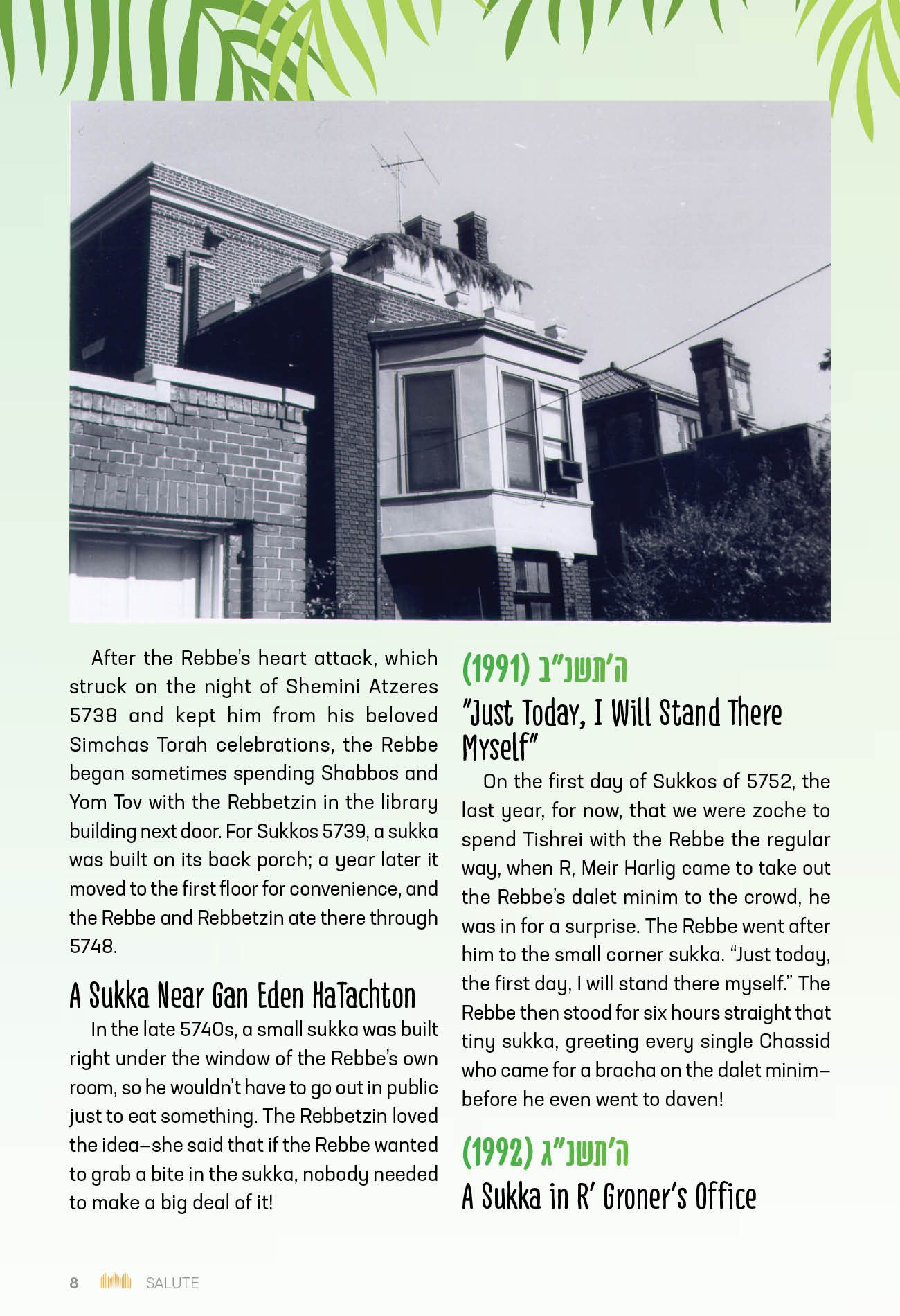
After the Rebbe’s heart attack, which struck on the night of Shemini Atzeres 5738 and kept him from his beloved Simchas Torah celebrations, the Rebbe began sometimes spending Shabbos and Yom Tov with the Rebbetzin in the library building next door. For Sukkos 5739, a sukka was built on its back porch; a year later it moved to the first floor for convenience, and the Rebbe and Rebbetzin ate there through 5748.
A Sukka Near Gan Eden HaTachton
In the late 5740s, a small sukka was built right under the window of the Rebbe’s own room, so he wouldn’t have to go out in public just to eat something. The Rebbetzin loved the idea—she said that if the Rebbe wanted to grab a bite in the sukka, nobody needed to make a big deal of it!
ה’תשנ”ב (1991)
“Just Today, I Will Stand There Myself”
On the first day of Sukkos of 5752, the last year, for now, that we were zoche to spend Tishrei with the Rebbe the regular way, when R, Meir Harlig came to take out the Rebbe’s dalet minim to the crowd, he was in for a surprise. The Rebbe went after him to the small corner sukka. “Just today, the first day, I will stand there myself.” The Rebbe then stood for six hours straight that tiny sukka, greeting every single Chassid who came for a bracha on the dalet minim—before he even went to daven!
ה’תשנ”ג (1992)
A Sukka in R’ Groner’s Office
Two years after the Gan Eden HaTachton sukka was built, someone had an even better idea—what about the closest spot of all, right in R’ Groner’s office? It sat between 770 and the next building, closer to the Rebbe’s room than anywhere else, and its roof stood directly under the open sky. The plan: take off the ceiling and replace it with one that could slide open to become a sukka.
The Rebbe agreed—but only on two conditions. First, the rabbanim of Crown Heights had to give a hechsher for a sukka in that room. Second, since the office used to be part of the shul’s women’s section, the gabbaim of the shul had to give their consent to the change.
Both came through: the local rabbanim looked into it and paskened that a sukka could indeed be built there, and the gabbaim gave their blessing too. That next Sukkos, R’ Groner’s office became the Rebbe’s own private sukka—and the Rebbe ate there in 5753 and 5754.
* * *
From three sukkos in 1940 to a royal sukka built by bachurim—every corner of 770 has its own Sukkos story. This Sukkos, when you sit in your own sukka, remember: הרחמן הוא יקים לנו את סוכת דוד הנופלת—may Hashem rebuild the Sukka of Dovid, Melech HaMoshiach, and we should once again be zoche to see the Rebbe Melech HaMoshiach dancing with us at Simchas Beis HaShoeiva in the third Beis HaMikdash!
Salute #1524 • pp. 2-9
© 2026 Beis Moshiach Magazine. All rights reserved.
This article originally appeared in Beis Moshiach #1524. You are welcome to share it with friends and family by email or in print, provided that you do not change, add to or omit any part of it, you credit the author and Beis Moshiach, and you include a link to archive.bmoshiach.org (written out in full in printed copies).
To republish this article in a newspaper, magazine, book or website, please request permission in advance at [email protected].