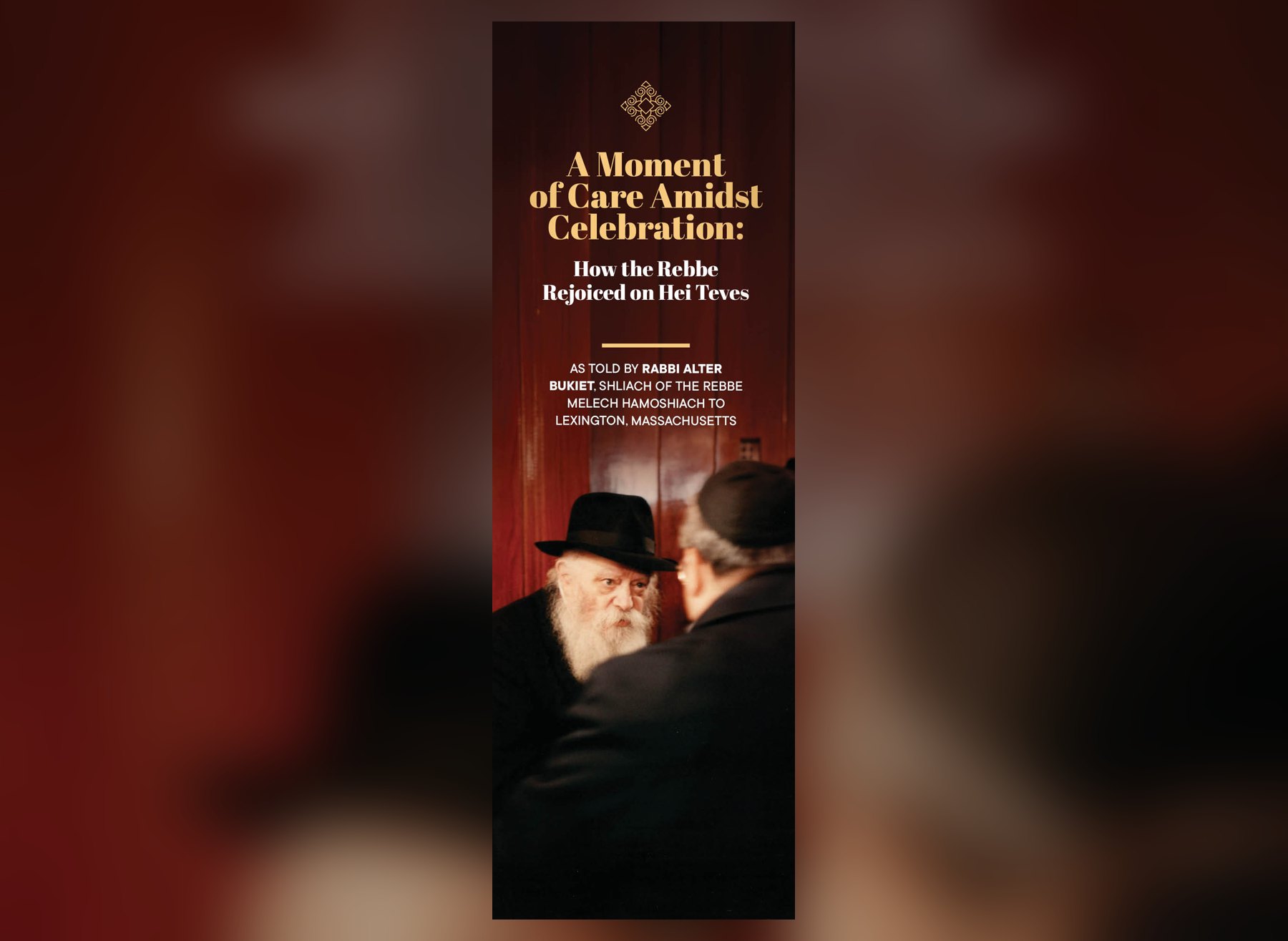
A Moment of Care Amidst Celebration
Rabbi Alter Fishel Bukiet never forgot that remarkable winter day in Crown Heights. It was Hei Teves 5747 (1987), a date that would become eternally etched in the annals of Chabad history. The morning had begun ordinarily enough in Sarasota, Florida, where R’ Bukiet served then as the Rebbe’s shliach, until a phone call from his father-in-law, Rabbi Faivish Vogel, changed everything.
“The lawyers just called,” R’ Vogel’s voice crackled with excitement over the line. “The verdict is coming today. The Chassidim will win. Get on a plane immediately and come to 770!”
Without a second thought, R’ Bukiet grabbed his talis and tefillin and rushed to the Tampa airport, not even knowing how long he’d be away. By 2:30 that afternoon, his plane touched down in New York, and within forty minutes, he found himself swept into the electric atmosphere of 770. The building was already alive for hours with celebration – Chassidim dancing both inside and out, their joy spilling onto the Brooklyn streets.
Making his way upstairs to the lobby, R’ Bukiet found it relatively quiet compared to the festivities below. Most of the crowd had gathered downstairs, eagerly awaiting the Rebbe’s arrival to Mincha. He positioned himself in a corner near the Kehos display case, when something caught his attention: an elderly man with white hair standing nearby, weeping silently. Most striking was the absence of a yarmulke on his head.
“Shalom Aleichem,” Rabbi Bukiet extended his hand warmly. “I’m Alti Bukiet.”
The man clasped his hand in return. “Feivel Dzidzik,” he responded, his voice quavering.
“Is everything alright?” Rabbi Bukiet had barely gotten the words out when the door to the Rebbe’s room opened. The Rebbe, emerging at that precise moment, heard the question and turned toward them, immediately noticing Feivel’s tears. With quick thinking, R’ Bukiet removed his yarmulka from under his hat and placed on Feivel’s head.
“Vos iz mit em?” the Rebbe asked in Yiddish. Rabbi Bukiet translated, and Feivel’s story came pouring out: “My wife is dying in the hospital. The doctor said that naturally, there’s nothing more they can do. But then the physician told me, ‘I’m a religious Jew, and there’s a Rebbe in Crown Heights who’s a spiritual giant. Go to him!’ So here I am.”
The Rebbe’s response was immediate: “What is her name?”
“Feiga bas Bracha,” Feivel replied through R’ Bukiet’s translation.
The Rebbe looked directly at Feivel and spoke in English, his words carrying the weight of both authority and compassion: “G-d has many years for me, and surely He has for your wife as well.”
Then, in a gesture that seemed to bridge heaven and earth, the Rebbe handed Feivel a nickel, motioning toward the tzedaka box mounted on the wall. After Feivel deposited the coin, the Rebbe moved toward the elevator, but this moment of divine proportions wasn’t finished yet.
With one foot in the elevator, the Rebbe turned back. “Bukiet, nu?” The words hung in the air, puzzling R’ Bukiet. The Rebbe repeated, “Bukiet, nu?” When met with continued confusion, the Rebbe clarified: “Hot er nit gelaygt tefillin haynt?” (Has he not put on tefillin today?)
The answer was no. The Rebbe gestured downstairs, instructing, “Bring him down and put on tefillin with him.”
Later, when the Rebbe was on his way out of the shul, they stood by the door. The Rebbe passed the two, and vigorously waved his hand toward Feivel, a gesture of blessing and encouragement that seemed to contain worlds.
* * *
Rabbi Bukiet often reflected on that day’s events. Here was the Rebbe, in the midst of one of the most significant moments in Chabad history – the victory of the sacred sefarim returning home – yet he paused everything to tend to one Jew’s pain, ensuring not only his spiritual comfort but his practical observance of mitzvos as well.
The story exemplified what Chassidim had always known about the Rebbe: that even in moments of the greatest communal significance, his care for every individual Jew remained paramount. For in the Rebbe’s eyes, there was no contradiction between leading a movement and stopping to help one crying soul find comfort and connection to Yiddishkeit.
In the years that followed, whenever R’ Bukiet tells this story to his community in Lexington, Massachusetts or to anyone else, he emphasizes this point: that true leadership means never being too busy to see the pain of another individual, and that even in our highest moments, we must remain attuned to the needs of those around us. For in that perfect balance between the collective and the individual, between joy and compassion, lies the essence of what it means to be a Jew.
Beis Moshiach #1443 • pp. 30-31
© 2026 Beis Moshiach Magazine. All rights reserved.
This article originally appeared in Beis Moshiach #1443. You are welcome to share it with friends and family by email or in print, provided that you do not change, add to or omit any part of it, you credit the author and Beis Moshiach, and you include a link to archive.bmoshiach.org (written out in full in printed copies).
To republish this article in a newspaper, magazine, book or website, please request permission in advance at [email protected].