Simchas Torah, Mashke, & the Limits of Boundaries
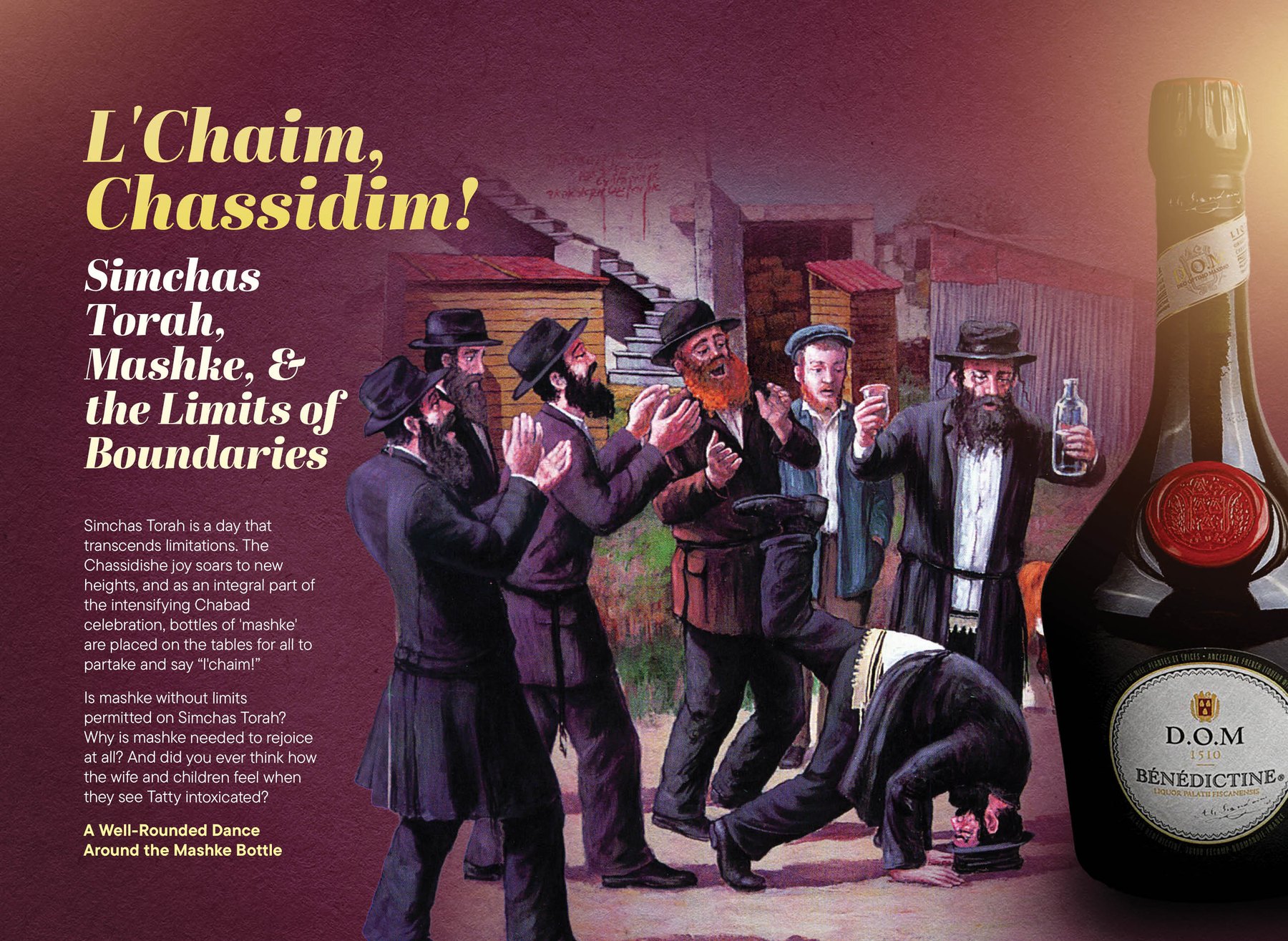
Simchas Torah is a day that transcends limitations. The Chassidishe joy soars to new heights, and as an integral part of the intensifying Chabad celebration, bottles of ‘mashke’ are placed on the tables for all to partake and say “l’chaim!” Is mashke without limits permitted on Simchas Torah? Why is mashke needed to rejoice at all? And did you ever think how the wife and children feel when they see Tatty intoxicated?
A Well-Rounded Dance Around the Mashke Bottle
“Simchas Torah in Lubavitch” – and when we say Lubavitch, we don’t just mean 770, but also the Chabad shuls scattered in every city and town.
As is the Chabad custom, before going to hakafos, people sit and farbreng for many hours. And when farbrenging, there’s nothing better than saying a hearty ‘l’chaim,’ for there’s no day more fitting for a proper ‘l’chaim’ than Simchas Torah.
Another ‘l’chaim’ and another…
Some are mehader to say many ‘l’chaims’ liberally on Simchas Torah, and even those who aren’t mehader don’t refrain from having a shot, or even a full cup…
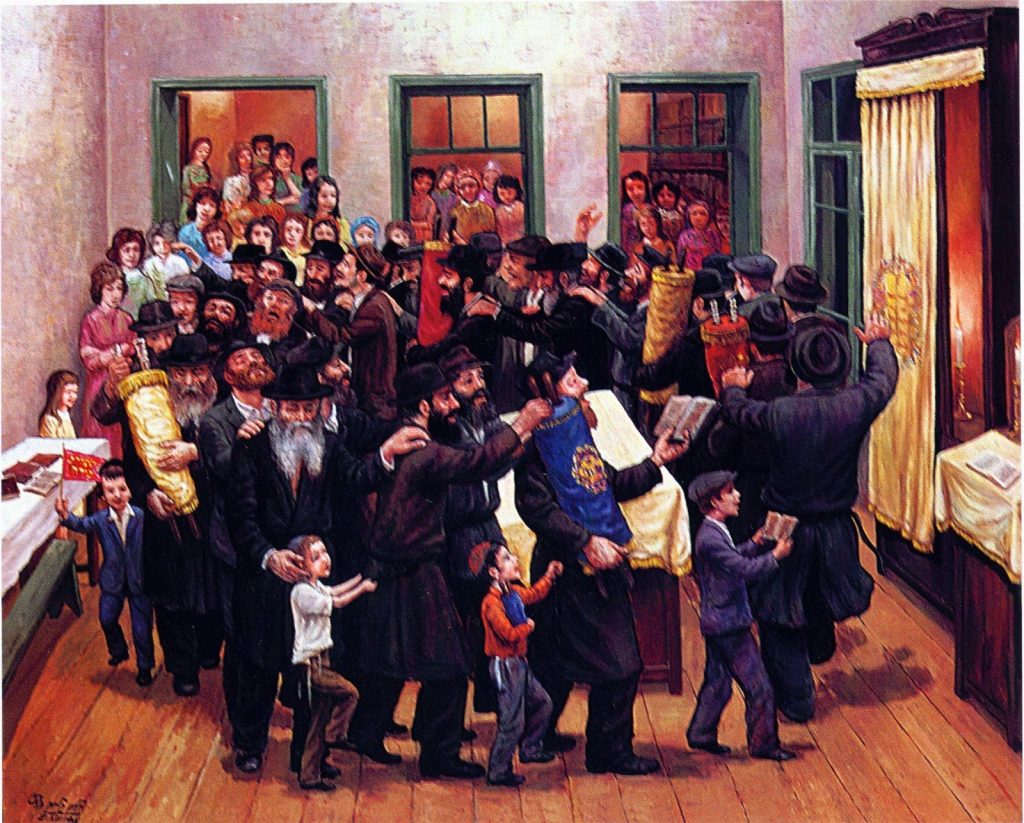
In an interesting account written by a visitor to Kfar Chabad decades ago, he describes from his perspective: “The hakafos – it’s not at all like what we’re used to in shul. Everything seems to have come apart. Who hears the baal tefilla? Even the hakafos themselves aren’t visible, and almost no one pays attention to them. Here and there, groups are dancing, but many are dancing alone, or in pairs (the women, of course, are upstairs in the Ezras Nashim). And if someone feels like climbing on a table or bench to dance, he does so and sings or calls out all sorts of comprehensible or incomprehensible things”…
Indeed, simcha breaks through barriers, but drunkenness… oh drunkenness… Is it permitted? Is it proper? What are its effects? And yet, “Zog nochamol l’chaim (Say l’chaim again). It’s Simchas Torah today after all…”
Toward that end, we went out to speak with various people to hear their opinions on the matter, and each person can draw their own conclusions according to their understanding and their mashpia’s advice.
Nu, before we set out, it’s fitting that we say “l’chaim.”
Connecting to the Rebbe’s Joy
Simchas Torah is a great and holy day, from which one can “draw bucketfuls and barrels” (not of mashke, but) of joy for the entire year. Some call it “the holiday of the seventh generation,” as it’s the day the Rebbe elevated us all these years, bringing us to peaks of joy.
When a Chassid wants to celebrate, he seeks to celebrate like in 770; to try to elevate himself a bit to the atmosphere of Tishrei with the Rebbe.
This desire has turned the question of saying ‘l’chaim’ on Simchas Torah into perhaps the Chabad question that has received the most answers, and yet the question still stands: Is it permitted, and how much?
Many Chassidim of all types have grappled with it over the years. There’s the Chassidic “hergesh,” the personal desire and the appearance to others. And the wife? What does she say? And how do the children feel about it?
“The most important thing on Simchas Torah is to know that this is a special day of the Rebbe,” begins Rabbi Yosef Tzvi Tzirkis, rabbi of the “Ohr Menachem Mendel” community in Yerushalayim. “Even before the Rebbe accepted the nesius, the Rebbe celebrated Simchas Torah in a way different from anything we knew about the concept of joy. Anyone who merited to see and hear the Rebbe on these days (it’s two days outside of Eretz Yisrael) felt that this was something extraordinary. The hisgalus of the Rebbe on Simchas Torah was unlike any other day of the year. It’s hard to describe in words to someone who didn’t see it with their own eyes. To see the Rebbe dancing for hours during hakafos, rejoicing with such wondrous joy… The great wonder is, how could we even contain it?!”
What should a Chassidic Jew who didn’t fly to 770 do to connect to the “Rebbe’s day” and this joy?
‘The ‘Rebbe’s day’ should start first and foremost by going on Tahalucha, as the Rebbe himself said this is his personal matter. When you begin Simchas Torah with Tahalucha, thinking and feeling that you’re going out on the Rebbe’s shlichus, and that the Rebbe is walking with each person – the entire rest of the day looks different… It gives chayus and light to the rest of the farbrengen, the hakafos, and everything.”
How do the wife and children connect to this day? Is this the one time a year when they need to “let go” of their husband/father, or should one ensure they connect too?
Obviously, the wife and children must feel part of the joy of this day, each family as appropriate for them and according to their community. There are places where it’s possible to come home for a short time for the Yom Tov meal with one’s wife and children between the Tahalucha and hakafos. Where that’s not possible, one can split between night and day – with the father being in shul at night and coming home during the day (or vice versa). Even then, one can go over to the Ezras Nashim to see that one’s wife and children feel included. In communities where everyone eats a meal together, and this is agreed upon with one’s wife, that can suffice. The main thing is that the wife and children don’t get the feeling that they’re being neglected; that they’re not part of the Rebbe’s day.”
But what will mainly make them feel included? How does one do that?
A living person influences their environment. Someone for whom Simchas Torah is an attempt to remember how it was when they were a bachur – their Simchas Torah will look accordingly. If they don’t live with anything, and are just trying to connect to what they were in the past – they won’t succeed in connecting their wife and children to the joy of the day.
When you see a living person rejoicing with inner, authentic joy, it has an effect. It’s about being a role model. Of course, one needs to find the right words to explain the essence of the day to one’s family, but the main thing is to be a role model; to be in a state of genuine inner joy that breaks through one’s limitations.
How can one radiate this inner vitality to one’s family and surroundings as well?
The well-known rule is that ‘a prisoner cannot free himself from prison.’ A person cannot reach ‘barrier-breaking joy’ on their own. The one who takes a person out of their limitations and prison is the Rebbe. To break out of limitations on Simchas Torah, one needs to live with the Rebbe. Therefore, the focus during the farbrengen when preparing for hakafos shouldn’t be on how many ‘l’chaims’ you’ve already said, and whether to say ‘l’chaim’ on Benedictine, Chivas, or Smirnoff. The focus should be on what it was like by the Rebbe, living with the memories, reviewing the Rebbe’s sichos. We need to convey the messages we received from the Rebbe on this day.
“I remember, for example, how during the Simchas Torah farbrengen of 5747, the Rebbe simply choked up with tears. The Rebbe spoke about Moshe Rabbeinu’s mesirus nefesh for every Jew, and the Rebbe cried terribly. I just remember it, and tears come to my eyes… We need to convey not just the content of the sichos, but also what it was like by the Rebbe.
The mashke can help a bit to remember the Rebbe, or actually to forget about ourselves, but it’s no more than an aid. The joy isn’t because of the mashke. The joy is because of the special day and the Rebbe’s connection to this day, which as is known, according to the order of Ushpizin of Chabad Rebbeim, Simchas Torah is the day of the Rebbe’s Ushpizin. What needs to be on the table at the farbrengen in abundance is the Rebbe, not the mashke. It’s clear that for someone who didn’t learn beforehand and didn’t prepare for Simchas Torah, the mashke won’t help them at all and won’t elevate them anywhere.
I will mention here that the Rebbe spoke sharply that the gezeira on mashke remains in effect even on Simchas Torah. The Rebbe spoke about this with real pain and anguish, and expressed that when there’s chayus from violating the gezeira, it’s chayus from kelipa and not from kedusha. This is in addition to all the associated damages that come from it, the negative example, etc.
The Day When I Can Return to Myself
Someone once said that until age forty, one doesn’t say too much ‘l’chaim’ because the Rebbe doesn’t allow it, and after forty one doesn’t say it because one no longer desires it…
But there are Chassidim who have passed age forty, and they make sure to say ‘l’chaim’ abundantly on Simchas Torah, aiming to shed their external layer and try to awaken the inner parts of their soul.
I got this perspective from someone who chose to call himself Yosef Mendelsky for the purpose of this article:
Simchas Torah is the only day of the year when I allow myself to be me. It may seem the opposite to an outsider – that Simchas Torah is the day of the year when I allow myself not to be me… because all year I’m known as someone immersed in worldly matters, and less connected to spiritual and Chassidic levels;
Suddenly on Simchas Torah you can see me sitting with a friend and forcefully demanding that he go out on ‘mivtza tefillin’ every week, or set a daily Chassidus shiur…
It turns out that I’m a Jew of Simchas Torah; this is my day. On Simchas Torah I manage to return to my core points; to the things I truly believe in, to be close to things that during the year I don’t manage to be close to, for various reasons.
And to get close to them again, I need to say ‘l’chaim’, and a lot. Since time immemorial, when Chasidim wanted to shed the shell of daily life and manage to connect to some inner point of truth – they said ‘l’chaim,’ and a lot of it.
Chassidim would quote the Gemara’s statement ‘We give the animal to drink before slaughter’, and explain that before slaughtering the animal soul – we need to give it to drink…
What’s the benefit if it only happens once a year?
President Shazar related that his father told him to remember that the measure of whether he had distanced himself too much from Chassidus or not was whether he could remember the ‘Dalet Bavos’ niggun…
Most of our memory is experiential memory; we remember things that were seared into our experience. If we’ve started to forget certain things, it’s a sign they’re no longer part of our experience.
The very fact that I manage, even if once a year, to connect to an inner point of truth, indicates that it’s still part of my experience. This is important and precious to me. I believe that ‘lo yidach mimenu nidach’ will be fulfilled in me too, and one day there will also be long-term results from my saying ‘l’chaim’.
And how does your family react to this?
I’m sure that when my wife knows that her husband still belongs to an inner point of truth, that it’s important to him, even if once a year, to stop everything and connect to an inner point of truth – then she appreciates it. I’m not just guessing, but I know, because we’ve talked about it.
And what about the children?
I’m also sure this is the example I can give my children, that they’ll see who I really am, what really interests me, what my point of belonging is, that what they sometimes see throughout the year doesn’t really define me.
When they see me on Simchas Torah speaking from the heart about how important it is to be mekushar to the Rebbe, and that this is the purpose of our lives, and other such expressions that come from my inner truth, which is covered all year – I have no doubt they grasp that inside I’m different, and I aspire to be like this outwardly too. I also believe that one day it will happen.
In the Pesach Haggada before the section ‘V’hi She’amda’ there’s a paragraph that says ‘magbihim es hakos’ (we raise the cup), and Chasidim humorously interpreted that the cup of mashke is what stood by our fathers and for us…
This Wasn’t the Simchas Torah I Wanted…
‘Anonymous,’ as she asked to remain even without a pen name, agreed to participate in this article and present the female perspective on what happened in her home, when things reached an extreme point and her young married sons didn’t control themselves and violated the Rebbe’s gezeira:
I’ll preface by saying, that the difficult experience I want to share was definitely extreme. One unfortunate year, out of decades of quite lovely Simchas Torahs. I’m only telling this to emphasize how dangerous it is to violate the Rebbe’s gezeira, even with the most ‘Chassidic’ justifications…
I started the preparations for last year’s Simchas Torah from the night before. Mendel and Mushky, Yossi and Rivky, announced they would be with us for Simchas Torah along with their nine children (bli ayin hara) and this required me to prepare accordingly. Together with my younger daughters we cooked, baked, whipped, chopped, fried, and thank G-d by four in the morning we were nearly done.
Nevertheless, I was already up at seven-thirty. The biological alarm clock did its job… I prepared the rooms, scrubbed, cleaned, ironed, and before the children came everything was ready.
After candle lighting, they went together to shul. Mendel and Yossi said not to wait for them, as they were going on Tahalucha.
When my husband returned from shul after davening and before hakafos to make kiddush, we were in the middle of putting the little ones to bed who had passed their bedtime. By the time the little ones finally fell asleep, it turned out that not only the little ones had fallen asleep; the struggle to get them to sleep had also overcome their mothers…
With no choice, we sat down at the table: my husband and I, the unmarried daughters and the older granddaughters. We had just started kiddush, when Mendel and Yossi showed up… or to be more precise, they stumbled in. It was clear they were after saying l’chaim in abundance. To tell the truth? My only thought at that moment was: ‘Just don’t let them vomit on my new sofas’…
Fortunately, they did sit around the table, started to sing a deep niggun, but then as their hearts were merry with mashke came a speech of ‘Abba… how is it you didn’t go on Tahalucha? How?!’ And so they shouted again and again as they pounded on the table with the fumes of mashke filling their heads. I turned red and was embarrassed to the bone for my husband who had to sit in front of his wife, daughters and granddaughters, and absorb insults from his drunk children – but I understood there was no one to talk to, and any attempt to silence them would only make the situation worse.
One of my daughters who caught the color of my face suggested they move to the sofas… That which I feared happened. They had just sat down when everything spilled out onto the new sofas.
I don’t remember the last time I cried because an object of mine was ruined, but this was the straw that broke the camel’s back… I’m sure I never thought I would cry on the day that’s supposed to be the happiest of the year… Is this the Simchas Torah I was waiting for? Is this the day I worked so hard for?
This situation only emphasized how important it is to keep the Rebbe’s gezeira, without any clever interpretations. My children never imagined they would ever speak like that to their father, and when they took another cup of l’chaim, they surely thought this would increase their Chassidic joy. But at the end of the day, the reality was neither joyous nor Chassidic…
A Child’s Helplessness
If we’re already talking about those extreme cases, which unfortunately exist on the fringes of every shul – think about our pure and innocent children, how things look from their perspective:
Nu, say l’chaim again!… L’chaim!
The farbrengen continues as a preparation for hakafos, but the head is already heavy, drooping. It’s worth resting it for a few minutes to have strength to dance during hakafos… but when the head goes down to rest, a feeling of nausea rises from the depths of the stomach to the throat… It doesn’t go in and it doesn’t come out… It’s just annoying…
The wife sees her husband with his head heavily resting on the table. “What’s with Abba?” She asks her Mendel with a hint of concern. “Go see what’s up with him…” Mendel is on a mission from his mother to his father, the one whose heavy head is resting either on the table or on the nearly intact plate of eggplant. “Abba… Abba… Ima asks, ‘What’s with you?’” “I’m fine,” the father grunts from the fumes of the mashke, unable to lift his head. And the boy retreats, not knowing how to deal with a father in a situation he doesn’t recognize…
“Throughout my entire childhood, I hated the drunks of Simchas Torah,” wrote one of those Mendel’ach in a painful column about a year ago, in which he describes his impressions as a child during Simchas Torah in the Chabad community. “I hated the drunkenness, I hated the glazed look in the eyes, I hated the mouth that lost its filters, I hated the fear of a helpless child about what would happen or not happen…”
“And to all the Chassidim who rise to defend the ‘sacred custom of Israel’ to say ‘l’chaim’ on Simchas Torah as if there is no tomorrow (and already attacking anyone who tries to say even half a word against this ‘custom’) – count to ten before you respond. Don’t try to give the famous answer that ‘you can’t be happy without saying l’chaim’… This answer doesn’t hold water!
“Just two years ago, we all stood in the garden next to the shul, six feet apart from each other, without a Sefer Torah in hand (only one person was allowed to hold it, with gloves), with a limit of one or two songs for the hakafa, and without a drop of mashke. Believe me, we were happy, we were truly happy. We knew we had to create joy from what we have, and we did quite well.
“Yes, I’ve already heard those who tell (mostly to themselves) the legend that ‘my wife supports me,’ ‘once a year she’s willing.’ You won’t be able to convince me to believe that. Try looking a woman in the eyes through the lens of alcohol levels and see if she is truly happy. Try to look through the glazed gaze at your children who are witnessing their father ‘losing it,’ and it leaves cracks in their souls.
Let it not be misunderstood: I am absolutely not against saying l’chaim. I sometimes go out to sit with friends for a farbrengen until dawn, and I even allow myself to come back with a slightly glazed look – but not at anyone else’s expense. Not when my wife is waiting for kiddush and the kids are waiting for the Yom Tov atmosphere…
“So, to sum it up, look yourself in the eyes and be happy like mentchen. You will give a wonderful gift and a happy Yom Tov to your wives and your lovely children, and you will emerge, for a change, as real mentchen.”
In the Middle of the Farbrengen, Rabbi Chodakov was on the Line.
As a general rule, the gezeira on mashke imposed by the Rebbe applies to all days of the year, including Simchas Torah, and there is no opposing the king. It is a decree, and it cannot be changed.
Evidence for this appears in the instructions and numerous responses given by the Rebbe over the years, and there are too many to bring them all here. For example, the Rebbe said at the farbrengen of 12 Tammuz 5725, “..And to emphasize that the intention is regarding the actual action, below ten handbreadths, and for each individual, both on Shabbos and Yom Tov, as well as on the 12th of Tammuz, the 19th of Kislev, and Simchas Torah, and Purim, as well as other times that one declares is an exception… When it comes to a farbrengen, there is a limitation of three cups at most, and all together – at most a reviis.”
This instruction was repeated on several occasions, to the extent that in one year the Rabbi strongly commanded that those who drank excessively should not go on Tahalucha, and they are not his shluchim.
“Since I have information that there are those who are starting to ease up regarding mashke, when it comes to each person’s conduct, everyone has the choice to do what they want, contrary to my request in this matter. But regarding the Tahalucha on Shavuos, which is indeed my shlichus, I would like to convey that those who do not adhere to the regulations regarding mashke are not my shluchim, and I ask them not to participate in the Tahalucha. The same goes for traveling in the summer on behalf of Merkos L’Inyonei Chinuch, regarding going to shuls on Simchas Torah to bring joy to Jews, etc.”
Had the phenomenon of excessive drinking not existed in the Chabad communities in Israel and around the world, this article might not have even been necessary, but in practice, things on the ground are different…
The testimony of Rabbi Nachman Sudak a’h, the Rebbe’s shliach in England, is intriguing. He recounted that every year on Simchas Torah, he would take a lot of mashke, and thanks to that, he allowed himself to speak frankly and demand what could and should be demanded from those close to him.
“We had many good results from these farbrengens, each one in their own way; one started to grow his beard, another made good hachlatos, and so on.
“In the summer of 5723, a few months after the prohibition imposed by the Rebbe, I wrote to my father-in-law Rabbi Bentzion Shemtov, that it is difficult for me to farbreng without taking mashke. I felt that it was hard for me to ‘demand’ certain matters strongly if I was quite sober… I wrote about it to my father-in-law as a casual remark, and not at all to undermine the decision…
“My father-in-law took this letter of mine and showed it to one of the secretaries who showed the letter to the Rebbe.
“One of the nights of Chol HaMoed Sukkos, I was farbrenging in the sukka of Rabbi Bentzion Reider when suddenly the phone rang in the house and it was a call from New York. On the line was Rabbi Chodakov who said: Regarding the difficulty you mentioned with the drink – the Rebbe said without restrictions.
“I asked him if I alone was allowed to take mashke while the others were still subject to the gezeira? Because if so, my words will certainly have no effect on them, since they would not be in the category of ‘mekablim.’ In response to this, Rabbi Chodakov said: The Rebbe wrote without limitations! “Without restrictions includes those sitting with you.”
To End the Day Like a Chassid
At the end of the day, after the dancing and the exhaustion, we still wash our hands and sit down for an uplifting farbrengen, with the niggunim of the Rebbeim
Rabbi Tzirkis, how can we truly preserve the impact of ‘the Rebbe’s day’ for the rest of the year?
It is definitely important that the day not end in a way that the hakafos will be drowned out… The way to preserve the special light of this day is to make sure to conduct the farbrengen of motzoei Simchas Torah properly, as is customary with the Rebbe. This is the way that Simchas Torah will not be lost. To wash hands before sunset, to sing the niggunim of the Rebbeim, to farbreng and ensure that there is someone to review a maamar. It focuses the day and preserves the special light we received on it.
Beis Moshiach #1430 • pp. 32-41
© 2026 Beis Moshiach Magazine. All rights reserved.
This article originally appeared in Beis Moshiach #1430. You are welcome to share it with friends and family by email or in print, provided that you do not change, add to or omit any part of it, you credit the author and Beis Moshiach, and you include a link to archive.bmoshiach.org (written out in full in printed copies).
To republish this article in a newspaper, magazine, book or website, please request permission in advance at [email protected].