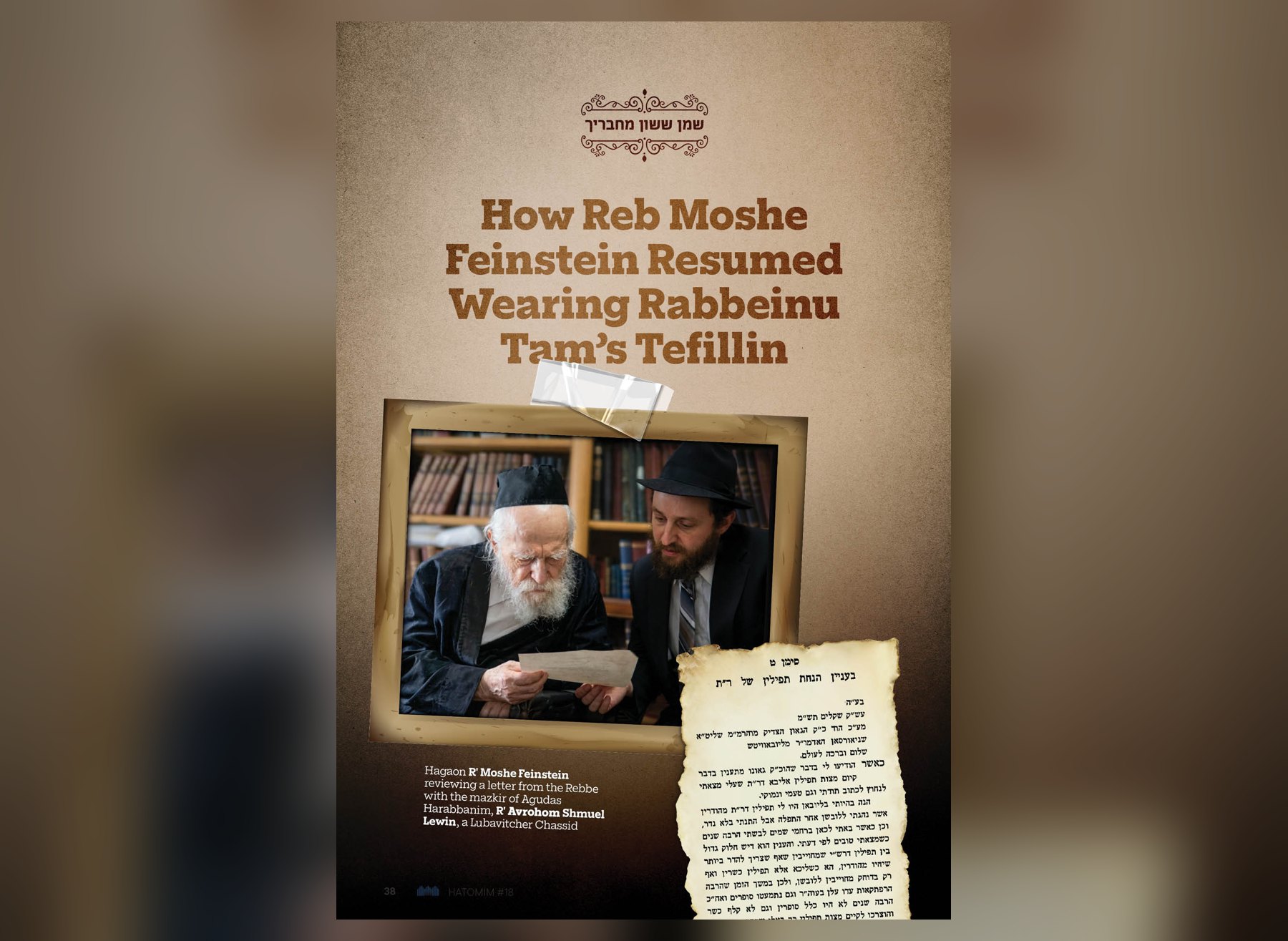
How Reb Moshe Feinstein Resumed Wearing Rabbeinu Tam’s Tefillin
The Torah commands us (Devarim 6:8): “Bind them as a sign upon your arm and they shall be for tefillin between your eyes.” While tefillin contain the four Scriptural passages mentioning this mitzva, they are worn differently according to custom and community. For generations, Lubavitcher boys becoming bar mitzva donned “Rashi” tefillin – until the Rebbe changed everything.
During a public farbrengen on Purim 5736 (1976), the Rebbe made a stunning announcement about the importance of donning two pairs of tefillin – a practice known as “tefillin d’Rabbeinu Tam.” This directive would not only transform Lubavitch practice, but would also touch the life of the era’s most prominent halachic authority in an unexpected way.
A Purim Surprise
It was Purim 5736. The farbrengen was in full swing, the atmosphere charged with the joy of celebrating Esther and Mordechai’s triumph. The Chassidim listened intently as the Rebbe extolled the miracles of that ancient time.
Suddenly, the Rebbe changed topics and began speaking about the merits of putting on Rabbeinu Tam tefillin in addition to Rashi tefillin. His voice, especially mellifluous on the recording, delivered words that would reverberate through the decades:
“This is the place to clarify and respond to a question many have… the question of whether to put on Rabbeinu Tam tefillin. My view is clear that now is the time to put on two pairs of tefillin… It is obligatory, during the times of the footsteps of Moshiach, to also put on Rabbeinu Tam tefillin… Whoever wishes to should put on Rabbeinu Tam tefillin in addition to Rashi tefillin will be blessed.”
The announcement sent shockwaves through the assembled. Although the Alter Rebbe writes in Piskei HaSiddur that every G-d-fearing man should lay Rabbeinu Tam tefillin, Chabad Chassidim had traditionally waited for the Rebbe’s permission – and typically not until after their wedding. Rarely, and only with authorization, did bar mitzva boys do so.
Yet in the sicha of Parshas Vaeschanan 5749 (1989), the Rebbe would later advise that they be worn even in the two months prior to bar mitzva. Gradually, as a result of the Rebbe’s instruction, his followers began to don Rabbeinu Tam tefillin. But they were not alone in heeding his words.
Reb Moshe’s Personal History
The story of how Reb Moshe Feinstein came to resume this practice reveals a fascinating chapter in his life. Reb Moshe was no stranger to Rabbeinu Tam tefillin. He had worn them in his youth in Luban until age eighteen. His father, too, had worn them throughout his life, though he had not established it as a binding family minhag for his children.
Reb Moshe had continued wearing them after davening, but only on condition (bli neder), as he did not view the practice as a strict obligation. While there had been disputes in earlier generations, he noted that the halacha had been settled in favor of Rashi tefillin for hundreds of years. He viewed Rabbeinu Tam as a midas chassidus – a pious act – rather than a requirement.
When Reb Moshe emigrated to America, he was forced to leave behind many precious possessions in Luban: his extensive collection of holy books, personal manuscripts he had written, and his high-quality tefillin. Though he wore a pair of old Rabbeinu Tam tefillin for many years in America, he eventually had to retire them. Finding reliable sofrim and kosher parchment in his new country proved challenging, and Reb Moshe had made a firm decision: he would only wear Rabbeinu Tam tefillin if they were truly mehudarim – of the highest quality. While one must wear even minimally kosher Rashi tefillin because it is an obligation, there was no reason to wear non-premium Rabbeinu Tam tefillin since the practice was a stringency rather than a duty.
A Fateful Flight
Rabbi Tzvi Hersh Spritzer had thrown himself wholeheartedly into the Rebbe’s mitzva campaigns. Following the launch of Mivtza Tefillin on Lag B’Omer 5727 (1967), he worked tirelessly to influence Jews to put on tefillin daily. He would help them purchase affordable pairs – ranging from $30 to $40 (equivalent to $250 today) – by buying the parshiyos from a sofer, the battim from another source, and the straps from yet a third person.
When the Rebbe announced Mivtza Mezuza in 1974, comparing a mezuza to a helmet that protects from harm, Rabbi Hershel dedicated himself to this campaign as well, ensuring that affordable mezuzos were installed in hundreds of Jewish homes.
One year, on a plane returning from Eretz Yisrael where he had visited his father, a distinguished Belzer Chassid, Rabbi Hershel took out a sefer and invited his seatmate to join him in learning. When his companion introduced himself as Rabbi Dr. Moshe Tendler, Rabbi Moshe Feinstein’s son-in-law, Rabbi Spritzer immediately recognized a Divine opportunity.
“When were Reb Moshe’s mezuzos last checked?” he asked. Rabbi Dr. Tendler was taken aback – he didn’t know. Despite his father-in-law possessing the finest mezuzos, they, like all mezuzos, needed periodic checking. Rabbi Hershel offered to handle this and return them quickly.
A day or two later, Rabbi Hershel went to Reb Moshe’s home on the Lower East Side to collect the mezuzos. After submitting a report of his activities to the Rebbe, and knowing the Rebbe had spoken about the importance of Rabbeinu Tam tefillin, Rabbi Spritzer scheduled an appointment with Reb Moshe for a Wednesday a few weeks later.
The Gadol’s Response
When Rabbi Spritzer broached the subject of Rabbeinu Tam tefillin, he was surprised to learn that the sage had worn them until age eighteen but then stopped. Reb Moshe’s eyes lit up with interest – this was clearly a practice dear to his heart.
“What did the Rebbe say at the farbrengen?” Reb Moshe asked eagerly. He expressed that he would happily resume the practice if the Rebbe were involved in their procurement – choosing the sofer to write the parshiyos and giving his opinion on the details. For Reb Moshe, this was a “great thing” – an opportunity to fulfill the mitzva according to his specific requirements and return to a cherished practice from his youth.
At Reb Moshe’s request for Beis Yosef script, Rabbi Hershel went that very day to Crown Heights and approached Rabbi Eliezer Zirkind, a skilled sofer and friend. After Rabbi Hershel explained who the tefillin were for and the importance of having the revered Gadol resume this practice, Rabbi Zirkind agreed to write them in Beis Yosef script specially for Reb Moshe.
A Midnight Call
Rabbi Hershel immediately wrote to the Rebbe about these developments. That very night, at midnight, Rabbi Zirkind’s phone rang. Mrs. Zirkind answered. It was Rabbi Chodakov, the Rebbe’s secretary.
“Is Rabbi Zirkind awake?” When a groggy Rabbi Zirkind came to the phone, Rabbi Chodakov asked if he could come to the office immediately.
Shortly after, Rabbi Zirkind stood at Rabbi Chodakov’s door at 770.
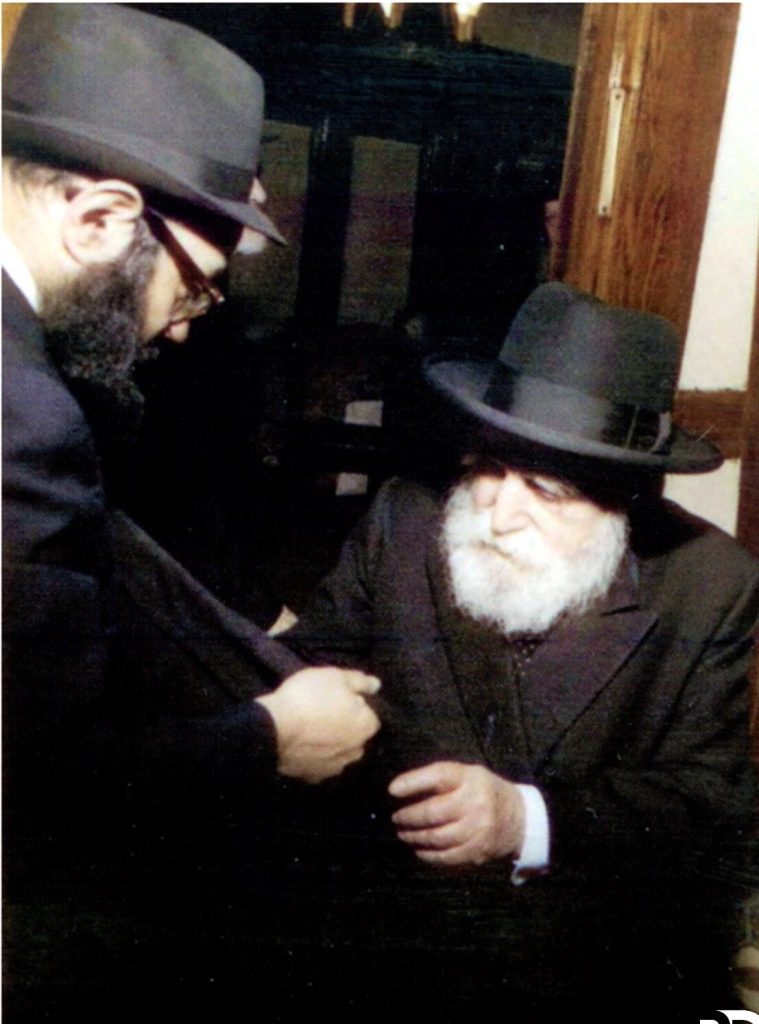
“The Rebbe asked that you meet with Rabbi Feinstein to discuss the details of writing the tefillin,” Rabbi Hodakov explained. “The meeting has already been arranged. Tomorrow at nine, Rabbi Feinstein will be waiting.”
Meticulous Halachic Precision
The next morning at 9:00 AM, Rabbi Zirkind met with Reb Moshe at his home. He introduced himself as the sofer who met the Rebbe’s approval and was proficient in Beis Yosef script. Reb Moshe was greatly pleased and began discussing the writing process in meticulous detail.
Based on Kabbala, Rabbi Zirkind generally wrote tefillin without interruption – not even speaking until after placing the parshiyos into the battim. The process took at least eight hours. However, Reb Moshe had specific concerns that required close oversight.
Given that Rabbi Zirkind was more accustomed to writing in Chabad script than Beis Yosef script, Reb Moshe requested that each of the four sections be written separately, allowing him to inspect each one upon completion before the next would be written. This would ensure that every detail met his exacting standards.
Reb Moshe also addressed a specific technical concern regarding the spacing between sections – the stumos and pesuchos (closed and open sections). He was particular about ensuring the scribe did not leave unnecessarily large gaps of nine letters, which he felt might create a halachic issue. The Chabad custom, following the Shulchan Aruch HaRav, often requires specific gaps to ensure a “closed section,” but Reb Moshe preferred a different arrangement according to the Beis Yosef.
Rabbi Zirkind sat down to write the first section the very next day. When finished, he sent it to Reb Moshe for inspection, then proceeded to the next. The writing was completed two days later, on Sunday afternoon.
The Perfect Fit
After Reb Moshe approved all the sections, Rabbi Zirkind brought them in standard Chabad-sized battim measuring 4×4 centimeters. When Reb Moshe placed the tefillin shel rosh on his head to check the fit, his trained eye immediately noticed an issue: a small part of the base didn’t lay completely flat on his forehead.
For Reb Moshe, this was not merely a matter of comfort – it was a question of halachic precision and stability. He requested smaller boxes to ensure the tefillin would sit perfectly. With the boxes changed, Rabbi Zirkind brought the completed tefillin to Reb Moshe, who resumed laying Rabbeinu Tam that very same day.
Letters of Gratitude
A letter from Reb Moshe, dated Erev Shabbos Shekalim 5740 (1980), appears in volume eight of Igros Moshe. In it, Reb Moshe thanks the Rebbe for his help and shares the personal history of his practice:
“I put them on after davening but on condition that it would be bli neder. But when questions arose about whether one could fulfill the mitzva according to the view of Rabbeinu Tam, I did not do so anymore.”
He continues with heartfelt gratitude:
“And now, when I was informed in the name of the Rebbe that there are parshiyos of tefillin d’Rabbeinu Tam for me, to my specifications, this is a great thing, aside from being able to also fulfill the mitzva of putting on tefillin d’Rabbeinu Tam as I was accustomed to doing. As for the money, I thank Hashem Who helped me and will help me pay the sofer what he asks for, and the sofer will get good battim…”
Reb Moshe ends the letter with the salutation: “Who greatly esteems him [the Rebbe].”
The Rebbe’s Blessing
A few days later, Reb Moshe received a response from the Rebbe. In the letter, the Rebbe acknowledged Reb Moshe’s correspondence and offered profound insights about Rabbeinu Tam tefillin. The Rebbe wrote:
“Recently, I received two letters from Kvod Toraso… and am responding with haste to thank and bless you for the brachos and wishes. And mainly as it says explicitly in the verse: ‘I will bless those who bless you’ – Hashem with His blessing and His addition to the blessing, which is greater than the original (Devarim Rabba 1:13) and in Berachos (55a) – that you should live long, good days and years.
“And especially, since you attached a response discussing a number of matters regarding tefillin and the conclusion regarding the actual practice of tefillin d’Rabbeinu Tam. And being that the middah [trait] of HaKadosh Baruch Hu is measure for measure… then according to this, an increase in one who puts on tefillin brings an increase in the reward of lengthening his days as it says, ‘Hashem is upon them, may they live… and He should fortify me with health and grant me life’ (end of Menachos 44a).
“Particularly as regards the arm that is opposite the heart and the head that is opposite the brain – Chabad of our Holy Torah all the way to drawing conclusions according to halacha.”
The letter was signed: “With honor and esteem and manifold blessings, M. Schneersohn.”
The Rebbe’s reference to the heart and brain was particularly poignant – these are the organs corresponding to the placement of the hand and head tefillin, and the Rebbe was blessing Reb Moshe with health in precisely these areas.
The Legacy
This remarkable story, shared to mark the anniversary of Mivtza Tefillin, reveals how the Rebbe’s influence extended far beyond Lubavitch circles. Through the dedication of Rabbi Tzvi Hersh Spritzer and the humility of Reb Moshe Feinstein zt”l, then Rosh Yeshiva of Mesivta Tifereth Jerusalem, the greatest halachic authority of the generation resumed a practice he had set aside decades earlier – all because of the Rebbe’s directive about living in the “footsteps of Moshiach.”
The story demonstrates the Rebbe’s meticulous personal involvement in every detail of a mitzva – from the midnight call to Rabbi Zirkind, to the careful coordination of the 9:00 AM meeting, to ensuring every halachic concern was addressed. It reveals the respect accorded to the Rebbe by Torah giants across the spectrum, and the profound impact of the Rebbe’s campaigns on strengthening Yiddishkeit worldwide.
Today, as thousands of Lubavitcher bachurim and men don Rabbeinu Tam tefillin daily, they continue the practice that the Rebbe declared essential for our times – a practice that even the Gadol HaDor embraced through the Rebbe’s guidance and blessing, returning to a cherished custom from his youth in Luban.
HaTomim #18 • pp. 38-43
© 2026 Beis Moshiach Magazine. All rights reserved.
This article originally appeared in Beis Moshiach #1491B. You are welcome to share it with friends and family by email or in print, provided that you do not change, add to or omit any part of it, you credit the author and Beis Moshiach, and you include a link to archive.bmoshiach.org (written out in full in printed copies).
To republish this article in a newspaper, magazine, book or website, please request permission in advance at [email protected].